Sauropods – including iconic long-necked dinosaurs like Brachiosaurus and Apatosaurus – were the largest animals ever to walk the earth. No other dinosaur or land mammal even comes close. Now, a new Adelphi University study provides insights into how these super giants achieved their record-breaking sizes over time.
Credit: Silhouettes by Scott Hartman, Nobu Tamura (vectorized by T. Michael Keesey), Steven Traver.
Sauropods – including iconic long-necked dinosaurs like Brachiosaurus and Apatosaurus – were the largest animals ever to walk the earth. No other dinosaur or land mammal even comes close. Now, a new Adelphi University study provides insights into how these super giants achieved their record-breaking sizes over time.
“It was previously thought that sauropods evolved their exceptional sizes independently a few times in their evolutionary history, but through a new analysis, we now know that this number is much higher, with around three dozen instances over the course of 100 million years around the globe,” said paleontologist Michael D’Emic, assistant professor of biology at Adelphi University in New York and author of the study, “The Evolution of Maximum Body Size in Sauropod Dinosaurs,” in the May 8 edition of Current Biology.
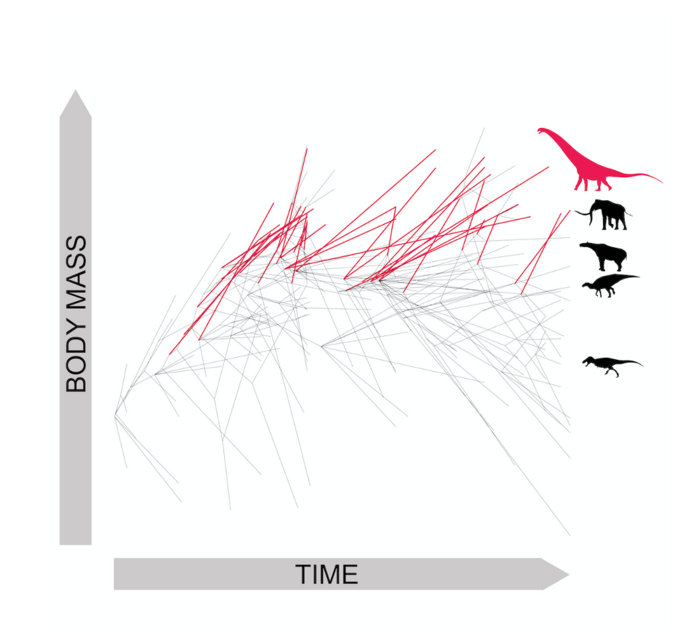
To investigate sauropod body size evolution, D’Emic compiled measurements of the circumferences of hundreds of weight-bearing bones, correlated with the weight of the animal they belonged to. He then used a technique called ancestral state reconstruction to map the reconstructed body masses of nearly 200 sauropod species onto their evolutionary tree.
The results show that sauropods reached their exceptional sizes early in their evolution and that with each new sauropod family to evolve, one or more lineages independently reached superlative status.
“Before going extinct with the other dinosaurs (besides birds) at the end of the Cretaceous Period, sauropods evolved their unrivaled sizes a total of three dozen times,” he explains. “These largest-of-the-largest sauropods were ecologically distinct, having differently shaped teeth and heads and differently proportioned bodies, indicating that they occupied the ‘large bodied’ niche somewhat differently from one another.”
Microscopic study of their bones revealed that sauropods had different growth rates as well, suggesting that the record-setters were metabolically distinct. This mirrors the pattern in mammals, which evolved very large body sizes quickly in the wake of the dinosaur extinction, before plateauing in the gigantic-mammoth range.
D’Emic’s findings contradict “Cope’s Rule,” the popular 19th-century theory that animals’ size evolves over time. Instead, the new study sees animals achieving different body sizes depending on their ecological context and whatever niches happened to be available–which can appear random when looked at from a large scale.
“While other researchers have explained sauropods’ immense size in general based on their unique combination of features, there is no one feature or set of features that characterize the sauropods that did surpass terrestrial mammal size from the ones that didn’t,” he says.
Untangling why certain lineages evolved their super-giant sizes while other ones didn’t will be the next step in the research.
About Adelphi: A modern metropolitan university with a personalized approach to higher learning
Adelphi University, New York, is a highly awarded, nationally ranked, powerfully connected doctoral research university dedicated to transforming students’ lives through small classes with world-class faculty, hands-on learning and innovative ways to support academic and career success. Adelphi offers exceptional liberal arts and sciences programs and professional training at the undergraduate and graduate level with particular strength in our Core Four-Arts and Humanities, STEM and Social Sciences, the Business and Education Professions, and Health and Wellness.
Recognized as a Best College by U.S. News & World Report, Adelphi is Long Island’s oldest private coeducational university. It serves more than 7,250 students at its beautiful main campus in Garden City, New York-just 23 miles from New York City’s cultural and internship opportunities-and at dynamic learning hubs in Manhattan, the Hudson Valley and Suffolk County, as well as online.
More than 119,000 Adelphi graduates have gained the skills to thrive professionally as active, engaged citizens, making their mark on the University, their communities, and the world.
Journal
Current Biology
Method of Research
Meta-analysis
Subject of Research
Animals
Article Title
The Evolution of Maximum Body Size in Sauropod Dinosaurs
Article Publication Date
8-May-2023