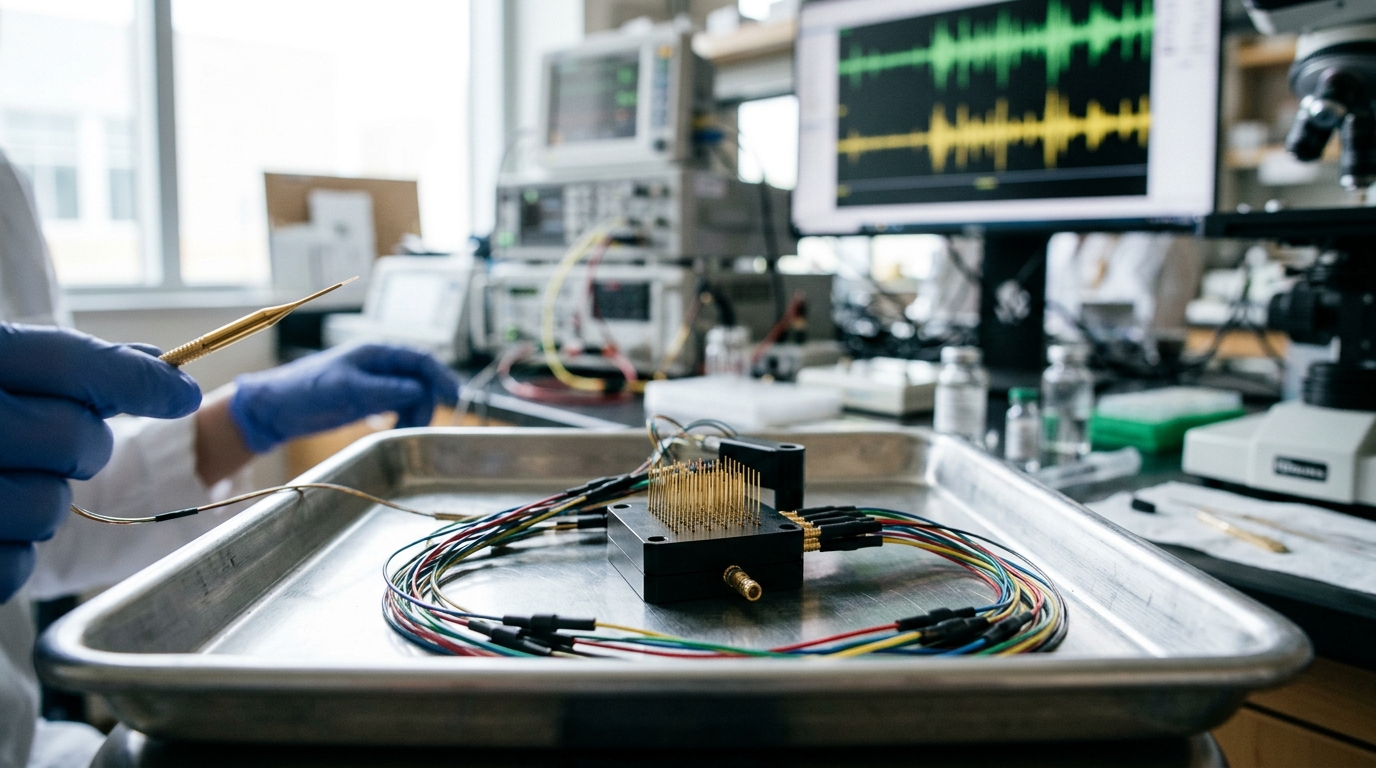
Researchers from the University College London, Imperial College London, and the University of Copenhagen have developed a reproducible computational framework for analyzing electrocardiogram-derived skin sympathetic nerve activity, or ECG-derived SKNA. This non-invasive surrogate for sympathetic activity offers a practical foundation for future closed-loop neuromodulation systems that rely on dynamic physiological feedback. The study, published in Frontiers in Bioengineering and Biotechnology, addresses the significant challenges associated with quantifying sympathetic signals, which are inherently noisy, burst-like, and highly dependent on processing methods.
Existing methods for analyzing SKNA often rely on semi-manual processing or static measurements, limiting their utility in dynamic event-based physiology and large cohort reproducibility. The new framework integrates electrocardiography preprocessing, multi-channel SKNA extraction, adaptive burst detection, event-centred physiological analysis, and sequential replay.
The development of this framework was grounded in recordings from 50 pigs subjected to apnoeas induced by intermittent negative upper airway pressure, or INAP.
A critical component of the framework is its adaptive thresholding mechanism, which defines detection limits as the maximum of a two-component Gaussian mixture model intersection, the baseline 95th percentile, and a baseline variability criterion.
To evaluate the framework’s potential for real-time applications, the researchers performed sequential offline replay on the pre-processed SKNA data. In this process, each replay decision was restricted to SKNA samples available up to that specific decision point. Burst occupancy was calculated in a 30-second trailing window updated every 10 seconds, with trigger activation requiring occupancy above 5% in two consecutive windows.
During the sequential replay, a trigger was present during INAP in 43 of the 50 recordings, representing an 86% detection rate. Among the 49 recordings where the detector was initially off at the onset of INAP, 42 developed a new post-onset trigger activation. The median detection latency for these new activations was 24.0 seconds, with an interquartile range of 18.9 to 54.3 seconds.
The pipeline was also applied to an independent multi-event INAP recording. In this test, all three INAP events generated replay triggers, with detection latencies of 28.4, 30.0, and 20.0 seconds.
Furthermore, the continuous replay of an intervention recording showed event-specific SKNA and trigger outputs before and during dorsal root ganglion, or DRG, stimulation.
The study concludes that this reproducible event-driven framework captures heterogeneous SKNA responses and allows for sequential evaluation as new samples become available. By enabling the dynamic monitoring of SKNA responses during physiological perturbations, the framework provides a practical foundation for prospective real-time validation.
Subject of Research: Development of a reproducible event-driven computational framework for analyzing ECG-derived skin sympathetic nerve activity in the context of closed-loop neuromodulation.
Article Title: A reproducible event-driven analytical framework for ECG-derived skin sympathetic nerve activity analysis: towards afferent signal processing for closed-loop neuromodulation
Article References: Rahmani, S., Norup Hertel, J., Linz, B., Linz, D., Divanbeighi Zand, A. P., Marks, V. S., Jespersen, T., Sattler, S., Nissen, S. D., Denison, T., Green, A. L., & Lambiase, P. D. (2026). A reproducible event-driven analytical framework for ECG-derived skin sympathetic nerve activity analysis: towards afferent signal processing for closed-loop neuromodulation. Frontiers in Bioengineering and Biotechnology, 14, Article 1980881. https://doi.org/10.3389/fbioe.2026.1980881
Image Credits: AI Generated
DOI: 10.3389/fbioe.2026.1980881
Keywords: ECG-derived SKNA, closed-loop neuromodulation, sympathetic nerve activity, signal processing, intermittent negative airway pressure, real-time analysis, bioengineering, physiological feedback, reproducible, event-driven, analytical, framework
News Source: Gregory Coleman. (November 13, 2026). Event-Driven Framework Analyzes ECG-Derived Skin Sympathetic Nerve Activity in Pigs. Scienmag.