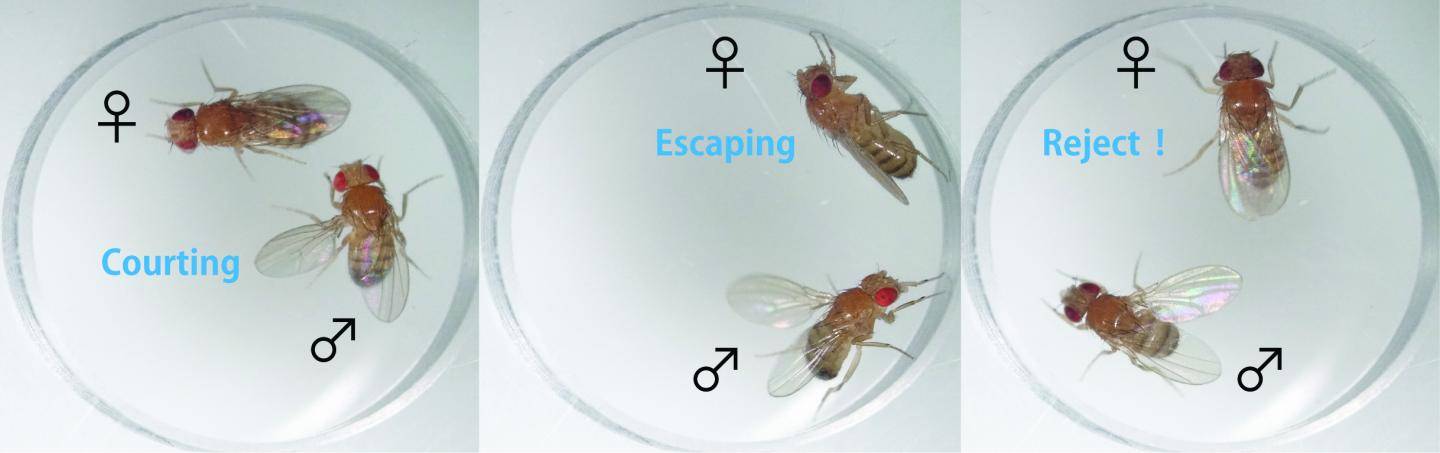
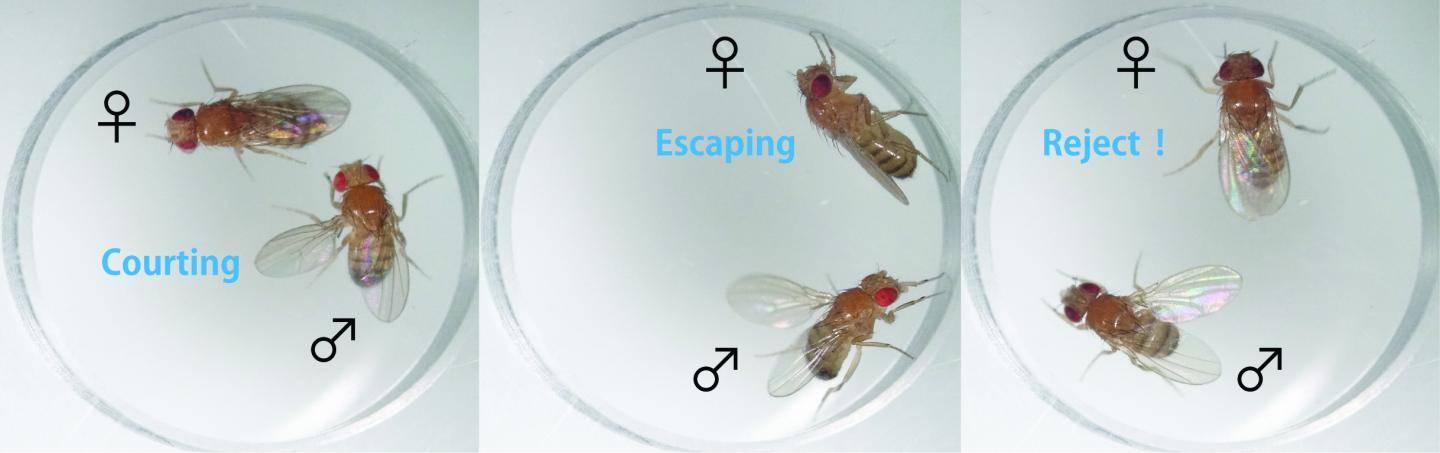
Credit: Azusa Kamikouchi
Researchers at Nagoya University develop fruit fly model to explore how learned auditory cues alter mating behavior and sexual preference.
Nagoya, Japan – The ability to learn and speak language depends heavily on the sounds and language we experience during early infancy. While this may sound self-evident, we still do not understand exactly what happens neurologically as a developing infant learns how to speak. In a study published in eLife, researchers at Nagoya University devised a new neurological model in fruit flies that may illuminate this process–and made some key discoveries about insect mating along the way.
"Higher mammalian species such as humans learn how to vocalize by listening to sounds from their own species," lead author Xiaodong Li says. "Much of the research on how this occurs has been done in songbirds, which have much simpler neural circuits than humans. Even in songbirds, though, our understanding of how auditory inputs translate into vocalized outputs is still very rudimentary."
To get around this intractable problem of complexity, the research team focused on Drosophila melanogaster. This unassuming fruit fly is commonly used in research as a model organism, because its biology is much simpler than humans–but surprisingly similar in fundamental ways. As fruit flies are unable to vocalize, however, the team studied a different mode of communication often shaped by auditory experience: courtship.
"As part of their courting ritual, male fruit flies vibrate their wings in pulses," Li explains. "Every species of fruit fly is attracted to a unique wing pulse pattern. Attraction to a specific pulse is an evolutionary trait that promotes copulation while dissuading inter-species mating. Importantly, what we discovered was that this attraction is a learned behavior in fruit flies, contrary to the prevailing view that it happens innately."
After emerging from their pupae as young adults, fruit flies spend a lot of time around their peers before they become mature enough to mate. The researchers hypothesized that exposure to these wing pulse "songs" during this time may teach them to prefer their species' own pulse.
To test this idea, the team clipped the wings of young flies and put them in isolated chambers. The flies were either left alone to mature, or exposed to a sound that mimicked their species' wing pulse. Males and females were then put together and another pulse was played, this time from a different species. If sexual preference was purely innate, the team reasoned, then the early exposure to their own species' mating song would have no impact on the 'dating' that eventually commenced.
The result? When flies were first exposed to their own species' song, subsequent mating went on in a typical fashion. Without the prior auditory training, however, the courtship ritual became notably less courtly: untrained females copulated in response to another species' song, while untrained males began to chase one another (a behavior in the insect world known as "chaining").
Though an intriguing discovery on its own, the researchers went one step further, seeking out the neurons responsible for this learned behavior. By experimentally manipulating levels of the neurotransmitter GABA and its receptor in the brain, the team pinpointed female pC1 neurons as crucial players in the courtship learning process. The discovery that fruit fly neurons can turn sound into sexual preference makes it possible to study how learning can shape communicative behaviors.
"The pC1 neuron cluster is known to be involved in evaluating sexual cues, but what we've found is that this cluster can be molded in response to auditory experiences during development," lead investigator Azusa Kamikouchi says. "This finding opens up an entirely new research field. It allows us to use a highly tractable and simplified model in flies to study how auditory learning translates, at the neurological level, into sensorimotor behaviors that in many ways resemble the phenomenon of language."
###
The article, "Auditory Experience Controls the Maturation of Song Discrimination and Sexual Response in Drosophila," was published in eLife at DOI:10.7554/eLife.34348.
Media Contact
Koomi Sung
[email protected]
@NU__Research
http://www.nagoya-u.ac.jp/en/
Original Source
http://en.nagoya-u.ac.jp/research/activities/news/2018/03/even-flies-like-a-familiar-song-how-auditory-learning-shapes-fly-behavior.html http://dx.doi.org/10.7554/eLife.34348