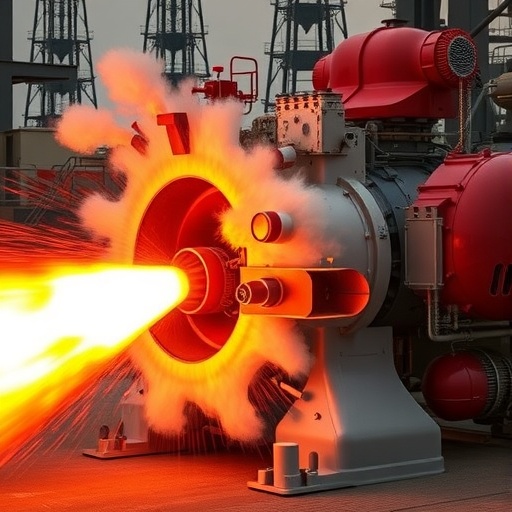
In a remarkable breakthrough within the field of aerospace engineering and combustion science, researchers Pallela and Thakur have pushed the boundaries of pulse detonation engine technology. Their pivotal study, titled “Numerical evaluation of quiescent mixtures suitable for a sustainable detonation in pulse detonation engine,” highlights innovative simulation techniques designed to optimize and refine detonation processes for improved efficiency and sustainability.
Pulse detonation engines (PDEs) offer substantial advantages over traditional propulsion systems, including higher efficiency and reduced environmental impact. By utilizing a continuous cycle of detonation waves, these engines capitalize on the explosive force generated by rapid combustion, providing thrust that can significantly outperform conventional engines. However, achieving a stable and sustainable detonation cycle has been a long-standing challenge in this field, primarily due to the complexities involved in managing fuel-air mixtures.
The research conducted by Pallela and Thakur focuses on identifying quiescent or calm mixtures that can facilitate a controlled and efficient detonation process. In their numerical evaluations, the authors employed state-of-the-art computational fluid dynamics (CFD) techniques. This approach enables the simulation of various combustion scenarios with different fuel compositions and operating conditions, shedding light on the intricate behavior of detonation waves in a PDE context.
One of the key findings of the study reveals that specific quiescent mixtures can significantly enhance the stability of the detonation wave, contributing to a more consistent and prolonged thrust output. These mixtures not only optimize fuel efficiency but also reduce byproducts that are harmful to the environment, aligning with global objectives for cleaner propulsion technologies. The research highlights the importance of precise mixture characterization, as small variations can result in substantial differences in engine performance.
Moreover, the authors detailed their methodology in evaluating these quiescent mixtures, implementing advanced algorithms to simulate detonation events under varied conditions. This numerical approach enables researchers to predict outcomes with greater accuracy and provide insights into the mechanisms governing detonation behavior. The significance of this research lies in its potential application; by fine-tuning the fuel mixtures utilized in PDEs, the aerospace industry could transition towards more sustainable practices.
As aerospace engineers and researchers continue to explore the boundaries of propulsion technology, the insights provided by Pallela and Thakur offer a promising avenue for future developments. The incorporation of their findings into practical applications could lead to the next generation of engines that not only meet the increasing demands for power and efficiency but do so with minimized ecological footprints.
The study also emphasizes the role of numerical simulations in the design and testing of new engine concepts. Traditionally, experimental approaches have dominated the field, often requiring extensive testing and iteration. However, the insights garnered through computational simulations can expedite the development process, allowing engineers to make informed decisions and refine designs before physical prototypes are constructed.
Potential future research directions stemming from this study include further exploration of alternative fuels and their interactions within quiescent mixtures. Additionally, the integration of machine learning with traditional simulation methods could yield even more refined predictive capabilities, accelerating the discovery of optimal mixtures for diverse engine configurations.
In conclusion, the research presented by Pallela and Thakur is a significant step towards enhancing the performance and sustainability of pulse detonation engines. Their innovative approach to understanding quiescent mixtures not only supports current advancements in aerospace technology but also provides a framework for future exploration. As the field of aerospace propulsion evolves, studies such as these will be instrumental in shaping a cleaner and more efficient future.
In summary, the synthesis of advanced numerical methods and experimental science highlighted in this study enhances our understanding of detonation processes. As researchers continue to unravel the complexities of combustion, the results from this paper pave the way for pioneering changes in engine design and operation. The ongoing journey towards sustainable aviation is illuminated by innovations such as those presented by Pallela and Thakur, setting the stage for a new era in aerospace propulsion technology.
The implications of this research extend beyond propulsion systems, as the findings may well influence the design of power generation systems in other sectors. The strategies for optimizing fuel mixtures in PDEs could inform broader combustion technologies, promoting the development of cleaner and more efficient energy solutions on a global scale. Ultimately, Pallela and Thakur’s work represents a convergence of science and engineering, addressing the pressing challenges of sustainability in modern technology.
As the aerospace industry grapples with increasing scrutiny over carbon emissions and environmental impact, studies like this one shed light on pragmatic pathways to reform. With the insights gained from Pallela and Thakur’s research, engineers are better equipped to innovate solutions that will not only serve today’s needs but also anticipate the challenges of tomorrow.
Subject of Research: Numerical evaluation of quiescent mixtures for sustainable detonation in pulse detonation engines.
Article Title: Numerical evaluation of quiescent mixtures suitable for a sustainable detonation in pulse detonation engine.
Article References: Pallela, A., Thakur, A.K. Numerical evaluation of quiescent mixtures suitable for a sustainable detonation in pulse detonation engine. AS (2025). https://doi.org/10.1007/s42401-025-00425-2
Image Credits: AI Generated
DOI: 21 November 2025
Keywords: Pulse detonation engine, sustainable propulsion, quiescent mixtures, numerical simulations, combustion efficiency, aerospace engineering, cleaner technologies.
Tags: advantages of pulse detonation technologyaerospace engineering advancementsbreakthroughs in combustion sciencechallenges in detonation cycle stabilitycomputational fluid dynamics in combustioncontrolled detonation process researchefficiency improvements in aerospace enginesenvironmental impact of propulsion systemsinnovative simulation techniques in PDEsnumerical evaluation of fuel-air mixturesoptimization of detonation processessustainable pulse detonation engines