


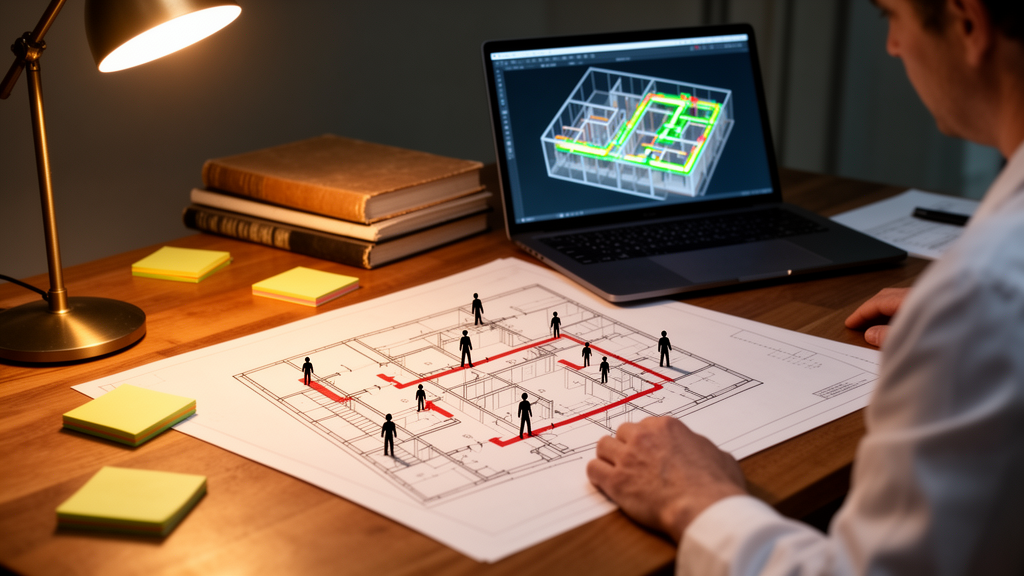
The review, published in the journal City, Territory and Architecture, analysed model-based approaches to emergency evacuation in buildings through the lens of architectural workflows, applying the PRISMA reporting protocol and the population, exposure, comparator and outcome (PECO) framework to screen records from the Scopus and Web of Science databases.
The screening process began with 2,100 records. After removing 359 duplicates and 858 non-English publications, and excluding 271 records whose disciplinary focus fell outside scope—including clinical medicine, aerospace engineering and pharmacology—the team assessed 612 articles against the PECO criteria. Three researchers screened independently to minimise bias, and the final set of 53 journal articles was confirmed jointly by all authors in August 2025. The search was completed by 15 July 2025, and stand-alone virtual reality studies were deemed out of scope because they serve primarily as experimental tools rather than predictive computational models.
Five modelling families dominate the field. Agent-based modelling (ABM) leads with 26 studies, followed by social force models (SFM) with 14, cellular automata (CA) with 13, multi-agent systems (MAS) with 3, and SFPE guidelines and steering-type engineering models with 2. A long tail of specialised or hybrid techniques—including neural-network policy models and reinforcement learning frameworks—appeared only once or twice. Seven studies also incorporated Building Information Modelling (BIM), not as a behavioural model in its own right but as an integration framework coupling building geometry with models such as ABM, CA or MAS.
Each family carries distinct strengths. ABM simulates heterogeneous evacuees with explicit decision rules, capturing variation in cognition, decision-making and movement—critical for evaluating complex buildings—and is widely applied to fire scenarios, with some studies extending it to earthquake evacuation both with and without structural collapse. SFM represents evacuees as particles subject to attractive and repulsive forces, excelling at obstacle avoidance, crowd congestion and high-density dynamics. CA discretises space into a grid of cells governed by transition rules, offering computational efficiency that allows thousands of evacuees to be simulated across complex layouts, though its simplified local rules limit its ability to capture individual cognitive or social behaviour. MAS extends ABM by emphasising coordination and communication, with some models integrating reinforcement learning so agents autonomously refine escape strategies through trial and error.
The hazard landscape is heavily skewed. Fire evacuation dominates with 23 studies, reflecting the centrality of fire safety in building codes and performance-based design, where evacuation time calculations remain a standard requirement. An equal number—23—addressed general emergency evacuation with unspecified or abstract hazards, frequently using virtual environments to test route choice, wayfinding and group behaviour. Earthquake evacuation appeared in only four studies, though these notably linked human behaviour to structural response, integrating damage assessment to account for blocked exits and falling debris. Three studies examined crowd evacuation outside specific hazard categories, focusing on merging flows and collective movement in congested egress areas.
Building context was often vague. Applications spanned 15 low-rise, 6 mid-rise, 12 high-rise and 3 super high-rise buildings, with 17 studies not specifying scale at all. Most strikingly, 29 of the reviewed works did not specify a particular building type, relying instead on generic simulated layouts or abstract virtual environments to test algorithms. None of the studies addressed detached residential dwellings, and the authors note that aged care facilities and other settings housing vulnerable populations remain near-absent from the literature—a gap where architectural design could play a critical protective role.
Integration strategies reveal where the field is heading. ABM has been coupled with BIM for geometric and semantic navigation data, with fire dynamics software such as FDS and PyroSim to calculate available safe egress time from smoke and temperature fields, and with structural analysis tools like LS-DYNA to simulate earthquake-damaged escape paths. SFM studies paired their local interaction rules with global pathfinding algorithms such as A*, navigation grids and optimisation methods including ant colony optimisation. CA models served as efficient simulation engines within hybrid frameworks, handling spatial movement while ABM layers supplied decision-making and psychological traits; one study combined a CA staircase simulation with a genetic algorithm optimising elevator scheduling. SFPE flow-rate calculations were used to calibrate steering-based simulations in software such as Pathfinder and Simulex, providing quantitative benchmarks for performance-based design in high-rise buildings.
The review distinguishes between direct and indirect contributions to design. Twenty-one studies offered actionable recommendations: placing stairs and lifts at opposite sides of buildings to disperse flows, ensuring symmetrical exit configurations, specifying minimum exit numbers and widths, maintaining crowd densities below 2.5 persons per square metre, avoiding central handrails in stair cores, and optimising exit corner geometry. A further 32 studies contributed indirectly through analytical tools, behavioural insights, empirical benchmarks such as high-rise speed–density relationships, and optimisation frameworks for exit placement and guide allocation. In the synthesis, ABM contributed across all five mapped design dimensions, while SFM and CA showed capacity in spatial and component-level design but little in human-centred detailing, and SFPE-plus-steering approaches remained specialised to vertical circulation benchmarks.
The authors identify persistent gaps: behavioural realism remains simplified, psychological and cognitive factors are underrepresented, social interactions such as communication and group dynamics are underexplored, and the integration of machine learning techniques with architectural design workflows stays fragmented. They outline three research priorities—expanding underrepresented intersections such as applying SFM to human-centred detailing for vulnerable populations, benchmarking ABM, SFM and CA under identical conditions, and embedding models in digital twin frameworks that integrate BIM, hazard simulators and AI-based MAS for continuous design evaluation.
The review also acknowledges its own constraints. It covered only peer-reviewed journal articles from 2015 to 2025, excluding conference papers and earlier foundational work; terminology variation across disciplines may have caused omissions; findings may not generalise beyond architectural environments to transport hubs or open-air venues; and synthesis relied on reported results rather than re-running simulations, constraining cross-study comparison. The search strategy also did not treat virtual reality as a core term, so VR-based evacuation experiments are not comprehensively captured. Even so, the trajectory the authors describe is clear: evacuation modelling has progressed from isolated approaches toward hybrid, interoperable frameworks in which semantic-rich BIM environments, behavioural models and advanced algorithms combine—pointing toward digital twins that embed evacuation safety directly within the architectural design process.
Subject of Research: A systematic review of computational model-based approaches to emergency evacuation in buildings and their relevance to architectural design practice
Article Title: Model-based approaches to emergency evacuation in buildings: a systematic literature review in the context of architectural practice and design
Article References: Ostwald, M. J., Lee, J. H., & Zhou, L. (2026). Model-based approaches to emergency evacuation in buildings: a systematic literature review in the context of architectural practice and design. City, Territory and Architecture, 13(1), Article 24. https://doi.org/10.1186/s40410-026-00321-y
Image Credits: AI Generated
DOI: 10.1186/s40410-026-00321-y
Keywords: evacuation modelling, agent-based modelling, cellular automata, social force model, building safety, BIM, fire evacuation, earthquake evacuation, multi-agent systems, architectural design, systematic review, digital twins
News Source: Denise Maddox. (October 29, 2026). Evacuation modelling review maps 53 studies shaping safer building design. Scienmag.



