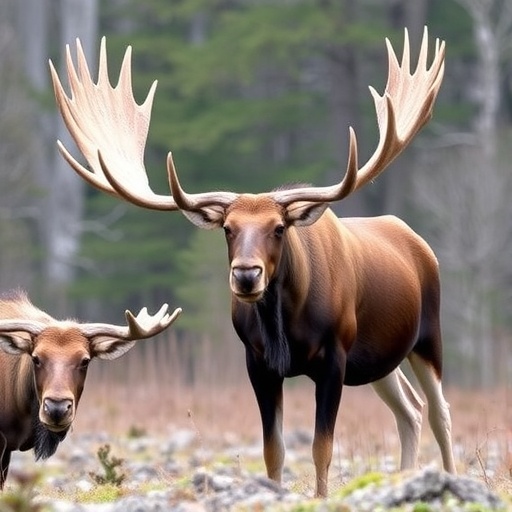
In a groundbreaking study shedding new light on the evolutionary trajectory and environmental resilience of one of Eurasia’s most emblematic megafauna, researchers have decoded the mitochondrial DNA (mtDNA) of the Eurasian moose (Alces alces). This research, which analyzes both ancient subfossil and modern specimens, offers unprecedented insights into how climatic oscillations and anthropogenic pressures have sculpted the genetic makeup, population dynamics, and geographical distribution of this iconic cold-adapted ungulate over the last 50,000 years.
The Eurasian moose, a species uniquely adapted to frigid environments, has witnessed dramatic shifts in population size and habitat range throughout its history. Harnessing the power of mitochondrial genomics, scientists reconstructed phylogeographic patterns, revealing the divergence of European and Asiatic-American moose lineages approximately 100,000 years before present (BP). This divergence is particularly significant as it nested these lineages in distinct ecological zones subjected to different climatic regimes and environmental challenges, setting a diverse evolutionary stage.
Through meticulous Bayesian coalescent analyses of complete mtDNA genomes from 95 subfossil and 137 current specimens, the research team decoded the fluctuations in the effective female population size (Nef) of moose across millennia. The findings reveal a pivotal demographic bottleneck immediately following the Last Glacial Maximum (LGM), reflecting the profound impact of glacial advances on wildlife populations. This bottleneck was succeeded by a pronounced population expansion during the Middle Holocene, a period characterized by climatic amelioration and habitat expansion for cold-adapted species.
However, this glimmer of demographic recovery was gradually overshadowed by a troubling decline in Nef leading to contemporary times. The Asiatic-American lineage experienced a halving in effective female population size, while the European lineage’s Nef plummeted fourfold. Intriguingly, the decline was not uniform across Europe. The Central European group suffered the most severe range contractions, marked by habitat fragmentation and escalating anthropogenic pressures, while the Eastern group’s population remained relatively stable. Conversely, the Western group exhibited a notable geographical shift without substantial fluctuation in effective population size.
Such divergent demographic trajectories within moose populations underscore the complex interplay of environmental pressures and human activity over the Holocene epoch. Despite the moose’s physiological affinity for cold climates and sensitivity to heat stress, temperature increases alone do not fully explain the recent population declines. The study convincingly posits that human-induced factors, particularly overhunting and habitat degradation, have had a more profound and immediate effect on moose demographics.
This hypothesis resonates with broader ecological narratives, where large-bodied, cold-adapted ungulates have historically been vulnerable to expanding human frontiers and intensified resource exploitation. As forests were reshaped for agriculture and urban development, the resultant habitat fragmentation undercut moose’s capacity to migrate and maintain genetic continuity. Overhunting, driven by subsistence and commercial demands, further exacerbated population reductions, particularly in Central Europe where human density and activity have persisted at high levels.
Remarkably, the Western moose populations’ relatively stable Nef despite geographic shifts hints at ecological flexibility within this lineage. The movement of these groups may reflect an adaptive response to localized habitat alterations, avoiding the worst of human encroachment while capitalizing on changing resource distributions. This resilience contrasts with the dire demographic contraction witnessed in central regions and highlights spatial heterogeneity in species responses to external disturbances.
From a phylogeographic perspective, the study decoded the intricate relationships between ancient lineage diversification and contemporary genetic structure. All extant mtDNA groups were traced back to origins predating the LGM, emphasizing a deep-time genetic heritage that persisted through glaciations and interglacials. This ancient diversification likely mirrors the moose’s capacity to occupy diverse refugia during harsh climatic episodes, providing a genetic reservoir that facilitated postglacial recolonization and demographic expansion.
The integration of subfossil data with modern genetic sampling was pivotal in reconstructing these temporal population dynamics. Subfossil specimens, preserved in permafrost and peat bogs, offered a temporal window into past moose diversity and distribution, enabling direct comparison with contemporary populations. Such diachronic analyses are critical for understanding long-term ecological processes and disentangling the relative contributions of climate and human activities.
In light of these revelations, the conservation outlook for the Eurasian moose reflects a nuanced landscape. While historically resilient to climatic fluctuations, the species now faces compounded pressures from ongoing human activities and accelerating climate change. Maintaining genetic diversity and enabling habitat connectivity will be critical to ensuring the persistence of moose populations, especially in regions identified as most vulnerable, such as Central Europe.
This research serves as a clarion call for integrated conservation strategies that prioritize both habitat preservation and sustainable human-wildlife coexistence. By charting the genetic and demographic history of moose, the study offers valuable baselines for monitoring future changes and assessing the effectiveness of management interventions.
Moreover, the findings enrich our understanding of megafaunal responses to past climate events, feeding into broader ecological and evolutionary discourses. The moose stands as a sentinel species for cold-adapted ecosystems, and its history encapsulates the intricate dance between environmental transformations and anthropogenic impacts that continue to shape biodiversity.
The multidisciplinary approach leveraging cutting-edge genomics, paleoecology, and biogeography exemplifies the power of integrative science in decoding past and present biodiversity patterns. As technologies in ancient DNA extraction and sequencing advance, complementary studies on other megafauna will augment our capacity to predict species’ trajectories under future climate scenarios.
This study also underscores the importance of mitochondrial genome analyses in revealing maternal lineage histories and demographic shifts, complementing nuclear genomic insights. These mitochondrial markers offer particularly compelling resolution for phylogeographic reconstructions, essential for species with complex demographic histories.
In sum, the Eurasian moose’s journey through the vicissitudes of climate and human influence unveils profound lessons about species survival and adaptability. As we grapple with the twin challenges of biodiversity loss and climate change, such research highlights the urgency of bridging ecological knowledge with conservation action to safeguard the future of megafaunal legacies in Eurasia and beyond.
Subject of Research: Eurasian moose (Alces alces); mitochondrial genomic analysis; phylogeography; demographic history; effective population size dynamics; Holocene and Late Pleistocene epoch; impacts of climate change and human activity.
Article Title: Phylogeographic and demographic responses of Eurasian moose to climate change since the Late Pleistocene.
Article References: Popović, D., Baca, M., Mackiewicz, P. et al. Phylogeographic and demographic responses of Eurasian moose to climate change since the Late Pleistocene. Heredity (2026). https://doi.org/10.1038/s41437-026-00854-5
Image Credits: AI Generated
DOI: 11 June 2026
Keywords: Eurasian moose, mitochondrial DNA, phylogeography, effective population size, Late Pleistocene, Last Glacial Maximum, Holocene, climate change, human impact, genetic diversity, demographic history
Tags: ancient subfossil DNA analysisanthropogenic effects on moose populationsBayesian coalescent demographic analysisclimate change impact on megafaunacold-adapted ungulate adaptationEurasian megafauna evolutionary historyEurasian moose mitochondrial DNA evolutiongenetic divergence of moose lineagesLast Glacial Maximum population bottleneckmitochondrial genomics in wildlife studiesphylogeography of Alces alcespopulation dynamics of cold environment species