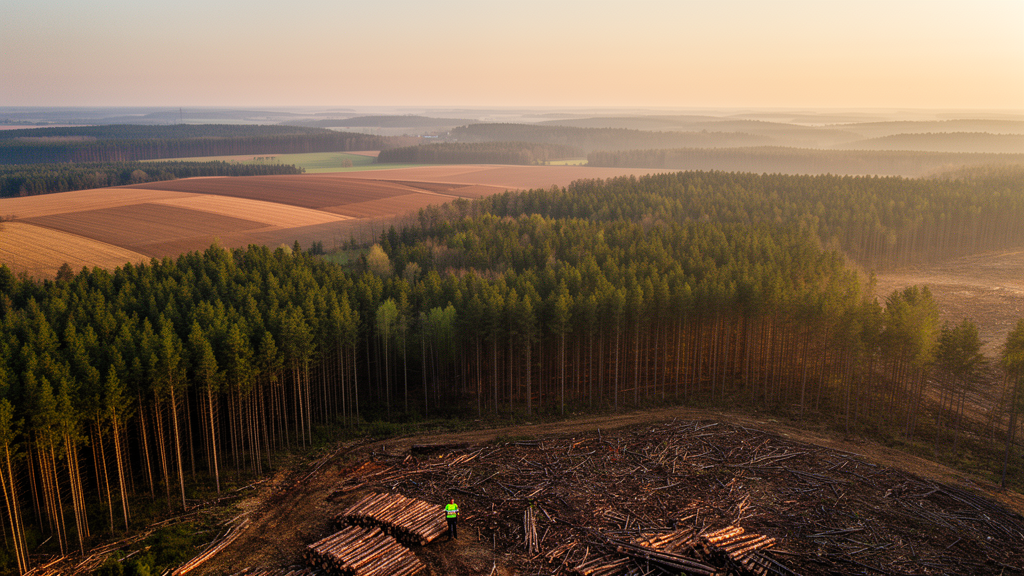
The European Union has cut its total net greenhouse-gas emissions by roughly 39.5 percent between 1990 and 2024, yet the land sector has not followed the same trajectory. According to a new Perspective article published in the journal Carbon Neutrality, the EU’s land use, land-use change and forestry sector, known as LULUCF, removed approximately 231 million tonnes of carbon dioxide equivalent in 2024, while the latest Member State projections still point to a remaining gap of 40 to 55 million tonnes of carbon dioxide equivalent against the binding target of minus 310 million tonnes for 2030. The analysis, led by Behrouz Gholamahmadi and Eva Ivits, argues that the shortfall is not simply a matter of insufficient political ambition but reflects a deeper mismatch between how climate policy imagines land sinks and how ecosystems actually behave.
The scale of the weakening is substantial. The EU-27 LULUCF sink stood at about minus 236 million tonnes of carbon dioxide equivalent in 2022, roughly 30 percent lower than in 2012, with the deterioration driven mainly by the declining forest sink. Total removals have fallen by around 30 percent since their early-2010s peak, even though forest area has expanded by approximately 6 percent since 1990. Forest land remains the dominant source of removals, contributing about minus 292 million tonnes of carbon dioxide equivalent in 2022, with harvested wood products adding a further minus 39.7 million tonnes. Every other major land category worked against the balance: cropland emitted 21.7 million tonnes, grassland 19.5 million tonnes, wetlands 23.2 million tonnes and settlements 28.7 million tonnes of carbon dioxide equivalent in the same year.
The authors identify a cluster of interacting causes behind the forest sink’s decline. Lower forest carbon uptake has become the main proximate contributor to the recent weakening, despite stable or expanding forest area. The scientific literature points to lower forest increment, ageing stand structures, rising harvest pressure and intensifying disturbances linked to drought, wildfire, storms and insect outbreaks. Recent spatially explicit modelling indicates that anthropogenic and natural disturbances are increasingly outpacing biomass recovery, and the authors note that this evidence does not support forest ageing or natural saturation as a sufficient explanation for the EU-wide trend. Age structure still matters in particular forest types, but shorter rotations and higher harvest intensity can reduce standing biomass and reshape age-class distributions.
Climate-driven stress is already visible in the monitoring record. European Environment Agency drought impact indicators show that in 2024 around 601,193 square kilometres of the EU were exposed to severe drought conditions, while vegetation productivity failed to recover to the 2000 to 2020 baseline across 156,703 square kilometres. The affected areas included 87,567 square kilometres of cropland, 33,518 square kilometres of forest and 24,056 square kilometres of grasslands and heathlands. Over the longer 2000 to 2025 period, an estimated annual average of about 47,000 square kilometres of drought-affected woodland and forest failed to return to baseline productivity levels. This supports the interpretation that drought undermines sink performance not only through discrete disturbance events but through sustained suppression of productivity across managed ecosystems.
Fire adds a sharper, more episodic threat. In 2024, fires were mapped in 21 of the EU-27 Member States, burning 419,298 hectares, of which 147,017 hectares occurred within Natura 2000 protected sites. The European Forest Fire Information System estimated wildfire-related emissions at approximately 20 million tonnes of carbon dioxide for that year. Although fires affect smaller areas than drought, they cause direct carbon losses and can abruptly disrupt the sink function of affected landscapes, releasing stored carbon and altering recovery trajectories for decades.
Competition for biomass compounds the pressure. Within the European Commission’s 2040 Climate Target Impact Assessment, a GLOBIOM sensitivity analysis of Scenario 3 indicated that an additional 20 Mtoe of woody-biomass demand could reduce the LULUCF sink by approximately 100 million tonnes of carbon dioxide equivalent. The authors are careful to frame this as a stress test of resource competition rather than a universal conversion factor: the estimate applies to 2040, assumes annual harvesting does not exceed annual forest increment, and assumes that higher biomass prices shift part of the available wood away from material uses. Under those assumptions the additional demand produced a wide 2040 outcome range of approximately minus 115 to minus 276 million tonnes of carbon dioxide equivalent. Wood use can still contribute to mitigation through carbon storage in harvested wood products and substitution for emissions-intensive materials, but those benefits depend on effective displacement, product longevity, supply-chain emissions and the timing of forest-carbon recovery.
Agricultural land remains a persistent drag on the net balance. Agricultural emissions fell from about 487 million tonnes of carbon dioxide equivalent in 1990 to 359 million tonnes in 2024, a reduction of around 26 percent, notably slower than the 39.5 percent cut achieved across total EU net emissions. Agriculture alone accounted for 12 percent of total EU net emissions in 2024. Within LULUCF, cropland emissions did improve, falling from 43.6 to 21.7 million tonnes of carbon dioxide equivalent between 2005 and 2022, but not enough to turn cropland into a net sink. Emissions from drained organic soils under managed grasslands and croplands reach tens of millions of tonnes of carbon dioxide equivalent annually, as drainage exposes waterlogged organic matter to oxygen and accelerates decomposition. Rewetting and improved water management can reduce these losses, although they require careful handling of trade-offs such as potential methane emissions.
A central complication is uncertainty in the numbers themselves. For the EU greenhouse-gas inventory submission covering 2022, the reported LULUCF uncertainty was 52.7 percent for the level and 29.4 percent for the trend. These are distinct metrics: level uncertainty concerns the absolute magnitude of the reported estimate, while trend uncertainty concerns the reported change over time, and the lower trend figure partly reflects the use of related methods and datasets across successive inventory years. Neither metric represents interannual variability, model-projection uncertainty or statistical confidence in the direction of the long-term trend. The authors also stress that improved monitoring can narrow the accounting gap and sharpen attribution, but it cannot accelerate ecosystem recovery, prevent disturbance or guarantee the persistence of stored carbon.
To organise these problems, the Perspective proposes a four-dimensional policy-system mismatch framework. The temporal mismatch arises because climate targets are fixed for 2030, 2040 and 2050, while forest growth, soil carbon accumulation and ecosystem recovery often require decades before measurable changes appear in carbon stocks. The accounting and observational mismatch reflects differences between reporting categories, monitoring capacity and actual stock-and-flux dynamics. The resource-competition mismatch captures the fact that the same land is expected to deliver sequestration, biomass production, biodiversity, food security and adaptation simultaneously. The stock-flux mismatch arises when annual net removals are emphasised without equivalent attention to carbon-stock stability, persistence and reversal exposure. Forward projections reinforce the concern: earlier scenario assessments projected average net removals declining from approximately minus 315 million tonnes of carbon dioxide equivalent per year during 1990 to 2021 to around minus 206 million tonnes per year during 2022 to 2050 under existing measures.
The authors’ proposed response is a planning concept they call dependable removal capacity, which evaluates how much of a headline land-removal estimate can genuinely be relied upon within a specified policy period. At minimum, such an assessment would report expected annual net removal alongside gross emissions and removals, stock change by major carbon pool, implementation and recovery times, exposure to drought, fire, wind, insects, drainage, erosion and harvesting, inventory and scenario uncertainty, competition for land and biomass including leakage, and safeguards for biodiversity, water and food production. Where quantitative evidence is insufficient, the authors argue, transparent scenarios and qualitative ratings are preferable to an apparently precise headline value. The Perspective does not call for lowering the EU’s LULUCF ambition; existing instruments such as the revised LULUCF Regulation, the Nature Restoration Regulation, the Carbon Removal and Carbon Farming Certification Framework and strengthened forest-biomass provisions under the Renewable Energy Directive can support more durable carbon management. But their combined effect, the authors conclude, depends on whether climate, energy, agriculture, restoration and bioeconomy policies are assessed jointly against their real implications for land, biomass and the persistence of carbon in European ecosystems.
Subject of Research: Weakening of the European Union land carbon sink and its implications for climate policy
Article Title: Land carbon sinks in the European Union are not keeping pace with carbon neutrality expectations
Article References: Gholamahmadi, B., & Ivits, E. (2026). Land carbon sinks in the European Union are not keeping pace with carbon neutrality expectations. Carbon Neutrality, 5(1), Article 31. https://doi.org/10.1007/s43979-026-00185-8
Image Credits: AI Generated
DOI: 10.1007/s43979-026-00185-8
Keywords: LULUCF, European Union, carbon sink, forest decline, carbon neutrality, drought, wildfire, biomass energy, soil carbon, greenhouse gas inventory, climate policy, carbon dioxide removal
News Source: Denise Maddox. (October 27, 2026). EU land carbon sink weakens as 2030 removals target slips out of reach. Scienmag.