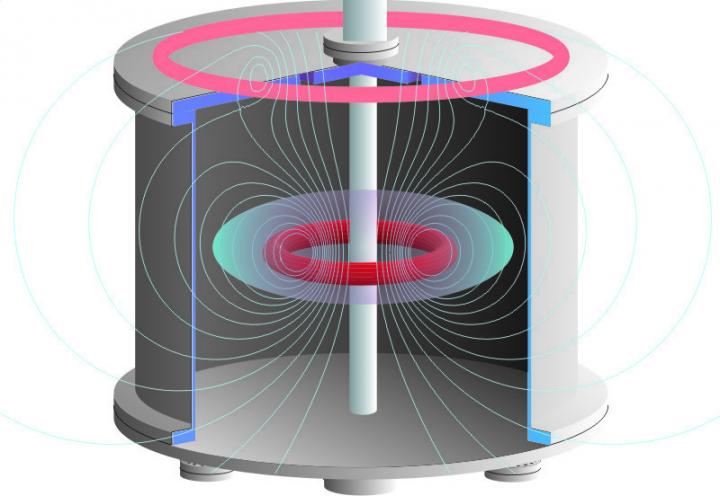
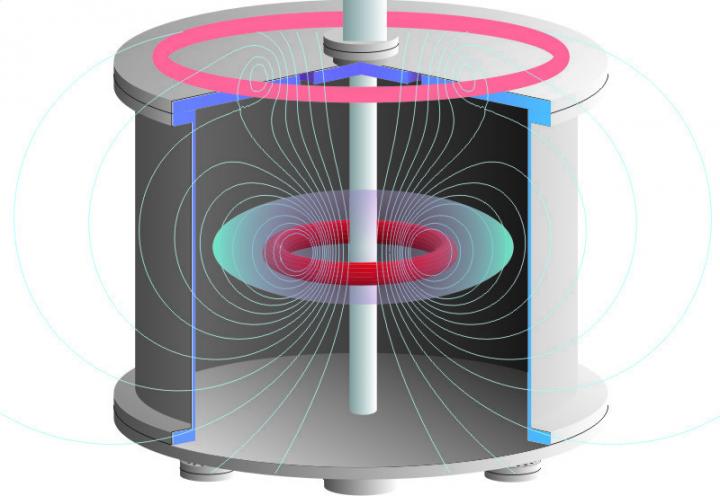
Credit: Graphic: IPP
The European Research Council (ERC) is awarding 2.4 million euros in support of the research on a matter-antimatter plasma composed of electrons and positrons to be produced for the first time in the world by Professor Dr. Thomas Sunn Pedersen at Max Planck Institute for Plasma Physics (IPP) in Greifswald. He is to receive one of the coveted Advanced Grants with which ERC supports pioneering, but risky research projects.
Just minutes after the big bang the universe was filled with equal amounts of matter and antimatter. A similar state is now to be produced by Professor Thomas Sunn Pedersen for the first time in the laboratory: a plasma composed of electrons and their antiparticles, viz. positrons. His objective is to confine an electron-positron plasma in a magnetic cage for at least ten minutes – long enough to allow exact investigation.
Extraordinary properties are predicted by plasma theory for electron-positron plasmas. They are expected to behave very differently to the "ordinary" plasmas produced by ionisation of atoms that are used in industry and fusion research. These plasmas are composed of light electrons and heavy ions, whereas electrons and positrons have exactly the same mass. This rids the exotic plasma of the mass difference between the positively and negatively charged plasma particles – the driving force behind the complex behaviour of ordinary plasmas, in which oscillations, waves, instabilities and turbulence develop. Investigating the computer codes used in fusion research on these exotic plasmas is therefore of great interests. But new discoveries are expected in astrophysics as well since it is assumed that electron-positron plasmas occur in the vicinity of neutron stars and black holes.
As in the universe, also the electron-positron plasma in the laboratory is to be confined by a magnetic dipole field. In the planned APEX-D device (A Positive Positron-Electron Experiment Dipole) the field is produced by a circular superconducting magnet coil. In a cylindrical ca. 20 litre vacuum vessel this coil is levitated by a ring-shaped conductor which is installed above the vessel and attracts the coil feedback-controlled. Similar devices have already been realised in the USA and Japan with ordinary plasmas. The electrons are to be injected into APEX-D with an electron gun. The positrons are to be supplied from the world's most powerful positron source by the FRM II research neutron source at the Technical University of Munich.
Once equal amounts of electrons and positrons are successfully fed into the magnetic trap the cold low-density plasma is expected to stay confined for hours, if not days, till all particles with their antiparticles have annihilated themselves pairwise in tiny flashes of energy – provided there is actually no turbulence in the electron-positron plasma as predicted by theory.
Encouraged by a series of successful preliminary experiments – e.g. positrons have already been trapped with an efficiency of 90 per cent in a device with an APEX-like field geometry – and spurred on by the funding awarded, the APEX-D project can now continue construction. Scientists from the Technical University of Munich, the University of Greifswald, where Thomas Sunn Pedersen teaches as professor, the University of California San Diego, USA, and the National Institute for Fusion Science in Toki, Japan, are major cooperation partners.
###
The European Research Council (ERC) was established in 2007 to support frontier research projects throughout Europe. Its grants, awarded annually, rank amongst the most attractive funding awarded in the context of the European Research Framework Programme. The only selection criterion is the researcher's scientific excellence and the innovative potential of the research idea. Furthermore, the planned project must be incorporated in a European scientific facility or in a country associated with the Framework Programme.
Media Contact
Isabella Milch
[email protected]
http://www.ipp.mpg.de/
############
Story Source: Materials provided by Scienmag