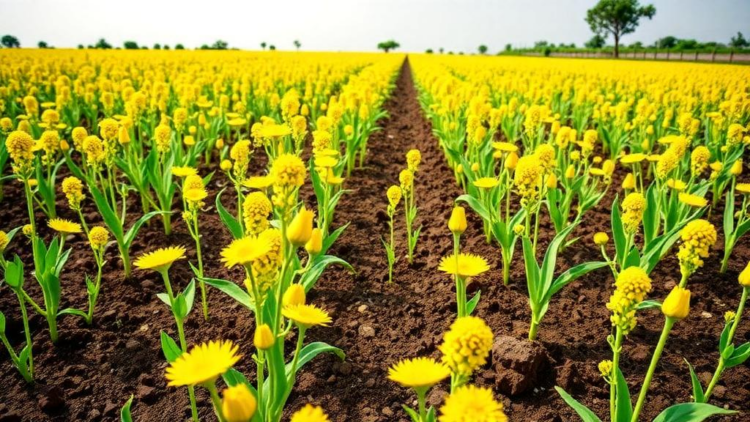
Ethiopia ranks among the world’s leading producers of oilseeds, yet the smallholder farmers who grow sesame, soybeans, sunflowers and other oil crops have watched their yields stagnate far below what modern agronomy says is possible. Now, an ambitious longitudinal analysis drawing on nearly two decades of national survey data has delivered a finding that upends conventional wisdom: the single most powerful lever for raising oilseed productivity in Ethiopia is not more fertilizer, but better soil and crop protection practices. The study, published in Discover Agriculture, also uncovered a troubling paradox involving the country’s agricultural extension services, which appear to be associated with lower, not higher, yields on the plots they cover.
The research, conducted by Daregot Berihun Tenessa of the Department of Economics at Bahir Dar University, tackles a stubborn data problem that has long hampered agricultural economics in sub-Saharan Africa. Ethiopia does not maintain a true longitudinal panel that follows the same farming households year after year, making it difficult to disentangle the dynamic forces shaping productivity. To overcome this, the study constructed a pseudo-panel from the Ethiopian Annual Agricultural Sample Survey, pooling nineteen waves of repeated cross-sectional data collected between 2003 and 2021. Households were grouped into fixed cohorts defined by administrative ward, the sex of the household head, and birth cohort, producing more than 196,000 cohort-wave observations with an average of roughly 50 households per cohort, comfortably above the thresholds econometricians consider reliable.
On top of this data structure, the analysis applied a dynamic System Generalised Method of Moments estimator, a technique designed to handle the endogeneity and measurement error that plague simpler cross-sectional studies. The approach embeds a modified Cobb-Douglas production function in a partial adjustment model, allowing lagged yields to influence current outcomes. Diagnostic tests supported the specification: the Arellano-Bond test found no problematic second-order serial correlation, the Hansen J-test confirmed the validity of the instruments, and the model treated fertilizer, improved seed and pesticide decisions as endogenous, reflecting the reality that farmers choose these inputs in response to unobserved shocks rather than at random.
The headline result concerns the sheer inertia of the system. The elasticity of lagged yields came out at 0.992, meaning that nearly every percentage point of yield achieved in one season carried over into the next. The author attributes this near-unity coefficient to quasi-fixed factors such as inherent soil fertility, the persistence of past management decisions like rotations and conservation investments, and the slow depreciation of accumulated farming knowledge. In practical terms, Ethiopian oilseed production is locked into a path determined by yesterday’s choices, which makes early and sustained investment in good practice far more consequential than one-off interventions.
Among conventional inputs, land emerged as the dominant driver of output, with an elasticity of 0.812, so a one percent increase in cultivated area raises oilseed output by roughly 0.8 percent. That figure, below one, hints at economies of scale in a sector still dominated by small, mechanisation-light farms. Far more striking, however, was the fate of urea fertilizer. Its elasticity was negative, at minus 0.162, indicating that each additional percentage point of urea applied was associated with a 0.162 percent decline in yield. The study links this counterintuitive result to misapplied nitrogen: application at the wrong times, volatilisation and leaching losses under erratic rainfall, unbalanced nutrient mixes lacking phosphorus and potassium, and indiscriminate use on leguminous oilseeds that can suppress biological nitrogen fixation. The problem, the analysis stresses, is allocative inefficiency rather than any inherent failure of nitrogen itself.
The management practices told a far more encouraging story. Households that implemented soil conservation measures recorded yields 32.91 percent higher than non-adopters, an effect the author explains through improved soil structure, reduced erosion, better water infiltration and enhanced nutrient retention that compounds over successive seasons. Even larger was the gap for crop protection: households taking measures against pests and diseases enjoyed yields 47.79 percent above those of non-adopters, consistent with global evidence that unmanaged biotic stress inflicts massive losses in rainfed systems. Together, the results sketch a dual mechanism in which soil health interventions build intrinsic resilience while crop protection shields that resilience from being eroded by pests and pathogens.
Climate adaptation strategies also paid measurable dividends. Farmers who built terraces on sloping land saw yields rise by 18.88 percent relative to non-adopters, while water catchment interventions delivered an even larger 21.89 percent boost. The author argues that the water catchment effect reflects a critical agronomic reality: oilseed crops such as soybeans and sunflowers reach their yield potential only when moisture is available during flowering and pod filling, and capturing ephemeral runoff buffers smallholders against the erratic rainfall patterns increasingly characteristic of the region. Crop diversification added its own benefit, with non-diversified farms producing 8.35 percent lower yields than diversified ones, echoing long-standing ecological findings that mixed cropping systems outperform monocultures over time.
Two institutional findings are likely to generate the most debate. First, plots without access to extension services produced 23.92 percent higher oilseed yields than plots where extension agents were active, a result the study interprets as a warning about the quality and relevance of top-down advisory programmes that have historically prioritised cereals such as wheat and teff. Second, crop-dominant households outperformed livestock-dominant and mixed farming households by roughly 50 percent, a finding that cuts against the prevailing enthusiasm for crop-livestock integration as a risk management strategy, though the author notes it aligns with recent evidence of short-term specialisation premiums in specific value chains. On the positive side of the ledger, access to credit raised oilseed output by 14.67 percent, underscoring the role of financial inclusion in enabling farmers to purchase the inputs and conservation labour that productivity gains require.
The temporal backdrop adds urgency to these findings. Average oilseed yields climbed from 7.7 quintals per hectare at the start of the study period to around 13 quintals per hectare between 2016 and 2019, an improvement of roughly 73 percent that the study attributes to increased input use and government-promoted practices. Yet production then fell in 2020 and 2021, a decline the analysis links to climatic pressures, input access problems and institutional gaps. Meanwhile, the area planted to oilseeds nearly halved, from about 800,000 hectares in 2004 to 400,000 hectares in 2021, and improved seed use remained strikingly rare, fluctuating between just 280 and 3,530 quintals annually against a backdrop of continued reliance on indigenous varieties.
The policy implications are pointed. The study calls for scaling up crop protection and soil and water conservation programmes, prioritising terracing and water catchments in moisture-stressed zones, and shifting extension advice away from pushing urea volumes toward precision agriculture with balanced nutrient blending and timing calibrated to local conditions. It also recommends expanding targeted microcredit lines to cover conservation inputs, and warns against repeating the perceived neglect of oilseeds under earlier national strategies such as PASDEP, which critics say privileged cereals. The author acknowledges the limits of the observational design, noting that causal claims rest on identification assumptions and that future work should exploit true panel data and quasi-experimental designs. Still, for a sector that supplies cooking oil, animal feed, export earnings and the livelihoods of millions of smallholders, the message is clear: the fastest route to higher yields runs through healthier soils, protected crops and smarter nitrogen, not simply more of everything.
Subject of Research: Determinants of oilseed crop productivity in Ethiopian smallholder agriculture, including input use, farm management and climate adaptation
Article Title: Longitudinal analysis of input use farm management practices and climate adaptation on Ethiopian oilseed crop yields
Article References: Tenessa, D. B. (2026). Longitudinal analysis of input use farm management practices and climate adaptation on Ethiopian oilseed crop yields. Discover Agriculture, 4(1), Article 299. https://doi.org/10.1007/s44279-026-00781-3
Image Credits: AI Generated
DOI: 10.1007/s44279-026-00781-3
Keywords: Ethiopia, oilseeds, crop yields, soil conservation, fertilizer use, climate adaptation, System GMM, pseudo-panel, agricultural extension, smallholder farming, crop protection, agricultural economics
Cite Scienmag News
APA MLA Chicago
Alan Morgan. (October 1, 2026). Ethiopia’s Oilseed Yields Hinge on Soil Conservation, Not More Fertilizer, 19-Year Study Finds. Scienmag. https://scienmag.com/ethiopias-oilseed-yields-hinge-on-soil-conservation-not-more-fertilizer-19-year-study-finds/
Alan Morgan. “Ethiopia’s Oilseed Yields Hinge on Soil Conservation, Not More Fertilizer, 19-Year Study Finds.” Scienmag, 1 October 2026, https://scienmag.com/ethiopias-oilseed-yields-hinge-on-soil-conservation-not-more-fertilizer-19-year-study-finds/. Accessed 1 October 2026.
Alan Morgan. “Ethiopia’s Oilseed Yields Hinge on Soil Conservation, Not More Fertilizer, 19-Year Study Finds.” Scienmag. October 1, 2026. https://scienmag.com/ethiopias-oilseed-yields-hinge-on-soil-conservation-not-more-fertilizer-19-year-study-finds/
Copy citation Download RIS
Tags: agricultural economicsagricultural extensionClimate Adaptationcrop protectioncrop yieldseffects of agricultural policies on yieldsEthiopiaEthiopian agricultural extension servicesEthiopian oilseed crop yieldsfertilizer useimpact of fertilizer on agriculturelong-term agricultural data analysislongitudinal agricultural studies in Africaoilseed production challenges in Ethiopiaoilseedspseudo-panelpseudo-panel data analysissmallholder farmingsmallholder farming productivitysoil and crop protection practicessoil conservationsoil conservation in Ethiopiasustainable farming in sub-Saharan Africasystem GMM