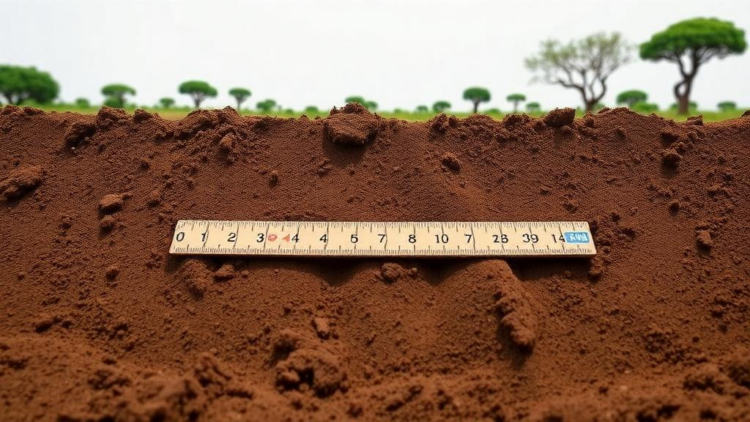
Across the eroded highlands of northwestern Ethiopia, some of the world’s most ambitious soil conservation campaigns are being built by hand, village by village, slope by slope. Millions of days of communal labor have gone into stone-faced soil bunds, check dams, micro-trenches and hillside terraces, all designed to hold back the runoff that strips the Ethiopian Highlands of some of its most productive farmland. But a new field study from central Gondar suggests that many of these structures, however impressive from a distance, are quietly failing a much simpler test: the tape measure.
Researchers from the Gondar Agricultural Research Center and the Amhara Agricultural Research Institute set out to answer a question that has rarely been asked systematically in Ethiopia’s conservation push: are the structures actually being built to the dimensions specified in the country’s national technical guidelines? The team, led by Atikilt Abera Alemayehu, selected nine watersheds across three districts—West Belesa, Gondar Zuria and Wegera—chosen deliberately because they contained newly constructed conservation works and spanned two distinct agroecological zones. One zone is a cool, moist mid-highland environment at roughly 2,300 to 3,200 meters elevation, receiving 1,200 to 2,000 millimeters of rain annually at temperatures of 10 to 15 degrees Celsius. The other is a tepid, moist mid-highland zone between 1,500 and 2,300 meters, with 900 to 1,600 millimeters of rainfall and temperatures of 15 to 20 degrees.
The stakes could hardly be higher. Ethiopia is routinely described as one of the most erosion-prone countries on Earth, and the Amhara region, where the study was conducted, loses enormous amounts of agricultural production every year. Rainfall in the highlands tends to be intense, and the soils are shallow and structurally weak, making them highly erodible. Measured erosion rates in the region range from 16 to more than 300 megagrams per hectare per year, depending on slope, land cover and rainfall intensity. Against that backdrop, physical conservation structures are the front line of defense, and their design specifications—heights, widths, depths, spacings and vertical intervals—are not arbitrary. They are the product of decades of national research into what actually stops soil from moving downhill.
The methodology was refreshingly direct. Armed with tape meters, water levels, string and graduated poles, the researchers walked the watersheds and measured the structures themselves, comparing each dimension against the ranges prescribed in Ethiopia’s national soil and water conservation guidelines. They then applied paired t-tests at a 5 percent significance level to determine whether the measured means differed statistically from the standard values, with the standard minimum and maximum ranges averaged for comparison. Four widely implemented measures were evaluated: stone-faced soil bunds, stone check dams, micro-trenches and hillside terraces. Stone-faced soil bunds appeared in every agroecology, typically on cultivated land, where they are favored both for their compatibility with farming operations and for their economic value as supports for forage crops.
The results were sobering. The measured heights of stone-faced soil bunds ranged from 0.62 to 0.69 meters, significantly below the recommended 0.85 meters, with shortfalls of 27.2 percent in West Belesa, 33.8 percent in Gondar Zuria and 18.8 percent in Wegera. That may sound like a modest discrepancy, but bund height is what determines how much runoff a structure can intercept and how much sediment it can trap. Previous research in northern Ethiopia has estimated that well-built stone bunds can trap more than 60 tons of sediment per hectare per year, and properly designed and maintained bunds have been shown to reduce soil loss by roughly 68 percent. A shortfall of one-fifth to one-third in height translates directly into lost storage capacity and reduced trapping efficiency.
The problems extended below ground as well. The ditches integrated with the bunds were significantly shallower and narrower than the standards across all three districts, with depth deficits of 50.8 percent in Gondar Zuria, 29.0 percent in West Belesa and 28.2 percent in Wegera. Shallow ditches hold less water and sediment, which means more runoff continues downslope with its erosive energy intact. The berms—the buffer strips left between the embankment and the ditch, which anchor the structure and provide planting sites for stabilization—were also substandard in West Belesa, measuring 0.131 meters against a recommended 0.225 meters, a 41.8 percent reduction. Insufficient berms prevent the establishment of stabilizing vegetation and leave bunds more vulnerable to collapse. Interestingly, not every deviation was negative: bund spacing in West Belesa and Wegera was significantly narrower than recommended, which reduces erosion but at the cost of higher expense, obstructed farm operations and lost cropping area. And in Wegera, bund length ran significantly over the standard, stretching to 96 meters against a recommended 70 meters—a deviation that can accelerate runoff along the structure and raise the risk of breaching.
The stone check dams built to rehabilitate gullies told a similar story. Their measured heights of 0.52 to 0.72 meters fell dramatically short of the recommended 1.25 meters, deviations of 42.2 to 58.4 percent, and their base widths of 1.01 to 1.74 meters were well below the 2.50-meter standard. These findings echo earlier work elsewhere in Ethiopia, where check dam base widths and effective heights were found to fall short of standards by 47 and 92.3 percent respectively. Undersized check dams are particularly dangerous because concentrated runoff can simply bypass or overtop them, and the study’s authors note that poorly designed dams can themselves be damaged by excess discharge. The one bright spot was spacing: check dams were placed at approximately correct intervals in the study watersheds. Apron dimensions, by contrast, swung wildly in both directions—51.6 to 82.3 percent below standard in West Belesa, but 110.4 to 373 percent above standard in Gondar Zuria and Wegera, likely a local response to the deep, active gullies the researchers observed, where oversized aprons help dissipate the scouring energy of runoff at a high investment cost.
Micro-trenches, the small infiltration pits cut into hillslopes to capture runoff and recharge soil moisture, were consistently too shallow, at 0.26 to 0.36 meters against a recommended 0.50 meters—deficits of 40.1, 59.2 and 94.6 percent in Gondar Zuria, West Belesa and Wegera respectively. Shallow trenches simply cannot store the water they are designed to capture, undermining their purpose on steep slopes. Their widths and lengths, however, were significantly larger than standard, and spacing deviated in opposite directions: nearly half again too wide in West Belesa, which raises erosion risk, and 67.5 percent too narrow in Wegera, which inflates labor and cost. The single hillside terrace measured, in the Watry watershed of West Belesa, showed perhaps the most dramatic deviation of all: a vertical interval of 6.46 meters against the guideline’s 2.5 meters, an overshoot of 158.4 percent. Wide vertical intervals allow runoff to accumulate and concentrate between structures, carving rills and gullies that damage cropland downstream—a pattern consistent with earlier Ethiopian studies that found terraces installed at fixed intervals regardless of slope.
Why does a country so invested in conservation build its defenses out of specification? The researchers point to a familiar tangle of constraints: shortages of materials, technical limitations, rocky or difficult soils, farmers’ own preferences, limited on-the-job training, and weak awareness and ownership of the land resources being protected. Mass mobilization campaigns, by their nature, prioritize area coverage—the sheer number of kilometers of bund and numbers of dams completed—over the technical quality of each individual structure. Yet the engineering literature is unambiguous that quality determines performance: structures built to standard have achieved soil-loss reductions of up to 93 percent, while mismatches between designed and built dimensions are a leading cause of failure, gully formation and wasted investment. The study’s recommendations are correspondingly practical. Farmers and extension experts need training in structural quality, backed by regular monitoring and evaluation, and future conservation work should be tailored to local agroecological and socioeconomic conditions rather than applied uniformly. Without that shift, Ethiopia risks continuing to pay for erosion control twice—once in labor and materials, and again in the soil that slips past structures built just a few centimeters too small.
Subject of Research: Technical compliance of physical soil and water conservation structures with national standards across agroecologies in the Ethiopian Highlands
Article Title: Evaluation of physical soil and water conservation measures on technical standards in different agroecologies of central Gondar, Ethiopia
Article References: Alemayehu, A. A., Samuel, T., Getu, L. A., & Addis, H. K. (2026). Evaluation of physical soil and water conservation measures on technical standards in different agroecologies of central Gondar, Ethiopia. Discover Soil, 3(1), Article 129. https://doi.org/10.1007/s44378-026-00292-z
Image Credits: AI Generated
DOI: 10.1007/s44378-026-00292-z
Keywords: soil erosion, Ethiopia, soil and water conservation, stone bunds, check dams, micro-trenches, hillside terraces, technical standards, highlands, watershed management, land degradation, agroecology
Cite Scienmag News
APA MLA Chicago
Alan Morgan. (October 3, 2026). Ethiopia’s Billion-Dollar Soil Push Is Failing a Simple Ruler Test. Scienmag. https://scienmag.com/ethiopias-billion-dollar-soil-push-is-failing-a-simple-ruler-test/
Alan Morgan. “Ethiopia’s Billion-Dollar Soil Push Is Failing a Simple Ruler Test.” Scienmag, 3 October 2026, https://scienmag.com/ethiopias-billion-dollar-soil-push-is-failing-a-simple-ruler-test/. Accessed 3 October 2026.
Alan Morgan. “Ethiopia’s Billion-Dollar Soil Push Is Failing a Simple Ruler Test.” Scienmag. October 3, 2026. https://scienmag.com/ethiopias-billion-dollar-soil-push-is-failing-a-simple-ruler-test/
Copy citation Download RIS
Tags: agroecological zones and conservation practicesagroecologychallenges in Ethiopia’s soil preservation effortscheck damscommunity-led land restoration projects in Ethiopiaeffectiveness of soil bunds and check damserosion mitigation strategies in EthiopiaEthiopiaEthiopia soil conservation failureEthiopian Highlands erosion controlevaluation of Ethiopian soil conservation guidelinesfield study on Ethiopian soil engineeringhighlandshillside terracesimpact of conservation structures on Ethiopian farmlandLand degradationmicro-trenchesmicro-trenches and hillside terraces in Ethiopiasoil and water conservationsoil erosionstone bundstechnical standardsvillage-level soil conservation structureswatershed management