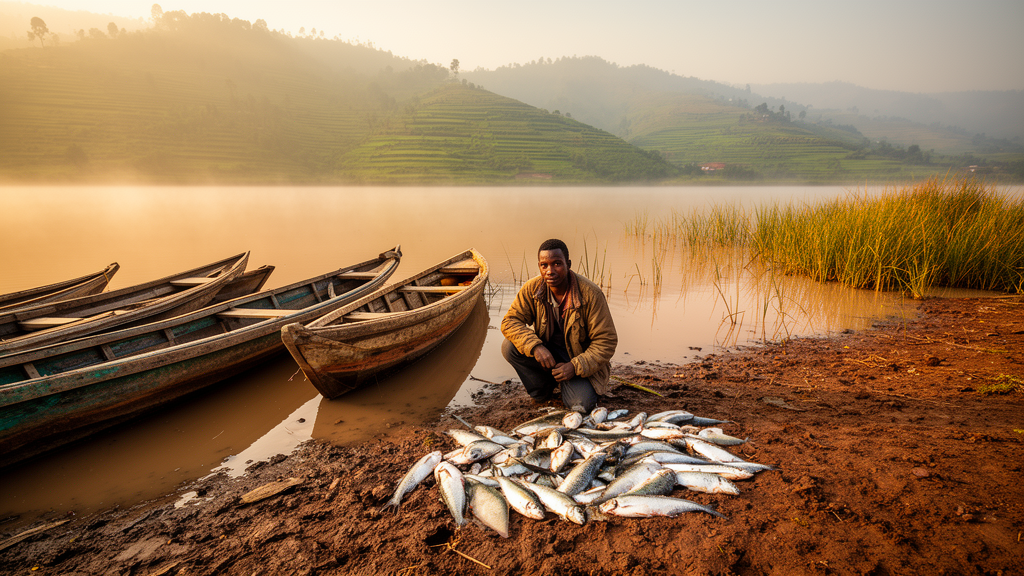
Lake Hashenge, a small closed high-altitude lake in the northern Ethiopian highlands, has long been treated as a promising fishery, yet its reported catches remain far below what scientists estimate the lake could produce. A new review synthesizing published studies, government reports, theses, and unpublished field data collected between 2011 and 2018 concludes that the fishery is constrained by a web of interacting pressures: eutrophication and low oxygen, sedimentation and habitat degradation, the dominance of introduced common carp, and climate-driven hydrological variability. The analysis, published in the journal Discover Life, draws on 31 sources that met the authors’ inclusion criteria, including 20 peer-reviewed articles, 8 institutional and government reports, and 3 theses.
The numbers tell a striking story of underperformance. Early assessments estimated a potential annual yield of 106 tons, against an actual catch of 21 tons at the time. A later study reported a catch per unit effort of 23.38 kilograms per boat per day and estimated a maximum sustainable yield of 161.76 tons per year. More recent figures suggest annual production of roughly 7 to 10 tons, while other reports place average annual catches at 7 to 10 tons compared with potential yields of 25 to 30 tons per year. According to one study cited in the review, the average annual catch from the two fishing cooperatives was only about 64 quintals, equivalent to 6.4 tons. Reported catches have generally ranged from 3.1 to 21 tons per year, a substantial gap between potential and realized production that the authors attribute partly to differences in estimation methods, sampling intensity, environmental conditions, and periodic disturbances such as fish kills and water quality fluctuations.
Fishing at Lake Hashenge is a story of introductions. Historical records indicate the lake was stocked with Nile tilapia (Oreochromis niloticus) and common carp (Cyprinus carpio) during the early 1980s. The National Fishery and Resources Research Center at Sebeta restocked the lake with Nile tilapia, common carp, and Cyprinus carassius fry during 1982 and 1983, and again in 2001. After the severe famine of 1984 in the Tigray and Amhara regions, the World Food Programme, working with the Ministry of Agriculture, facilitated the stocking of Nile tilapia fingerlings by helicopter in 1985. That same year, the first fishery cooperative was established with 30 local members, and by March 1986 fishing and marketing activities had begun. A baseline survey later confirmed the presence of only Nile tilapia and common carp, suggesting that Cyprinus carassius either failed to adapt, was misidentified, or was competitively excluded by common carp. Today the lake supports three fish taxa: the two introduced commercial species and a native genus, Garra.
The lake’s ecological fragility is rooted in its geography. Situated at roughly 2,440 meters above sea level, with a surface area of about 20 square kilometers and a maximum depth of about 25 meters, Lake Hashenge is a closed basin with no surface outlet and a drainage area of 129 square kilometers. Mean monthly air temperatures range from 13 to 19 degrees Celsius, and annual rainfall varies from 0 to 250 millimeters in a bimodal pattern. These high-altitude conditions matter for fish. The lake’s temperatures are generally lower than the reported optimum breeding range of Nile tilapia, which is 21 to 35 degrees Celsius, and the review suggests this may have limited the species’ establishment and reproductive success after introduction. Common carp, which tolerates lower temperatures, appears to have adapted more successfully, and the fishery is now dominated by carp while Nile tilapia contributes a relatively smaller proportion of catches than in some other Ethiopian lakes and reservoirs.
Recurrent mass fish mortality events, most notably in 2000 and 2014, have repeatedly disrupted the fishery and caused socioeconomic losses for surrounding communities. During the June 2014 fish kill, a dissolved oxygen concentration of 2.15 milligrams per liter was recorded, a level that falls within or below tolerance limits reported for economically important species such as Nile tilapia and common carp. Observations from that event included dark-brown water, dead fish accumulated along the shoreline, unpleasant odors resembling hydrogen sulfide, and unusually colored zooplankton samples. The authors are careful about causation: they note that the available evidence is insufficient to conclusively identify oxygen depletion as the sole cause of the mortality event, because detailed information on thermal stratification, vertical oxygen profiles, sampling depth, and other water-quality parameters was not reported. They describe the observations as consistent with, rather than definitive proof of, hypoxia-related fish mortality.
The catchment itself is under pressure. Land-use surveys identified four dominant categories within the 129-square-kilometer drainage: sparse woodland covering 41.96 percent, cultivated land 31.8 percent, water bodies 16.78 percent, and grazing and wetland areas 9.45 percent. Rain-fed cultivation has extended onto steep slopes, intensive livestock grazing has reduced vegetation cover, and quarrying and settlement expansion have altered hillsides that were previously more densely vegetated. Local measurements cited in the review suggest long-term sediment accumulation, with sediment deposits reaching nearly 14 meters at some locations and an average lake depth of approximately 14 meters. The use of nitrate- and phosphate-based fertilizers and synthetic pesticides in the catchment may increase nutrient and chemical inputs through surface runoff, and improper solid-waste disposal from the nearby town of Hashenge may also contribute to declining water quality. Major tributaries draining the Adigolo, Menkere, and northern wetland areas transport sediment during the rainy season, and gully erosion is evident along several drainage pathways.
Climate records add another layer of stress. Meteorological data from the nearby Korem station show a statistically significant warming trend over the past 27 years: between 1993 and 2019, annual maximum temperature increased by approximately 0.9 degrees Celsius, or 0.034 degrees Celsius per year, with a correlation coefficient of 0.43 and a p-value of 0.024. Changes in minimum temperature were relatively small and not statistically significant. Rainfall records for the same period demonstrate strong seasonality and considerable interannual variability, with mean monthly rainfall highest in August at approximately 279 millimeters, particularly wet conditions in 2014, and relatively dry conditions in 2015. Previous studies estimated that approximately 5.7 million cubic meters of water was lost from the lake through evaporation during a 135-day period, and analyses of the lake’s elevation-area relationship indicated that a 2-meter decline in water level could reduce lake surface area by approximately 1.45 square kilometers. Such hydrological changes could modify the extent and distribution of fish habitats, including spawning and nursery areas, though the resulting effects on fish populations have not been directly quantified.
The review also flags the ecological consequences of stocking non-native species. Studies in other freshwater ecosystems have shown that common carp can alter aquatic habitats through intensive benthic foraging, resuspending bottom sediments and increasing water turbidity, which may affect the spawning habitats of tilapia species that construct nesting sites in shallow areas. A review cited in the paper reported elevated nutrient levels in approximately 75 percent of cases where common carp were introduced. However, the authors stress that the extent to which Lake Hashenge’s increasing turbidity and periodic water-quality problems are directly attributable to common carp, rather than to watershed degradation, sediment inflow, and climatic variability, has not been quantitatively assessed. They frame potential impacts of carp on water quality, eutrophication, or fish community structure as plausible hypotheses rather than established conclusions, and call for future studies to quantify the species’ ecological effects.
Beyond the water, the fishery faces market and institutional constraints. Limited cold-storage facilities, inadequate transportation services, and insufficient market infrastructure reduce product quality and restrict access to distant markets, and because fish is highly perishable, interruptions in cold-chain facilities increase post-harvest losses. Fish supplied from larger water bodies, particularly the Tekeze Reservoir, has expanded availability in regional markets and intensified competition. Consumer preference for Nile tilapia over common carp, the dominant species harvested from Lake Hashenge, further affects the economic value of landings. Limited access to formal credit, insufficient investment capital, and weak institutional support constrain the ability of fishers and cooperatives to acquire boats, gear, transportation, and cold-storage systems. Fishery associations have diversified by providing boat rental services for researchers, visitors, and local tourists, and by supporting recreational and social events, which provides supplementary income, but infrastructure maintenance, marketing, transportation, and organizational capacity remain challenges.
Despite these pressures, Lake Hashenge remains an important source of food, income, and livelihood for local communities, and its ecological significance extends beyond fisheries. The lake is recognized as an Important Bird Area, supporting endemic, threatened, resident, and migratory waterbirds, with surveys recording 69 bird species including 38 waterfowl species. The authors argue that integrated catchment management, strengthened fisheries governance, and adaptive management strategies are needed to support ecosystem conservation and sustainable fish production. They emphasize that the relative contribution of climate-related factors compared with watershed degradation, sedimentation, nutrient loading, and land-use change remains unclear, and that additional long-term limnological, hydrological, and fisheries studies are needed to quantify these interactions and their implications for fish production in this unique high-altitude lake.
Subject of Research: Environmental stressors and management constraints affecting the fisheries of Lake Hashenge, a closed high-altitude lake in northern Ethiopia
Article Title: Current status environmental stressors and management constraints affecting fisheries in lake Hashenge, Northern Ethiopia
Article References: Tesfay, S., Teferi, M., & Gebreyohannes, B. (2026). Current status environmental stressors and management constraints affecting fisheries in lake Hashenge, Northern Ethiopia. Discover Life, 56(1), Article 43. https://doi.org/10.1007/s11084-026-09763-3
Image Credits: AI Generated
DOI: 10.1007/s11084-026-09763-3
Keywords: Lake Hashenge, Ethiopia, inland fisheries, eutrophication, fish kills, common carp, Nile tilapia, sedimentation, climate variability, watershed degradation, fish stocking, highland lakes
News Source: Violet Maxwell. (October 28, 2026). Ethiopian highland lake Hashenge yields far below its potential as fish kills and sediment choke the fishery. Scienmag.