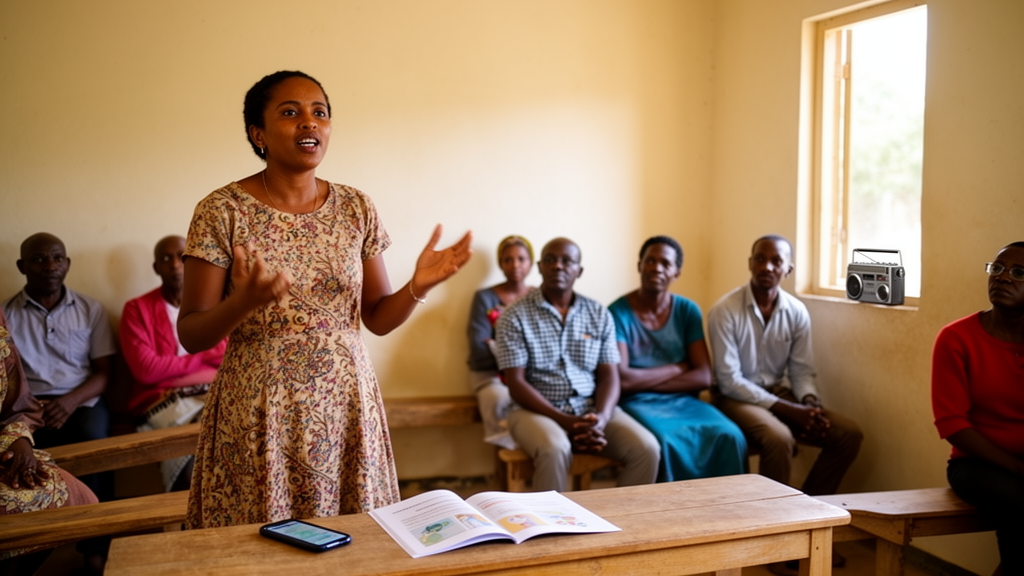
In a cross-sectional analysis of 16,322 responses from Ethiopia’s Small, Happy, and Prosperous Family in Ethiopia survey, reproductive knowledge and media exposure showed different associations with fertility preferences across three socioeconomic clusters. Deeper knowledge and greater media exposure were associated with lower fertility preferences in the Rural cluster, but with higher preferences in the Transitional cluster. In the Urban cluster, knowledge was associated with higher fertility preferences while media exposure was associated with lower preferences. The study therefore found no single national relationship linking information-related factors to fertility intentions.
Researchers applied k-means clustering to stratify the regional survey data into Rural, Transitional and Urban archetypes. They then used double machine learning, integrating LightGBM-based linear double machine learning with causal forest double machine learning, to adjust for high-dimensional confounders and capture nonlinear heterogeneity. The analysis also calculated Robustness Values, which quantify the threshold of omitted-variable bias for an estimated association. This combination of methods was designed to compare conditional associations within the statistically derived clusters rather than average them across the entire Ethiopian sample.
The Rural cluster showed negative associations for both information measures. Knowledge depth had an estimated association of −0.051 with fertility preference, while media exposure had an estimate of −0.063. The reported p-values were p < .001 for knowledge depth and p = .009 for media exposure. The causal forest analysis indicated that the association between media exposure depended on pre-existing knowledge in rural settings. In this cluster, the observed media relationship was therefore not structurally independent of respondents’ knowledge levels within the model.
The Transitional cluster produced the opposite pattern. Knowledge depth was positively associated with fertility preference, with an estimate of +0.067, while media exposure had a positive association of +0.101. Both relationships were reported as statistically significant, with p < .001 for each measure. As in the rural analysis, the causal forest results suggested that media exposure operated differently depending on pre-existing knowledge in transitional settings. These results contradict the assumption that greater exposure to reproductive information is uniformly associated with preferences for fewer children.
Urban respondents displayed a divided pattern. Knowledge depth was positively associated with fertility preference, with an estimate of +0.048 and p = .002. Media exposure was negatively associated with fertility preference, with an estimate of −0.075 and p = .005. The causal forest analysis suggested that media exposure in the urban cluster operated structurally independently of pre-existing knowledge, unlike its behavior in the rural and transitional settings. Because the data were cross-sectional, the estimates represent adjusted conditional associations rather than causal effects: the study cannot establish that knowledge or media exposure caused people to hold particular fertility preferences. The authors said the findings support considering cluster-specific strategies, including continued foundational education in rural areas, prioritizing economic structural shifts over information campaigns in transitional zones, and using standalone mass media for normative reframing in urban centers. These are policy implications proposed by the study, not tested interventions or demonstrated program outcomes.
Subject of Research: How socioeconomic context shapes associations between fertility preferences, reproductive knowledge, and media exposure in Ethiopia
Article Title: Double machine learning analysis identifies heterogeneous patterns in Ethiopian fertility intention: cross-sectional study
Article References: Kim, Y., Nam, E. W., Gebru, H. B., & Lee, H. (2026). Double machine learning analysis identifies heterogeneous patterns in Ethiopian fertility intention: cross-sectional study. BMC Public Health. https://doi.org/10.1186/s12889-026-29734-7
Image Credits: AI Generated
DOI: 10.1186/s12889-026-29734-7
Keywords: Ethiopia, fertility preferences, fertility intentions, reproductive knowledge, media exposure, double machine learning, causal forest, cross-sectional study, socioeconomic clusters, public health, Double, machine
News Source: Ophelia Keating. (October 26, 2026). Ethiopian fertility preferences show context-dependent links to knowledge and media. Scienmag.