• HOME
  • NEWS
  • EXPLORE
    • CAREER
      • Companies
      • Jobs
    • EVENTS
    • iGEM
      • News
      • Team
    • PHOTOS
    • VIDEO
    • WIKI
  • BLOG
  • COMMUNITY
    • FACEBOOK
    • INSTAGRAM
    • TWITTER
Monday, August 17, 2026
BIOENGINEER.ORG
No Result
View All Result
  • Login
  • HOME
  • NEWS
  • EXPLORE
    • CAREER
      • Companies
      • Jobs
        • Lecturer
        • PhD Studentship
        • Postdoc
        • Research Assistant
    • EVENTS
    • iGEM
      • News
      • Team
    • PHOTOS
    • VIDEO
    • WIKI
  • BLOG
  • COMMUNITY
    • FACEBOOK
    • INSTAGRAM
    • TWITTER
  • HOME
  • NEWS
  • EXPLORE
    • CAREER
      • Companies
      • Jobs
        • Lecturer
        • PhD Studentship
        • Postdoc
        • Research Assistant
    • EVENTS
    • iGEM
      • News
      • Team
    • PHOTOS
    • VIDEO
    • WIKI
  • BLOG
  • COMMUNITY
    • FACEBOOK
    • INSTAGRAM
    • TWITTER
No Result
View All Result
Bioengineer.org
No Result
View All Result
Home NEWS Science News Chemistry

Etching process enhances the extraction of hydrogen during water electrolysis

Bioengineer by Bioengineer
May 14, 2021
in Chemistry
Reading Time: 2 mins read
0
IMAGE
Share on FacebookShare on TwitterShare on LinkedinShare on RedditShare on Telegram

IMAGE

Credit: The authors

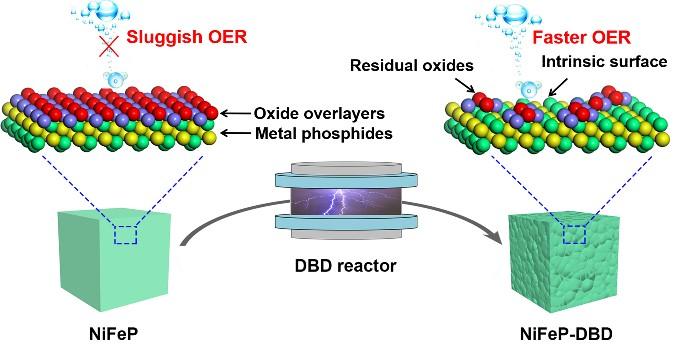
Extracting hydrogen from water through electrolysis offers a promising route for increasing the production of hydrogen, a clean and environmentally friendly fuel. But one major challenge of water electrolysis is the sluggish reaction of oxygen at the anode, known as the oxygen evolution reaction (OER).

A collaboration between researchers at Hunan University and Shenzhen University in China, has led to a discovery that promises to improve the OER process. In their recent paper, published in the KeAi journal Green Energy & Environment, they report that etching – or, in other words, chemically removing – the oxide overlayers that form on the surface of the metal phosphide electrocatalysts regularly used in electrolysis, can increase OER efficiency.

Professor Shuangyin Wang of the State Key Laboratory of Chem/Bio-sensing and Chemometrics at Hunan University led the study. He explains: “While metal phosphides are often used as catalysts due to their unique physicochemical properties such as high conductivity, earth-abundance reserves and excellent performance, a common, but often neglected fact is that they are quick to suffer atmospheric oxidation when they are exposed to air. This causes them to form oxide overlayers on their surface, which can change the surface reconstruction process and confuse the structure-performance relationship.”

To solve this problem, Professor Wang and his colleagues decided to etch away those oxide overlayers using a dielectric barrier discharge plasma technique. And they discovered that the etching process not only accelerated the surface reconstruction process, but greatly enhanced the formation of metal hydroxides and OER activity.

According to Prof. Wang: “These findings are helpful for understanding the structure-performance relationship of metal phosphides in electrooxidation reaction. And we suspect that the same etching process has the potential to be used on other oxygen-susceptible metal compounds such as chalcogenides, nitrides and carbides.

“Our hope is that our study guides the rational design and engineering of more efficient electrocatalysts for water electrolysis.”

###

Contact the paper’s lead author: Shuangyin Wang, [email protected]

The publisher KeAi was established by Elsevier and China Science Publishing & Media Ltd to unfold quality research globally. In 2013, our focus shifted to open access publishing. We now proudly publish more than 100 world-class, open access, English language journals, spanning all scientific disciplines. Many of these are titles we publish in partnership with prestigious societies and academic institutions, such as the National Natural Science Foundation of China (NSFC).

Media Contact
Cassie He
[email protected]

Related Journal Article

http://dx.doi.org/10.1016/j.gee.2021.03.005

Tags: Chemistry/Physics/Materials SciencesEnergy/Fuel (non-petroleum)
Share12Tweet8Share2ShareShareShare2

Related Posts

Butterfly-Inspired Technology Could Transform Air Quality Monitoring

August 15, 2026
Artesunate Targets GBA, Triggering Apoptosis in Liver Cancer Cells

Artesunate Targets GBA, Triggering Apoptosis in Liver Cancer Cells

August 15, 2026

New molecule may enable cleaner, more efficient metal recovery

August 15, 2026

Controlled sulfidation enhances supercapacitor electrode performance

August 15, 2026
Please login to join discussion

POPULAR NEWS

  • Pilot Study Examines Personal Care Use, Social Media Engagement Among NJ Students

    29 shares
    Share 12 Tweet 7
  • KAIST develops semiconductor neuron that harnesses noise to selectively process signals

    29 shares
    Share 12 Tweet 7
  • Imagining natural and extra robotic thumbs together strengthens kinesthetic sensorimotor networks

    29 shares
    Share 12 Tweet 7
  • PARP1 Drives Neuropathic Pain Through GPX4-Dependent Ferroptosis in Injured Mice’s Sensory Neurons

    29 shares
    Share 12 Tweet 7

About

We bring you the latest biotechnology news from best research centers and universities around the world. Check our website.

Follow us

Recent News

Pilot Study Examines Personal Care Use, Social Media Engagement Among NJ Students

KAIST develops semiconductor neuron that harnesses noise to selectively process signals

Imagining natural and extra robotic thumbs together strengthens kinesthetic sensorimotor networks

Subscribe to Blog via Email

Enter your email address to subscribe to this blog and receive notifications of new posts by email.

Join 85 other subscribers
  • Contact Us

Bioengineer.org © Copyright 2023 All Rights Reserved.

Welcome Back!

Login to your account below

Forgotten Password?

Retrieve your password

Please enter your username or email address to reset your password.

Log In
No Result
View All Result
  • Homepages
    • Home Page 1
    • Home Page 2
  • News
  • National
  • Business
  • Health
  • Lifestyle
  • Science

Bioengineer.org © Copyright 2023 All Rights Reserved.