Credit: University of Seville
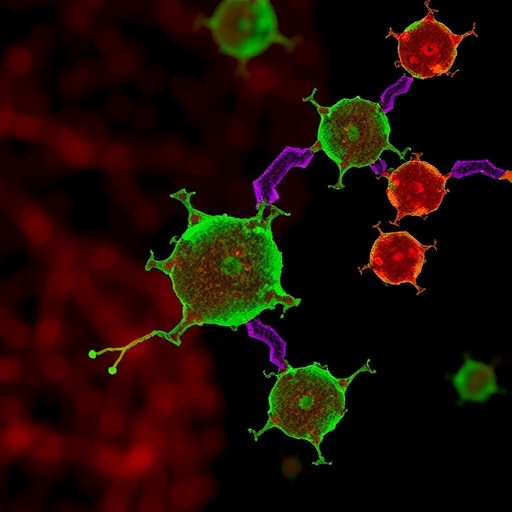
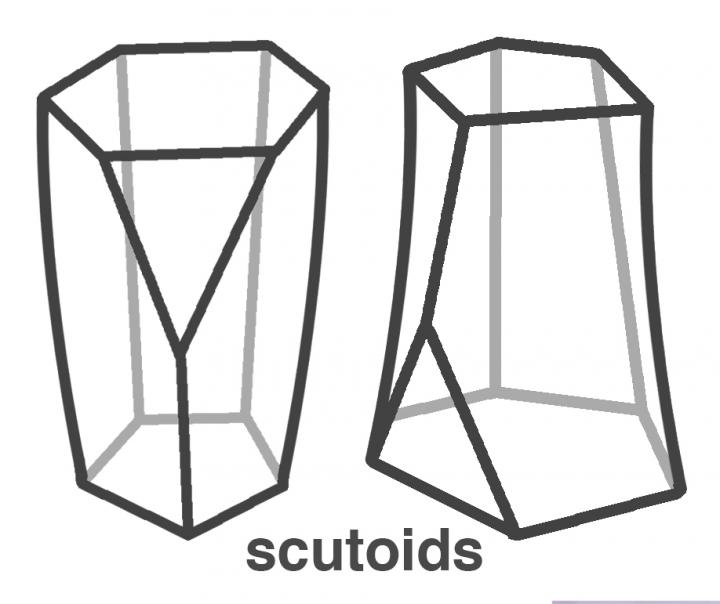
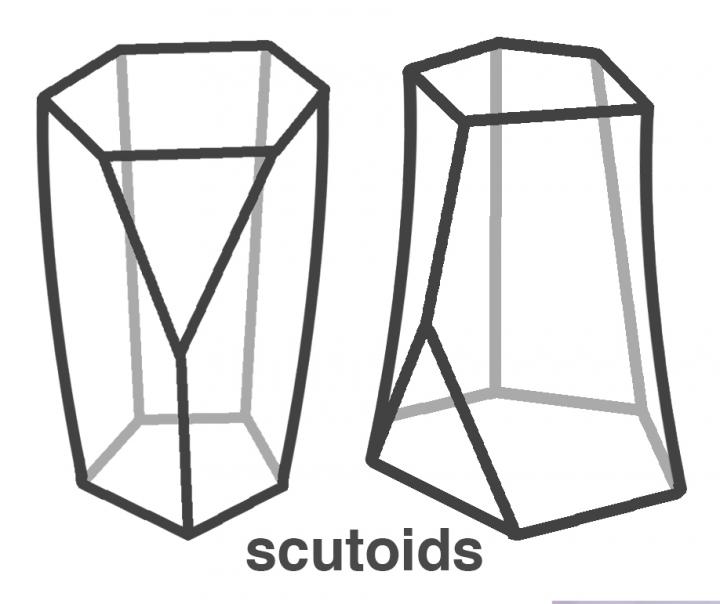
Researchers from the Department of Cellular Biology at the University of Seville and Seville Institute of Biomedicine (IBiS) have shown that epithelial cells, which are those that cover the surfaces of many organs, adopt a new, previously undescribed geometric shape, the scutoid, so that tissue can curve. This finding, which has just been published in the review Nature Communications, allows organ to acquire very complex yet very stable shapes. The experts state that these new and beautiful shapes, scutoids, are the solution that nature has found to fold and curve the epithelia.
"The epithelial cells are the "construction blocks" with which an organism is formed. They are like 'pieces of Tente or Lego from which animals are made'. The epithelia form structures with multiple functions like forming a barrier against infections or absorbing nutrients. In this way, during the development of an embryo, it changes from a simple structure formed from only a handful of cells to an animal with very complex organs. This process doesn't only occur because of the growth of the organism, but also because the epithelial cells start 'moving and joining together' to organise themselves correctly and give the organs their final shape", explains the University of Seville Biology faculty teacher Luisma Escudero.
Until now, these "blocks" were represented as being prism-shaped or being like truncated pyramids. However, upon examining epithelial curves in laboratory samples, the researchers found evidence that these real cells adopt other more complex shapes. "This is due to the fact that when tissue curves it tends to minimise energy, to be more stable, and for that reason our biophysical data indicates that what these cells do is adopt an scutoid shape", adds the researcher.
An scutoid is a solid geometric shape, like a cube or a pyramid, which had not been described until now. The epithelial cells adopt this form when the tissue curves, giving it a more stable structure. It could be said that they look like 'twisted prisms'.
From basic research to applied science
This discovery is included within basic science, at the interface between biology, mathematics and physics. However, this type of research is necessary for biomedicine. Specifically, this study opens the door to understanding how organs are formed during their development and what might be missing in some diseases in which this process is altered.
This research has been led by the Department of Cellular Biology at the Biology Faculty of the University of Seville and the Seville Institute of Biomedicine (IBiS), and the laboratory of Dr Javier Buceta from Lehigh University (USA). In addition, it benefitted from the collaboration of Alberto Márquez and Clara Grima of the 'Discrete Mathematics Research Group: Graph Theory and Computational Geometry" at the University of Seville, and experts from the Centro Andaluz de Biología del Desarrollo (Andalusian Centre for Developmental Biology).
Regarding the next step, the authors of the project state that they want "to find the molecules that cause the cells to adopt the escutoide shape. So, in the medium term, we will be able to begin to try to apply this knowledge to the creation of artificial tissue and organs in the laboratory, a great challenge for biology and biomedicine".
###
Media Contact
Luis Maria Escudero
[email protected]
34-655-772-838
@unisevilla
http://www.us.es