• HOME
  • NEWS
  • EXPLORE
    • CAREER
      • Companies
      • Jobs
    • EVENTS
    • iGEM
      • News
      • Team
    • PHOTOS
    • VIDEO
    • WIKI
  • BLOG
  • COMMUNITY
    • FACEBOOK
    • INSTAGRAM
    • TWITTER
Monday, August 31, 2026
BIOENGINEER.ORG
No Result
View All Result
  • Login
  • HOME
  • NEWS
  • EXPLORE
    • CAREER
      • Companies
      • Jobs
        • Lecturer
        • PhD Studentship
        • Postdoc
        • Research Assistant
    • EVENTS
    • iGEM
      • News
      • Team
    • PHOTOS
    • VIDEO
    • WIKI
  • BLOG
  • COMMUNITY
    • FACEBOOK
    • INSTAGRAM
    • TWITTER
  • HOME
  • NEWS
  • EXPLORE
    • CAREER
      • Companies
      • Jobs
        • Lecturer
        • PhD Studentship
        • Postdoc
        • Research Assistant
    • EVENTS
    • iGEM
      • News
      • Team
    • PHOTOS
    • VIDEO
    • WIKI
  • BLOG
  • COMMUNITY
    • FACEBOOK
    • INSTAGRAM
    • TWITTER
No Result
View All Result
Bioengineer.org
No Result
View All Result
Home NEWS Science News Health

Epilepsy research focused on astrocytes

Bioengineer by Bioengineer
January 25, 2021
in Health
Reading Time: 3 mins read
0
IMAGE
Share on FacebookShare on TwitterShare on LinkedinShare on RedditShare on Telegram

Neurobiology: Publication in the Journal of the Society for Neuroscience
IMAGE

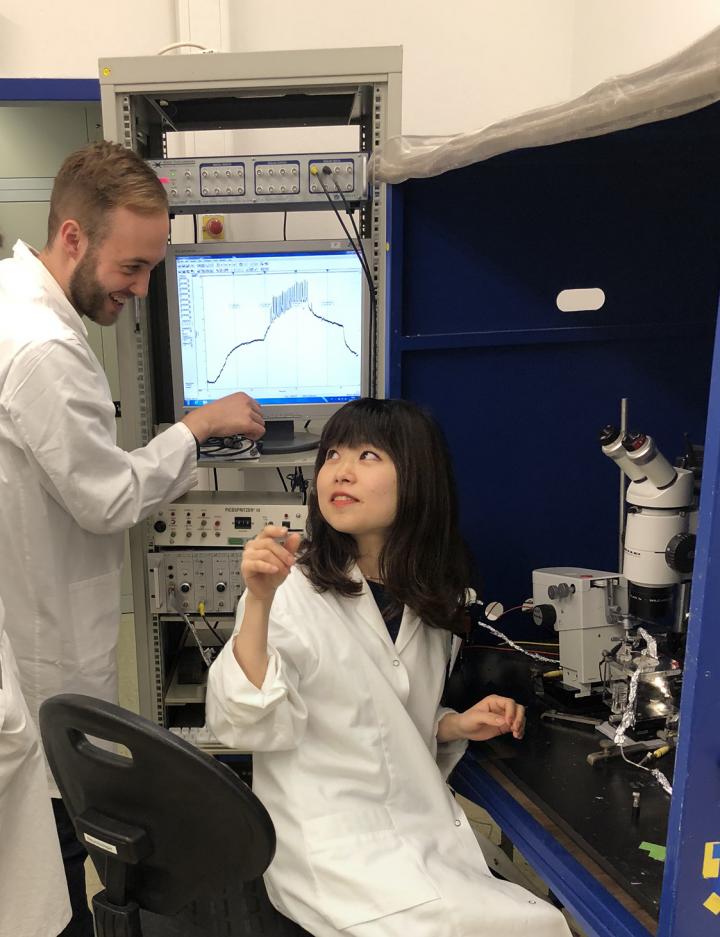
Credit: HHU / Institute of Neurobiology

During epileptic seizures, a large number of nerve cells in the brain fire excessively and in synchrony. This hyperactivity may lead to uncontrolled shaking of the body and involve periods of loss of consciousness. While about two thirds of patients respond to anti-epileptic medication, the remainder is refractory to medical treatment and shows drug-resistance. These patients are in urgent need for new therapeutic strategies.

Together with colleagues in Japan, Prof. Dr. Christine Rose and her doctoral student Jan Meyer from the Institute of Neurobiology at HHU have performed a study to address the cellular mechanisms that promote the development of epilepsy. While up to now, most studies and anti-epileptic drugs targeted nerve cells (neurons), this research team focused on a class of glial cells known as astrocytes.

Glial cells account for approximately half of all cells in the brain. There are different types of glial cells, which perform different functions. Astrocytes control the local environment and are responsible for the ion balance in the brain, but also play an important role in signal transmission between neurons.

In their recent paper, the researchers show that epileptic discharges lead to a rise in the pH of astrocytes, that is in their intracellular ‘alkalisation’. The change in pH disrupts the communication within the intercellular astrocyte networks. This reduced communication between astrocytes appears to exacerbate epileptic activity of neurons.

This finding points towards a potential new target for suppressing epileptogenesis at a very early stage, namely by using drugs to suppress changes in astrocytic pH accompanying neuronal activity.

The researchers were able to confirm this option by showing that animals which were given such drugs suffered less severely from epileptic hyperexcitability than untreated animals.

Prof. Rose said: “This observation is very intriguing. But it still needs to be established whether or not it can be transferred to humans. And it will take a very long time before any potential drug can be developed and be really used in the clinics.”

###

The research was carried out as a collaboration between the HHU and three universities in Japan (Keio University and Tokyo Medical and Dental University in Tokyo, Tohoku University in Sendai) as part of the “Young Glia” programme of the DFG-Priority Programme SPP 1757 “Functional Specialisations of Neuroglia” coordinated by Prof. Rose. This programme promotes collaboration between German and Japanese laboratories. In particular, it encourages and assists young scientists in realising their own bi-national research projects. For example, the HHU doctoral student Jan Meyer travelled to Japan, while Mariko Onodera from Tohoku University spent two periods working at the Institute of Neurobiology in Düsseldorf.

Original publication

Mariko Onodera, Jan Meyer, Kota Furukawa, Yuichi Hiraoka, Tomomi Aida, Kohichi Tanaka, Kenji F. Tanaka, Christine R. Rose, and Ko Matsui, Exacerbation of epilepsy by astrocyte alkalization and gap junction uncoupling, Journal of Neuroscience, 2021

DOI: 10.1523/JNEUROSCI.2365-20.2020

Media Contact
Dr. Arne Claussen
[email protected]

Original Source

https://www.hhu.de/en/news-article/astrozyten-im-fokus-der-epilepsieforschung

Related Journal Article

http://dx.doi.org/10.1523/JNEUROSCI.2365-20.2020

Tags: Biologyneurobiology
Share13Tweet8Share2ShareShareShare2

Related Posts

Machine Learning Model Development and Evaluation for Non-contact Lower Limb Injury Risk Prediction in Elite Male Rugby Union: A Multi-team, Multi-season Analysis

August 31, 2026

Divergent epigenetic profile underlie pubertal disorders in MKRN3-associated central precocious puberty and Prader–Willi syndrome: insights from a frameshift variant

August 31, 2026

FOMO’s Underlying Dimensions Are Differentially Related to Problematic Smartphone Use but Equally Related to Depression, Anxiety, Rumination, and Distress Tolerance

August 31, 2026

Differential expression of long non-coding RNAs can effectively distinguish monozygotic twins

August 31, 2026
Please login to join discussion

POPULAR NEWS

  • Development of a machine-learning risk stratification tool for vasoactive medication need after two-bolus fluid resuscitation in pediatric suspected sepsis

    29 shares
    Share 12 Tweet 7
  • Method for quantification of microplastic release from plastic-based materials during weathering

    29 shares
    Share 12 Tweet 7
  • Machine Learning Model Development and Evaluation for Non-contact Lower Limb Injury Risk Prediction in Elite Male Rugby Union: A Multi-team, Multi-season Analysis

    29 shares
    Share 12 Tweet 7
  • Gastrointestinal Parasitism in Cattle and Water Buffaloes in Pakistan: Prevalence and Associated Risk Factors

    29 shares
    Share 12 Tweet 7

About

BIOENGINEER.ORG

We bring you the latest biotechnology news from best research centers and universities around the world. Check our website.

Follow us

Recent News

Development of a machine-learning risk stratification tool for vasoactive medication need after two-bolus fluid resuscitation in pediatric suspected sepsis

Method for quantification of microplastic release from plastic-based materials during weathering

Machine Learning Model Development and Evaluation for Non-contact Lower Limb Injury Risk Prediction in Elite Male Rugby Union: A Multi-team, Multi-season Analysis

Subscribe to Blog via Email

Enter your email address to subscribe to this blog and receive notifications of new posts by email.

Join 85 other subscribers
  • Contact Us

Bioengineer.org © Copyright 2023 All Rights Reserved.

Welcome Back!

Login to your account below

Forgotten Password?

Retrieve your password

Please enter your username or email address to reset your password.

Log In
No Result
View All Result
  • Homepages
    • Home Page 1
    • Home Page 2
  • News
  • National
  • Business
  • Health
  • Lifestyle
  • Science

Bioengineer.org © Copyright 2023 All Rights Reserved.