• HOME
  • NEWS
  • EXPLORE
    • CAREER
      • Companies
      • Jobs
    • EVENTS
    • iGEM
      • News
      • Team
    • PHOTOS
    • VIDEO
    • WIKI
  • BLOG
  • COMMUNITY
    • FACEBOOK
    • INSTAGRAM
    • TWITTER
Thursday, May 21, 2026
BIOENGINEER.ORG
No Result
View All Result
  • Login
  • HOME
  • NEWS
  • EXPLORE
    • CAREER
      • Companies
      • Jobs
        • Lecturer
        • PhD Studentship
        • Postdoc
        • Research Assistant
    • EVENTS
    • iGEM
      • News
      • Team
    • PHOTOS
    • VIDEO
    • WIKI
  • BLOG
  • COMMUNITY
    • FACEBOOK
    • INSTAGRAM
    • TWITTER
  • HOME
  • NEWS
  • EXPLORE
    • CAREER
      • Companies
      • Jobs
        • Lecturer
        • PhD Studentship
        • Postdoc
        • Research Assistant
    • EVENTS
    • iGEM
      • News
      • Team
    • PHOTOS
    • VIDEO
    • WIKI
  • BLOG
  • COMMUNITY
    • FACEBOOK
    • INSTAGRAM
    • TWITTER
No Result
View All Result
Bioengineer.org
No Result
View All Result
Home NEWS Science News Health

Enzyme helps build motor that drives neuron death

Bioengineer by Bioengineer
August 6, 2018
in Health
Reading Time: 2 mins read
0
Share on FacebookShare on TwitterShare on LinkedinShare on RedditShare on Telegram
IMAGE

Credit: Carter Laboratory/Vanderbilt University

A biochemistry instructor curious about an enzyme discovered in the damaged neurons of people with multiple sclerosis made a leap toward a potential cure for countless neurodegenerative ills.

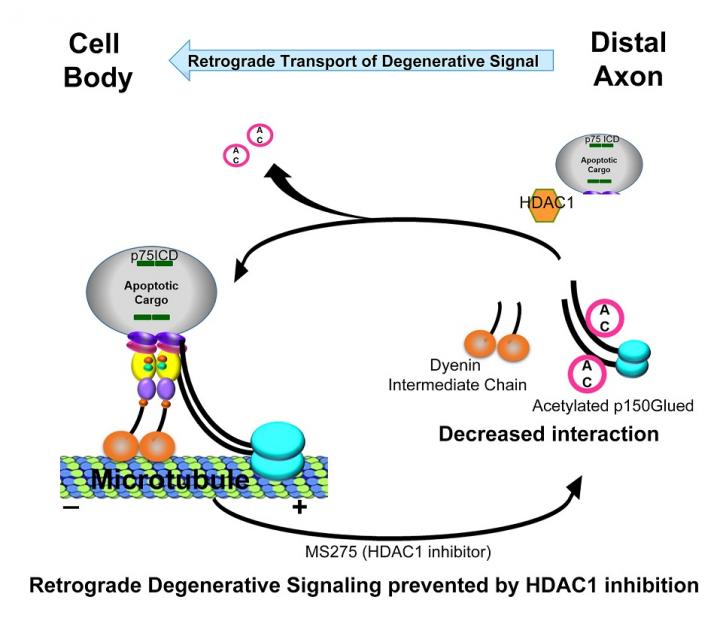
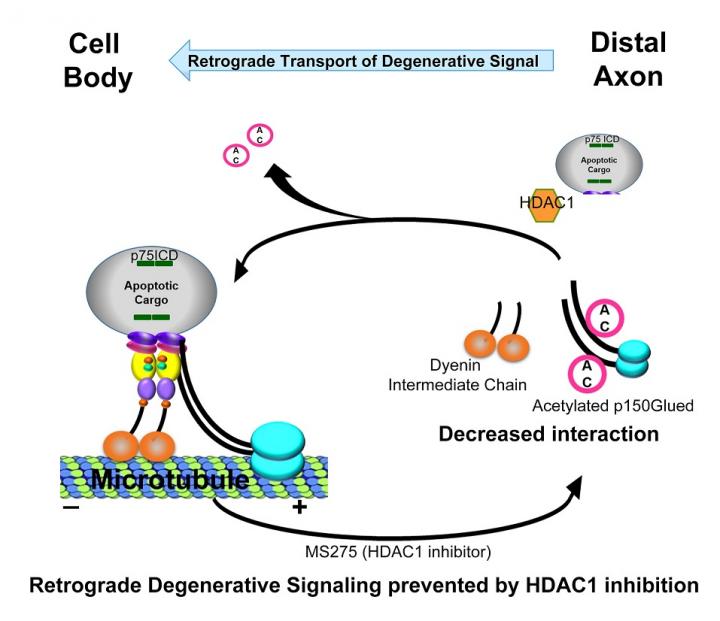
Vanderbilt University's Amrita Pathak, working with Bruce D. Carter, biochemistry professor and associate director of the Vanderbilt Brain Institute, found that the enzyme histone deacetylase 1 (HDAC1), normally in the nucleus of cells, is also present in the axons of some neurons. When a degenerative signal is activated, HDAC1 modifies a component of a molecular motor, which then drives a signaling agent down the axon to the neuron's cell body, killing it.

The motor is integral to that process, Carter said, because of the extreme length of axons in some neurons.

"Some of our neurons, if their cell bodies were the size of basketballs, their axons would reach about 6 miles," he said. "This is a new finding in terms of how the motor can be assembled and allow transport back to the cell body. There has been evidence of a retrograde degenerative signal, and now we've identified key components and a mechanism controlling their transport."

Their paper, "Retrograde degenerative signaling mediated by the p75 neurotrophin receptor requires p150glued deacetylation by axonal HDAC1," appears online today in the journal Developmental Cell.

The biochemistry team worked with Deyu Li, professor of mechanical engineering, to build microfluidic devices that separate the axon from the cell body, allowing them to determine which part of the degenerative signaling process was happening where.

The Carter laboratory has long studied that signaling agent, the neurotrophin receptor p75(NTR), and the role it plays in development and diseases of the brain. It's implicated in Alzheimer's disease, amyotrophic lateral sclerosis, traumatic brain injury, ischemia, hormone deficiency and other diseases or injuries to the nervous system.

Their research builds on the work of Vanderbilt University biochemist Stanley Cohen, who in 1986 shared the Nobel Prize for Physiology or Medicine for the discovery of nerve growth factor, the founding member of the neurotrophin family, and its effect on cells, Carter said.

Pathak, who used sympathetic neurons for her research, intends to find whether similar cellular processes are happening in motor neurons known to be affected in ALS. "If we can block that, we can block the neuron death that occurs," she said.

###

Media Contact

Heidi Nieland Hall
[email protected]
615-322-6614
@vanderbiltu

http://news.vanderbilt.edu/research/

Related Journal Article

http://dx.doi.org/10.1016/j.devcel.2018.07.001

Share16Tweet7Share2ShareShareShare1

Related Posts

Nonlinear Atomic Tunneling Enhanced by Bright Squeezed Vacuum

May 21, 2026

Genetic Insights from 619,372 Metabolic Profiles

May 21, 2026

Bacterial STIs Hit Record Levels in Europe as Congenital Syphilis Cases Nearly Double

May 21, 2026

Oral Semaglutide Lowers Cardiometabolic Risks in Obesity

May 21, 2026
Please login to join discussion

POPULAR NEWS

  • blank

    New Study Reveals Plants Can Detect the Sound of Rain

    733 shares
    Share 292 Tweet 183
  • ESMO 2025: mRNA COVID Vaccines Enhance Efficacy of Cancer Immunotherapy

    304 shares
    Share 122 Tweet 76
  • Research Indicates Potential Connection Between Prenatal Medication Exposure and Elevated Autism Risk

    846 shares
    Share 338 Tweet 212
  • Breastmilk Balances E. coli and Beneficial Bacteria in Infant Gut Microbiomes

    58 shares
    Share 23 Tweet 15

About

We bring you the latest biotechnology news from best research centers and universities around the world. Check our website.

Follow us

Recent News

Innovative Reusable Brick Walls Revolutionize Construction Industry

Nonlinear Atomic Tunneling Enhanced by Bright Squeezed Vacuum

Label-Free Super-Resolution Imaging of Live Cells

Subscribe to Blog via Email

Enter your email address to subscribe to this blog and receive notifications of new posts by email.

Join 82 other subscribers
  • Contact Us

Bioengineer.org © Copyright 2023 All Rights Reserved.

Welcome Back!

Login to your account below

Forgotten Password?

Retrieve your password

Please enter your username or email address to reset your password.

Log In
No Result
View All Result
  • Homepages
    • Home Page 1
    • Home Page 2
  • News
  • National
  • Business
  • Health
  • Lifestyle
  • Science

Bioengineer.org © Copyright 2023 All Rights Reserved.