Researchers can accurately track where typhoid fever cases are highest by monitoring environmental samples for viruses called bacteriophages that specifically infect the bacterium that causes typhoid fever. Senjuti Saha of the Child Health Research Foundation in Bangladesh and colleagues report these findings in a new study published February 15 in the open access journal PLOS Neglected Tropical Diseases.
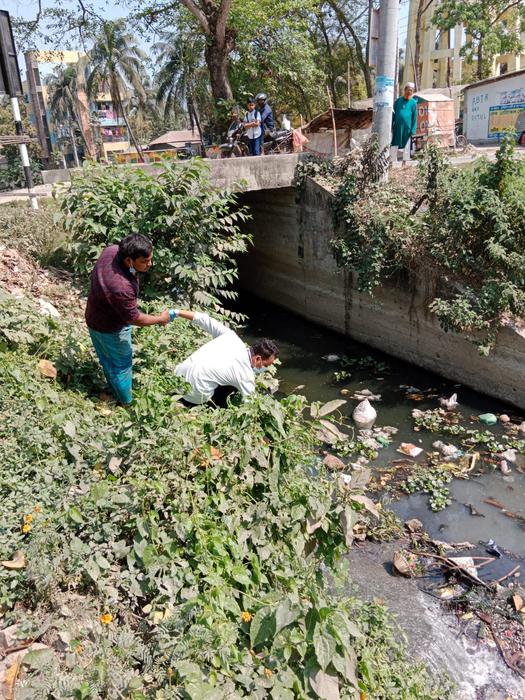
Credit: Hooda et al, CC-BY 4.0, https://creativecommons.org/licenses/by/4.0/)
Researchers can accurately track where typhoid fever cases are highest by monitoring environmental samples for viruses called bacteriophages that specifically infect the bacterium that causes typhoid fever. Senjuti Saha of the Child Health Research Foundation in Bangladesh and colleagues report these findings in a new study published February 15 in the open access journal PLOS Neglected Tropical Diseases.
Typhoid fever is a common infection in many low- and middle-income countries and causes an estimated 135,000 deaths and 14 million infections globally each year. The World Health Organization has prequalified two typhoid vaccines, but for policymakers to plan effective vaccination strategies, they need accurate, high-resolution estimates of where the burden is highest.
Traditionally, people have cultured the bacterium that causes typhoid fever from blood samples to determine where the infection is most common, but in the new paper, researchers tried a more cost-effective surveillance approach. They tested environmental water samples from sewage and other locations to detect bacteriophages specific to the water-borne pathogen that causes typhoid fever, Salmonella Typhi.
The team tested 303 water samples from two locations in Bangladesh: the urban capital city, Dhaka, and a rural district, Mirzapur. They found that bacteriophages specific for Salmonella Typhi were present in 31% of environmental samples in Dhaka, compared to just 3% of samples from Mirzapur. This corresponds to results from more than 8,400 blood cultures, in which 5% of cultures from Dhaka and 0.05% from Mirzapur tested positive.
The new results suggest that detecting bacteriophages specific for Salmonella Typhi may be a rapid environmental surveillance method that could help decision makers understand the presence of typhoid fever in the community. The researchers propose that environment monitoring of bacteriophage could be a simple, cost-effective and scalable tool to assist policy decisions on typhoid control.
The authors add: “”Looking for bacteriophages in wastewater is a low-cost method for identifying typhoid hotspots without doing expensive blood cultures on thousands of people.”
############
In your coverage, please use this URL to provide access to the freely available article in PLOS Neglected Tropical Diseases:
http://journals.plos.org/plosntds/article?id=10.1371/journal.pntd.0011822
Citation: Hooda Y, Islam S, Kabiraj R, Rahman H, Sarkar H, da Silva KE, et al. (2024) Old tools, new applications: Use of environmental bacteriophages for typhoid surveillance and evaluating vaccine impact. PLoS Negl Trop Dis 18(2): e0011822. https://doi.org/10.1371/journal.pntd.0011822
Author Countries: Bangladesh, USA
Funding: The present study was the funded by a grant from the Bill and Melinda Gates Foundation (INV003717) to SS. The funders had no role in study design, data collection and analysis, decision to publish, or preparation of the manuscript.
Journal
PLoS Neglected Tropical Diseases
DOI
10.1371/journal.pntd.0011822
Method of Research
Observational study
Subject of Research
People
Article Title
Old tools, new applications: Use of environmental bacteriophages for typhoid surveillance and evaluating vaccine impact
Article Publication Date
15-Feb-2024
COI Statement
Competing Interests: The authors have declared that no competing interests exist.