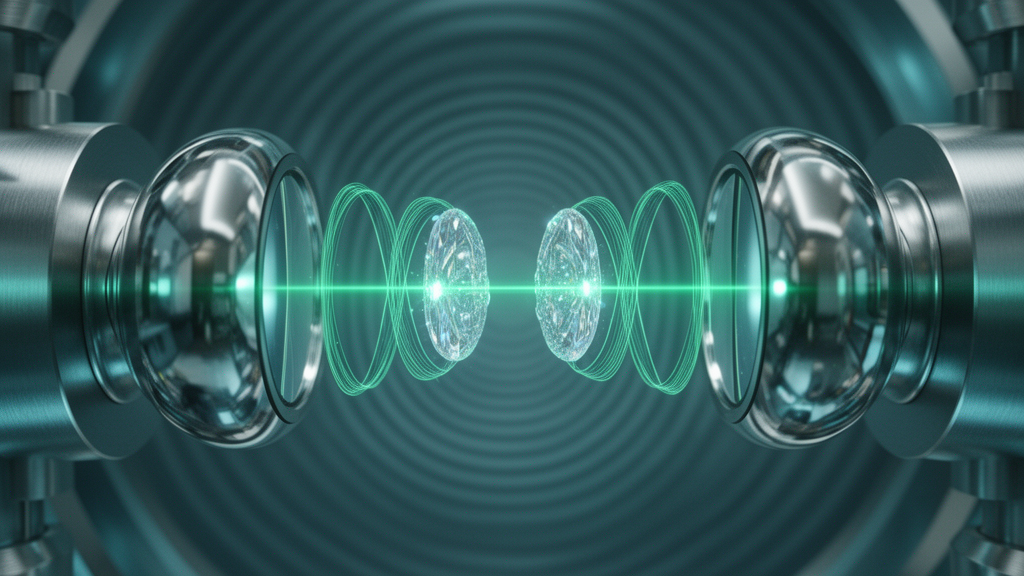
Theoretical physicists have demonstrated that environmental noise possessing temporal memory can actively protect and revive quantum entanglement between two qubits in an optical resonator, challenging the long-standing assumption that environmental fluctuations inevitably degrade fragile quantum resources. In a study published in Quantum Information Processing, researchers Fang Wang, Quanzhen Ding, Jun Jing, and Ting Yu analytically resolved the entanglement dynamics of a two-qubit Jaynes–Cummings system subjected to stochastic coupling fluctuations. By comparing memoryless white noise against memory-bearing Ornstein–Uhlenbeck noise, the investigation revealed that non-Markovian environmental correlations allow information that has leaked into the surrounding reservoir to flow back into the qubits, generating robust revivals of quantum coherence. This finding demonstrates that stochastic environments are not merely passive sinks of quantum information, but can instead be strategically harnessed through reservoir engineering to sustain bipartite correlations. The exact analytical solutions encompass both discrete Fock states and continuous coherent field distributions, identifying clear boundaries where quantum entanglement is either shielded indefinitely, periodically restored, or permanently extinguished.
The foundational Jaynes–Cummings framework, originally formulated in 1963 to describe the fundamental quantum interaction between a two-level atom and a quantized electromagnetic field mode, serves as the cornerstone for cavity quantum electrodynamics and circuit quantum electrodynamics platforms. In conventional quantum optical formulations, the coupling strength between matter qubits and the cavity radiation field is treated as a static constant, while environmental noise is routinely modeled as a memoryless Markovian bath inducing monotonic decoherence. In realistic experimental architectures, however, the coupling parameter naturally experiences continuous physical fluctuations due to mechanical cavity vibrations, thermal expansion of reflective mirrors, pump laser amplitude and phase instabilities, and spatial variations arising from atomic motion. To capture these pervasive physical effects, the researchers analyzed an interaction Hamiltonian wherein two identical qubits resonantly couple to a single cavity mode through a time-dependent coupling strength composed of a constant baseline interaction and a fluctuating classical noise term. This classical stochastic treatment rigorously reflects macroscopic experimental disturbances where thermal or mechanical noise sources exhibit significant occupation numbers.
To systematically explore how noise statistics govern entanglement preservation, the research team derived exact closed-form expressions for two-qubit concurrence without relying on approximate numerical sampling or Monte Carlo simulations. The stochastic coupling term was modeled as an Ornstein–Uhlenbeck process, which is characterized by a vanishing ensemble mean, an intrinsic decay rate, and a characteristic memory time parameter governing exponential temporal correlations. When the memory parameter approaches infinity, this stationary Gauss–Markov formulation smoothly converges to the standard white noise limit, representing completely uncorrelated Markovian dynamics. The researchers evaluated the accumulated phase across time as a Gaussian random variable whose statistical variance accounts for both continuous linear diffusion and exponential relaxation. Using fundamental Gaussian moment identities, the authors analytically integrated the noise-averaged density matrix elements into a unified decoherence parameter. This mathematical formulation encapsulates both coherent Rabi oscillations and exponential damping within a single transparent expression, providing a direct analytical pathway to map bipartite entanglement trajectories across previously inaccessible parameter spaces spanning weak and strong coupling regimes.
The authors established a concrete microscopic mechanism grounding these stochastic coupling fluctuations in physical experimental parameters by analyzing geometric perturbations within a standard Fabry–Perot optical cavity. For a resonant cavity of fixed nominal length, standing-wave boundary conditions dictate that small fractional displacements in cavity geometry produce proportional fractional shifts in the resonant mode frequency. Because the vacuum Rabi coupling strength scales inversely with the square root of the effective mode volume, small geometric length fluctuations induce matching fractional variations in the qubit-cavity coupling strength. When cavity length fluctuations arise from ambient thermal expansion, the relative variations in both transition frequency and coupling parameter scale linearly with the thermal expansion coefficient and temperature fluctuations. If these dimensional variations follow an Ornstein–Uhlenbeck process driven by mechanical vibrations or filtered acoustic noise, the interaction parameters directly inherit non-Markovian statistics with finite correlation times. This physical correspondence confirms that the mathematical stochastic Jaynes–Cummings model reflects concrete physical disturbances commonly encountered in superconducting circuit resonators and microcavity setups.
Analyzing the system when the optical cavity is initialized in a pure Fock number state revealed a striking asymmetry in entanglement evolution that depends strictly on the initial quantum configuration of the two qubits. When the qubit pair was initialized in the single-excitation subspace, the analytical concurrence showed that quantum correlations are exceptionally sensitive to the initial state orientation. Most prominently, the authors discovered that preparing the qubits in an antisymmetric Bell state generates a complete dark state of the interaction Hamiltonian. Because the raising and lowering operators of the two qubits act with opposing signs on this antisymmetric superposition, their collective coupling to the cavity radiation field cancels out identically at every instant. Consequently, the quantum state remains entirely unaffected by coupling fluctuations, locking Wootters’ concurrence at absolute unity for all time without experiencing any decoherence. For other single-excitation orientations, the entanglement exhibited coherent oscillations whose frequency scaled directly with the photon number and baseline coupling strength.
In stark contrast to the robust protection observed in the single-excitation manifold, initially entangled qubits prepared in the double-excitation subspace demonstrated inevitable, irreversible decoherence across all parameter ranges. Because the double-excitation configuration simultaneously populates states separated by two photon quanta, the global dynamics partition into independent Hilbert space sectors without any shared dark-state symmetry. Evaluating the asymptotic long-time concurrence demonstrated that the net entanglement change equals the negative absolute value of the sine of twice the initial state angle. For maximally entangled Bell states prepared in this manifold, the long-time concurrence decayed completely to zero, representing a total loss of quantum entanglement. The authors attributed this unavoidable degradation to cumulative dephasing induced by cavity interactions, destructive time-averaging over asynchronous Rabi oscillations, and progressive population accumulation within intermediate single-excitation states. This definitive contrast demonstrates that environmental decoherence cannot be mitigated solely through external dynamical controls, establishing that initial state geometry plays an indispensable role in safeguarding quantum correlations against noise.
When extending their analytical treatment to optical cavities prepared in continuous coherent states, the authors uncovered complex dynamical behaviors governed by the interplay between coherent field amplitude and noise correlation times. The reduced density matrix of the two-qubit system was obtained by tracing out the cavity field across the full Poissonian distribution of photon number states. Under memoryless Markovian white noise, the two-qubit concurrence exhibited rapid, irreversible decay across all coherent amplitudes, offering no opportunity for correlation recovery. However, when the system was subjected to strong Ornstein–Uhlenbeck noise characterized by extended correlation times, the entanglement dynamics mirrored the behavior of an idealized noise-free cavity. Pronounced revival peaks reappeared in the concurrence trajectories, proving that finite environmental memory allows quantum information temporarily transferred to the resonator to return coherently to the qubit pair. This memory-assisted recovery directly confirms that the spectral structure and temporal duration of environmental fluctuations, rather than absolute noise amplitude, dictate the ultimate survival of bipartite quantum correlations.
A central breakthrough of the study is the identification of distinct operating regimes and a sharp critical photon-number threshold within intermediate coherent state amplitudes. In the low-amplitude regime where the coherent parameter remains below unity, the cavity field is heavily dominated by vacuum and single-photon components, allowing near-perfect entanglement generation and extended correlation lifetimes under minimal noise. As the coherent amplitude enters the intermediate regime, the dynamics undergo a pronounced qualitative transition from low-frequency to high-frequency entanglement oscillations, creating an optimal operational window where non-Markovian noise produces maximal entanglement revivals. The researchers established that this intermediate domain provides concrete design parameters for quantum communication and information processing protocols, as engineered non-Markovian reservoirs can actively restore lost coherence. Conversely, Markovian white noise conditions within this same intermediate amplitude regime produced strictly monotonic decay without any revival signatures, establishing that information backflow is an exclusively non-Markovian physical phenomenon enabled by finite reservoir correlation times.
At high coherent amplitudes exceeding four units, corresponding to average photon numbers greater than sixteen, the researchers demonstrated that universal entanglement sudden death occurs irrespective of the noise model or correlation time. This complete collapse of quantum correlations stems from two complementary physical mechanisms governing macroscopic cavity fields. Dynamically, a large coherent state comprises a broad statistical distribution of discrete Fock components, each driving qubit transitions at an incommensurate effective Rabi frequency proportional to the square root of the excitation number. When averaged across stochastic noise realizations, these mutually out-of-phase frequency components interfere destructively, washing out off-diagonal density matrix elements and extinguishing concurrence. Physically, this behavior marks the classical correspondence limit, where the broadening photon-number variance acts as inhomogeneous spectral broadening that suppresses quantum coherence. Furthermore, evaluating the asymptotic entanglement of double-excitation states revealed a monotonic decline from approximately 0.583 in the vacuum limit down to near-zero for coherent amplitudes above 1.5, with total entanglement extinction occurring at amplitudes of two and above.
The findings establish cavity photon statistics and reservoir memory times as foundational control parameters for engineering robust quantum information platforms in cavity and circuit quantum electrodynamics architectures. While the theoretical model assumes an idealized lossless resonator, the authors noted that practical experimental implementations must contend with photon leakage through cavity mirrors. In experimental regimes where the cavity decay rate remains substantially smaller than the baseline coupling strength, stochastic coupling fluctuations dominate the decoherence dynamics, ensuring that the derived analytical formulas provide rigorous operational bounds on entanglement lifetimes. In the bad-cavity limit where photon dissipation matches coupling rates, cavity loss would inevitably suppress revival mechanisms. The researchers identified superconducting circuit quantum electrodynamics as an ideal experimental testbed for verifying these predictions, because coupling strengths and noise correlation times can be tuned independently in on-chip microwave circuits. By providing closed-form analytical criteria, this work offers concrete guidelines for optimizing quantum registers, error-mitigated quantum teleportation channels, and noise-resilient photonic networks.
Subject of Research: Quantum entanglement preservation under non-Markovian stochastic coupling in Jaynes–Cummings cavity electrodynamics
Article Title: Noise-assisted quantum entanglement: memory-enhanced coherence in stochastic Jaynes–Cummings dynamics
Article References: Wang, F., Ding, Q., Jing, J., & Yu, T. (2026). Noise-assisted quantum entanglement: memory-enhanced coherence in stochastic Jaynes–Cummings dynamics. Quantum Information Processing, 25(11), Article 368. https://doi.org/10.1007/s11128-026-05403-x
Image Credits: AI Generated
DOI: 10.1007/s11128-026-05403-x
Keywords: Jaynes-Cummings model, quantum entanglement, non-Markovian noise, Ornstein-Uhlenbeck process, concurrence, decoherence-free subspaces, cavity quantum electrodynamics, circuit QED, stochastic coupling, two-qubit dynamics, Fock states, coherent states, entanglement sudden death, quantum coherence revival, information backflow, Bell states, resonant cavities
News Source: Denise Maddox. (November 12, 2026). Environmental Memory Revives Two-Qubit Entanglement in Stochastic Optical Cavity Dynamics. Scienmag.