• HOME
  • NEWS
  • EXPLORE
    • CAREER
      • Companies
      • Jobs
    • EVENTS
    • iGEM
      • News
      • Team
    • PHOTOS
    • VIDEO
    • WIKI
  • BLOG
  • COMMUNITY
    • FACEBOOK
    • INSTAGRAM
    • TWITTER
Friday, March 27, 2026
BIOENGINEER.ORG
No Result
View All Result
  • Login
  • HOME
  • NEWS
  • EXPLORE
    • CAREER
      • Companies
      • Jobs
        • Lecturer
        • PhD Studentship
        • Postdoc
        • Research Assistant
    • EVENTS
    • iGEM
      • News
      • Team
    • PHOTOS
    • VIDEO
    • WIKI
  • BLOG
  • COMMUNITY
    • FACEBOOK
    • INSTAGRAM
    • TWITTER
  • HOME
  • NEWS
  • EXPLORE
    • CAREER
      • Companies
      • Jobs
        • Lecturer
        • PhD Studentship
        • Postdoc
        • Research Assistant
    • EVENTS
    • iGEM
      • News
      • Team
    • PHOTOS
    • VIDEO
    • WIKI
  • BLOG
  • COMMUNITY
    • FACEBOOK
    • INSTAGRAM
    • TWITTER
No Result
View All Result
Bioengineer.org
No Result
View All Result
Home NEWS Science News Biology

Ensuring a proper body plan

Bioengineer by Bioengineer
December 16, 2020
in Biology
Reading Time: 2 mins read
0
IMAGE
Share on FacebookShare on TwitterShare on LinkedinShare on RedditShare on Telegram

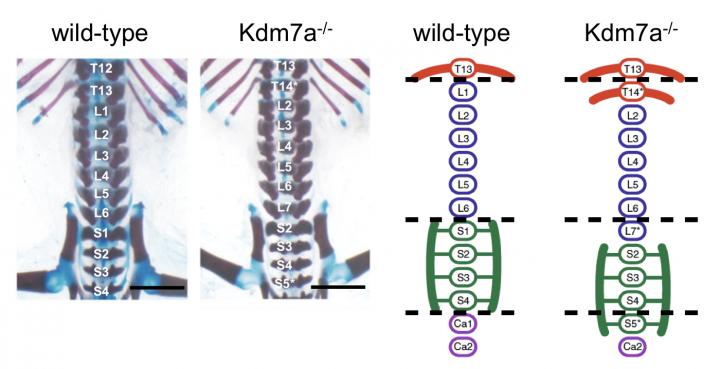
Researchers from the University of Tsukuba have shown that the enzyme lysine demethylase 7a helps ensure the ordered axial development of the mouse embryo by modulating Hox genes that specify positional characteristics along the head-to-tail axis
IMAGE

Credit: University of Tsukuba

Tsukuba, Japan – The body plan of an organism, crafted over millennia of evolutionary trial and error, is so exquisitely fine-tuned that even a subtle deviation can be detrimental to individual survival and reproductive success. Now, researchers at the University of Tsukuba have elucidated the workings of an enzyme, lysine demethylase 7a (kdm7a), that facilitates appropriate development of the mouse embryo from tip to tail, ‘according to plan’ by modulating expression of Hox genes. As these genes, master regulators of embryonal morphogenesis, have been highly conserved over evolution, the findings apply in varying degree to lower species and to all vertebrates, us included.

It is an astounding fact that the unicellular zygote formed at fertilization contains all the information needed for development into a multicellular organism of immense complexity organized in well-ordered symmetry. How these data are encrypted and decoded is an escalating mystery as emerging answers only unearth further questions. Hox genes allocate regions along the head-tail axis of the developing embryo for development of appropriate structures; in vertebrates they specify the numbers and sequential shapes of the spinal bones.

Some histone-modifying enzymes have been implicated in normal morphogenesis as well as in disease. Using CRISPR-Cas9 gene editing technology, the research team first developed knockout mice (Kdm7a?/?) by introducing frameshift mutation. As a result, they obtained mice carrying the mutations for truncated Kdm7a proteins lacking demethylase activity.

The researchers analyzed postnatal skeletal preparations of both wild-type and Kdm7a-/-mice. Dr Yasuharu Kanki, senior author, describes the findings. “As expected, all wild-type mice showed a normal axial skeleton. Interestingly, all Kdm7a?/? mice and some heterozygous mutants exhibited vertebral transformation; some vertebrae assumed the characteristics and appendages of their anterior neighbors.”

The researchers next used RNA sequencing to examine the expression of Hox genes during embryogenesis. Their findings support a functional role of Kdm7a-mediated transcriptional control, especially of the posteriorly situated Hox genes, and suggest that regulation of the repressive histone mark H3K9me2 might be involved.

“Our data help explain morphogenesis along the anterior/posterior axis in the mouse embryo and, by extension, in all vertebrates including humans,” says Dr Kanki. “Deciphering the interplay of various genetic and epigenetic determinants of embryonal morphogenesis as well as the underlying molecular mechanisms increases our knowledge of evolutionary developmental biology and may help in the understanding of disease.”

###

The article, “Lysine demethylase 7a regulates murine anteriorposterior development by modulating the transcription of Hox gene cluster” was published in Communications Biology at DOI:
https://doi.org/10.1038/s42003-020-01456-5.

Media Contact
Naoko Yamashina
[email protected]

Related Journal Article

http://dx.doi.org/10.1038/s42003-020-01456-5

Tags: BiologyBiotechnologyCell BiologyDevelopmental/Reproductive BiologyEvolutionGeneticsMolecular Biology
Share12Tweet8Share2ShareShareShare2

Related Posts

How to sway group opinions: Encourage opponents to stay undecided

How to sway group opinions: Encourage opponents to stay undecided

March 23, 2026
Deep Learning Model Maps How Individual Cells Shape Disease Outcomes

Deep Learning Model Maps How Individual Cells Shape Disease Outcomes

March 20, 2026

Removing only 15 female sharks annually could endanger the entire population, scientists warn

March 20, 2026

Scientists Urge Fragrance Industry to Transition from Sustainability Talk to Active Funding of Plant Conservation

March 20, 2026
Please login to join discussion

POPULAR NEWS

  • blank

    Revolutionary AI Model Enhances Precision in Detecting Food Contamination

    96 shares
    Share 38 Tweet 24
  • Imagine a Social Media Feed That Challenges Your Views Instead of Reinforcing Them

    1003 shares
    Share 397 Tweet 248
  • Uncovering Functions of Cavernous Malformation Proteins in Organoids

    54 shares
    Share 22 Tweet 14
  • Promising Outcomes from First Clinical Trials of Gene Regulation in Epilepsy

    51 shares
    Share 20 Tweet 13

About

We bring you the latest biotechnology news from best research centers and universities around the world. Check our website.

Follow us

Recent News

In-Sensor Cryptography Links Physical Process to Digital Identity

Can Psychosocial Factors Influence Cancer Risk?

Depression Factors in Elderly: Pre vs. Post-COVID Analysis

Subscribe to Blog via Email

Success! An email was just sent to confirm your subscription. Please find the email now and click 'Confirm' to start subscribing.

Join 78 other subscribers
  • Contact Us

Bioengineer.org © Copyright 2023 All Rights Reserved.

Welcome Back!

Login to your account below

Forgotten Password?

Retrieve your password

Please enter your username or email address to reset your password.

Log In
No Result
View All Result
  • Homepages
    • Home Page 1
    • Home Page 2
  • News
  • National
  • Business
  • Health
  • Lifestyle
  • Science

Bioengineer.org © Copyright 2023 All Rights Reserved.