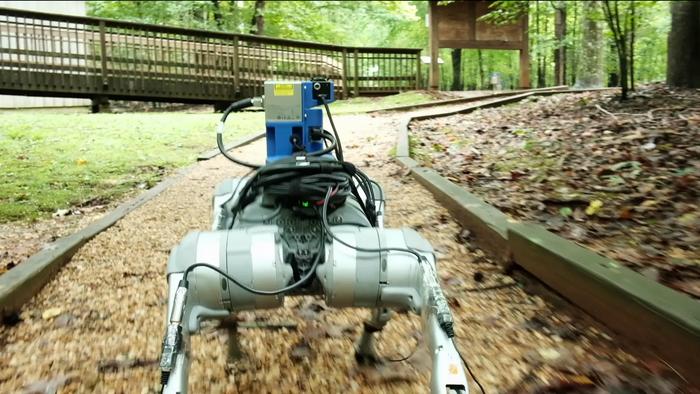

Researchers at Duke University have taken significant strides towards developing a groundbreaking framework known as WildFusion, designed to enhance the sensory perception of four-legged robots as they navigate complex and unpredictable terrains. Unlike traditional robotic navigation systems that primarily rely on visual data from cameras or LiDAR sensors, WildFusion integrates multiple sensory modalities—sight, touch, sound, and balance—mirroring how humans perceive and interact with their environment. This multimodal approach represents a transformative leap in the field of robotics, particularly for applications in disaster response, outdoor exploration, and autonomous navigation.
Robotic systems, traditionally confined to visual interpretation of their surroundings, have struggled with the challenges posed by environments laden with obstacles like dense forests, uneven ground, and unpredictable landscapes. These environments present a myriad of challenges, as they often lack clear paths or predictable landmarks. The human brain deftly utilizes a combination of senses to navigate such spaces, relying on cues from sight, sound, touch, and balance to assess safety and stability. WildFusion aims to confer similar capabilities to robots, allowing them to sense and adapt to their environments in real-time.
At the core of WildFusion is its sophisticated integration of various sensors. Using a quadrupedal robot as the test bed, the framework employs RGB cameras and LiDAR to gather essential information about the environment’s geometry and colors. However, what sets WildFusion apart is its incorporation of acoustic microphones and tactile sensors, which capture vibrations and touch stimuli as the robot traverses different surfaces. This rich blend of sensory data enhances the robot’s understanding of its surroundings, enabling it to make more informed decisions.
The process begins with contact microphones affixed to the robot’s limbs, which register the distinct vibrations produced by each step. For instance, the crunch of dry leaves differs from the soft squelch of mud, and these subtle vibrational variances provide critical information about the terrain beneath the robot. Complementing this, tactile sensors gauge the force exerted through each foot, enabling the robot to assess stability or slipperiness—vital information for navigating challenging conditions.
In constructing a holistic understanding of its environment, WildFusion harnesses an advanced deep learning model rooted in implicit neural representations. This innovative approach eschews traditional point-based environmental mappings and utilizes a continuous model of the surroundings, allowing the robot to conceptualize complex surfaces and features. This capability empowers the robot to fill in gaps when its visual data is incomplete or ambiguous, mimicking human cognitive processes in navigating challenging terrains.
The effectiveness of WildFusion has been validated through extensive testing in natural settings, notably at Eno River State Park in North Carolina. Observations from these trials demonstrated the robot’s newfound ability to navigate intricate environments like dense forests and uneven gravel paths confidently. The integration of diverse sensory inputs significantly enhanced the robot’s decision-making capabilities regarding the safest and most stable paths.
Future developments promise to widen the scope of WildFusion. The research team aims to integrate additional sensor modalities such as thermal or humidity sensors, which will further enhance the robot’s environmental awareness. By fostering a flexible modular design, WildFusion offers numerous potential applications, ranging from emergency disaster responses to the decommissioning of remote infrastructure and investigative exploration of uncharted landscapes.
In addition to its technical innovations, WildFusion addresses one of the robotics community’s critical challenges today: ensuring that robots perform reliably not just in controlled lab settings but across unpredictable real-world landscapes. The ability for robots to adapt their tactics and continue functioning amid chaotic conditions represents a monumental step toward a future in which robotic systems can support human activity in various environmental scenarios.
Ultimately, WildFusion emerges as a compelling paradigm shift in robotic navigation. This multifaceted sensory framework is poised to revolutionize how robots interact with their environments, empowering them to move confidently and intelligently through the complexities of our world.
Subject of Research:
Article Title: WildFusion: Multimodal Implicit3DReconstructions in the Wild
News Publication Date: 19-May-2025
Web References:
References:
Image Credits: Boyuan Chen, Duke University
Keywords:
Tags: advanced sensory systems for robotsautonomous navigation systems developmentchallenges in robotic navigationdisaster response robotics advancementsDuke University robotics researchfour-legged robot perception enhancementhuman-like perception in machinesmultimodal sensory integration in roboticsoutdoor exploration roboticsovercoming obstacles in robotic movementreal-time environmental adaptation for robotsrobot navigation technology