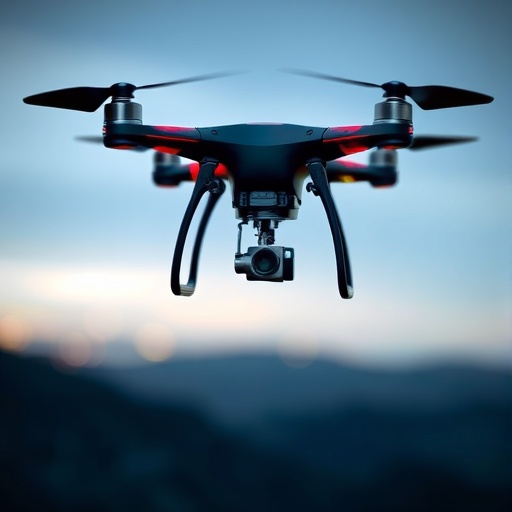
In an era where drones are increasingly becoming integral to various sectors including logistics, agriculture, and search and rescue, the development of safe and reliable teleoperation systems for unmanned aerial vehicles (UAVs) is of utmost importance. Researchers are tirelessly working to enhance the capabilities of quadrotor UAVs, particularly in the realm of teleoperation, which allows human operators to control a drone from a distance. A recent study led by Zhang and Tron explores the intriguing concept of haptic shared autonomy, a method designed to augment the operator’s control while ensuring safety and stability during teleoperation.
The study is pivotal in understanding how to balance human and machine collaboration while flying UAVs over potentially hazardous terrains. Haptic technology, which provides feedback from the machine to the operator’s senses, is at the heart of their approach. This interaction not only empowers operators but also helps mitigate the risks associated with remote piloting, particularly when quick reflexes and correct decision-making are critical.
In many scenarios, teleoperating a UAV can be fraught with challenges. Operators must navigate the drone through unknown environments, often facing unexpected obstacles or malfunctions. This becomes especially crucial in rescue operations, where every second counts. By implementing haptic shared autonomy, Zhang and Tron aim to create a system that enhances situational awareness while maintaining stringent safety protocols. The feedback provided by the haptic interface may alert operators to urgent changes in the drone’s environment, thereby facilitating informed decision-making even under stress.
Furthermore, the haptic feedback system serves a dual purpose—it not only assists in controlling the UAV but also reinforces the operator’s understanding of the drone’s status. By receiving tactile responses to the drone’s movements, operators can better predict its behavior and make timely adjustments. This aspect of the research could revolutionize how users interact with UAVs by providing a more intuitive flying experience. The blend of human touch and machine efficiency signifies a leap forward in the field of robotics, where the synergy between the two can lead to superior performance in dynamic environments.
The experiments conducted in this study involved a series of simulations and real-world tests to evaluate the safety and efficiency of the proposed teleoperation system. The authors meticulously crafted various scenarios where the quadrotor faced challenging conditions, such as rapidly changing weather patterns or sudden obstacles. The results indicated that the haptic shared autonomy significantly improved the operators’ performance, allowing them to maintain control over the UAV with heightened precision.
Moreover, the research highlights the importance of user-centered design in developing teleoperation systems. By focusing on the operator’s experience, Zhang and Tron emphasize the necessity of creating interfaces that are not only functional but also enhance the user’s ability to control the UAV effectively. This consideration is crucial as the effectiveness of a teleoperation system is often determined by how intuitively the operator can interact with the drone.
The implications of this technology extend beyond military applications; industries such as agriculture, environmental monitoring, and disaster response stand to gain immensely. The ability to control a drone in environments that would otherwise be unsafe for human operatives opens new avenues for exploration and data collection. For instance, in agricultural assessments, UAVs can traverse fields to monitor crop health, while haptic feedback could enable farmers to adjust operations in real-time based on environmental conditions.
An essential aspect of Zhang and Tron’s research is the potential for integration with autonomous systems. While full autonomy is the long-term goal for UAV technology, there are scenarios where human oversight is necessary. The concept of haptic shared autonomy allows for a smooth transition between manual control and automated systems, thereby maximizing efficiency while minimizing risks. As such, this research could represent a paradigm shift in how UAVs are utilized across various sectors.
Another noteworthy element of their findings is the potential for educational applications. As UAV technology becomes more embedded in academic curricula, incorporating haptic shared autonomy can provide students with a more engaging learning experience. By letting students operate drones with real-time feedback, educational institutions can foster a deeper understanding of remote piloting and the robotics field as a whole.
The societal implications of enhanced UAV operation cannot be overstated. As drones become prevalent in everyday life—from deliveries to disaster relief—the necessity for safety and precision in their operation will only grow. Zhang and Tron’s research offers a glimpse into a future where teleoperation is not only safer but also more effective, reducing the barriers for using UAVs in a broader array of situations.
Continuing advancements in this field will rely on the collaboration between engineers, pilots, and regulatory bodies. As more research validates these technologies, it will be imperative for policymakers to outline the frameworks necessary for their safe deployment. This means establishing guidelines that would govern the use of haptic shared autonomy in both civilian and military applications.
In conclusion, the research conducted by Zhang and Tron reveals transformative possibilities for the future of quadrotor UAV teleoperation. By introducing haptic shared autonomy, the duo has laid a foundation for a safer, more impactful interaction between humans and machines. As this area of study progresses, it is poised to redefine what is possible in UAV technology, paving the way for innovative applications that could profoundly affect how we perceive and utilize aerial capabilities.
As we embark on this new era of UAV technology, it becomes clear that further exploration of haptic interfaces and shared autonomy will not only enhance performance but also enrich our relationship with these autonomous agents. Zhang and Tron are leading the charge in a field that is set to reshape the future of flight, and their findings offer a promising glimpse of what is yet to come.
Subject of Research: Teleoperation of quadrotor UAVs under haptic shared autonomy
Article Title: Safe and stable teleoperation of quadrotor UAVs under haptic shared autonomy
Article References: Zhang, D., Tron, R. Safe and stable teleoperation of quadrotor UAVs under haptic shared autonomy. Auton Robot 49, 4 (2025). https://doi.org/10.1007/s10514-024-10186-0
Image Credits: AI Generated
DOI: https://doi.org/10.1007/s10514-024-10186-0
Keywords: Haptic shared autonomy, teleoperation, quadrotor UAVs, unmanned aerial vehicles, robotics, human-machine interaction.