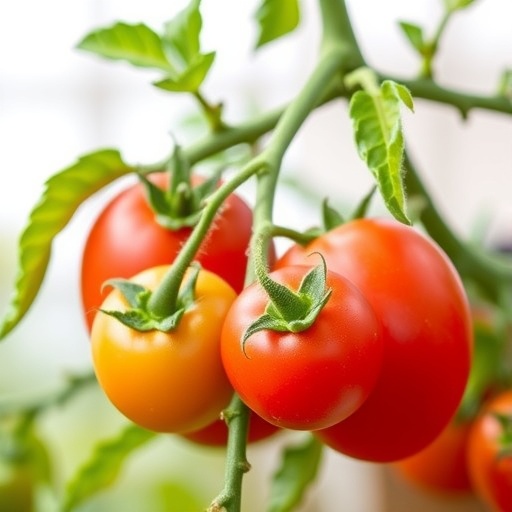
In groundbreaking research that promises to revolutionize the nutritional profile of tomatoes, scientists from Zhejiang University have unveiled the pivotal role of a transcriptional repressor known as SlMYB32 in modulating the biosynthesis of flavonols and flavanones. These bioactive compounds are celebrated for their potent pharmacological properties and have garnered significant attention for their contributions to human health. Despite extensive characterization of transcriptional activators in flavonoid pathways, the negative regulatory elements have remained largely elusive. This study leverages the precision of CRISPR/Cas9 genome editing technology to elucidate and manipulate these mechanisms, facilitating the enhancement of health-promoting metabolites in fruit crops.
Flavonols and flavanones constitute crucial classes of flavonoids that exert antioxidative, anti-inflammatory, and cardioprotective effects, thereby imparting extensive health benefits. Although transcriptional activators related to their biosynthesis have been well-documented, repressors capable of dampening their accumulation have not been systematically identified in tomato, a globally important horticultural crop. The Zhejiang University team aimed to bridge this knowledge gap by focusing on the transcription factor SlMYB32, hypothesizing that its suppression could lead to increased flavonoid accumulation.
Utilizing CRISPR/Cas9-mediated gene knockout techniques, researchers specifically targeted SlMYB32 in tomato plants to dissect its functional role. The resultant slmyb32 mutants exhibited notable phenotypic alterations consistent with enhanced flavonoid biosynthesis. Comprehensive metabolomic profiling revealed marked elevations in flavonols and flavanones, with an especially significant increase in quercetin 3-O-rutinoside, commonly known as rutin, reaching approximately 1 mg per gram of fresh weight. This substantial increase underscores the potential nutritional augmentation achievable through strategic genetic modification.
To unravel the transcriptional networks underpinning this phenotype, transcriptome analyses were conducted comparing wild-type and slmyb32 mutant fruits. The data illuminated significant upregulation of key genes integral to the phenylpropanoid and flavonoid pathways, including SlPAL6, Sl4CL3, and Sl4CL4. Additionally, expression of five candidate UDP-glycosyltransferases (SlUGTs), enzymes critical for flavonoid modification and stability, was also elevated. These molecular patterns strongly suggest that SlMYB32 functions as a transcriptional repressor by selectively binding to and downregulating these loci.
The mechanistic insights were further refined through dual-luciferase reporter assays and electrophoretic mobility shift assays (EMSA), which confirmed direct binding of SlMYB32 to promoter elements of SlPAL6 and Sl4CL3, resulting in repressed promoter activity. These findings compellingly position SlMYB32 as a negative regulatory hub capable of attenuating the flux through early phenylpropanoid pathway genes, thereby calibrating downstream flavonoid biosynthesis.
Interestingly, the transcriptomic perturbations extended beyond direct target genes. A total of 27 transcription factors spanning 12 distinct families exhibited differential expression profiles in the slmyb32 mutants. Notably, two additional SlMYB family members, two NAC domain factors, two AP2 domain proteins, and one WRKY transcription factor clustered within expression modules previously associated with flavonoid metabolism regulation. This hints at an intricate, hierarchical regulatory network wherein SlMYB32 modulates a broader transcriptional landscape impacting flavonoid synthesis.
The implications of this research reach far beyond fundamental science, offering translational opportunities for the agricultural sector. By manipulating negative repressors such as SlMYB32, breeders can develop biofortified tomato cultivars enriched in flavonoids without compromising fruit yield or quality. This approach aligns with contemporary goals of augmenting functional food components via precision breeding tools, thereby enhancing public health outcomes through diet.
Furthermore, these discoveries enrich the conceptual framework surrounding transcriptional regulation in plant secondary metabolism. Unraveling the balance between transcriptional activators and repressors provides a deeper understanding of how plants finely tune metabolite accumulation in response to developmental and environmental cues. SlMYB32 exemplifies the critical need to explore repressive transcription factors as key determinants in metabolic engineering strategies.
Given the rigor of the experimental design and the comprehensive molecular characterization provided, this study sets a benchmark for future investigations aiming to improve fruit nutritional profiles. The synergistic use of CRISPR/Cas9 editing, metabolomics, transcriptomics, and biochemical assays exemplifies the multidisciplinary methodologies essential for dissecting complex biosynthetic pathways in plants.
As demand for functional foods and nutraceuticals escalates globally, insights gained from studies such as this will catalyze innovations in crop biofortification. The work by Li and colleagues also demonstrates the vast potential of gene editing not only as a research tool but as a technically feasible approach for tangible improvements in crop quality that benefit human health.
In conclusion, the targeted disruption of the SlMYB32 gene unlocks an exciting avenue for elevating flavonols and flavanones in tomato fruit, heralding a new era of crop enhancement informed by sophisticated molecular genetics. This discovery not only advances our grasp of plant biosynthetic control but also contributes directly to nutritional science and sustainable agriculture.
Subject of Research: Cells
Article Title: CRISPR/Cas9-mediated mutagenesis of transcriptional repressor SlMYB32 improves flavonols and flavanones accumulation in tomato fruit
Web References: http://dx.doi.org/10.1016/j.jia.2025.11.011
Image Credits: Ruining Zhang
Keywords: Flavonols, Flavanones, SlMYB32, CRISPR/Cas9, Tomato, Transcriptional Repressor, Flavonoid Biosynthesis, Metabolomics, Transcriptomics, Gene Editing, Functional Food, Biofortification
Tags: bioactive flavonoids in horticultural cropscardiovascular protective compounds in geneticallyCRISPR/Cas9 genome editing in tomatoesenhancing flavonol biosynthesis in tomatoesflavonoid metabolism modulation in fruit cropsflavonoid pathway gene editinggenetic manipulation for antioxidant enhancementhealth benefits of tomato flavonoidsincreasing flavanone content via gene knockoutnegative regulators of plant secondary metabolitesSlMYB32 transcriptional repressor functiontranscriptional regulation of flavonoid pathways