• HOME
  • NEWS
  • EXPLORE
    • CAREER
      • Companies
      • Jobs
    • EVENTS
    • iGEM
      • News
      • Team
    • PHOTOS
    • VIDEO
    • WIKI
  • BLOG
  • COMMUNITY
    • FACEBOOK
    • INSTAGRAM
    • TWITTER
Saturday, June 27, 2026
BIOENGINEER.ORG
No Result
View All Result
  • Login
  • HOME
  • NEWS
  • EXPLORE
    • CAREER
      • Companies
      • Jobs
        • Lecturer
        • PhD Studentship
        • Postdoc
        • Research Assistant
    • EVENTS
    • iGEM
      • News
      • Team
    • PHOTOS
    • VIDEO
    • WIKI
  • BLOG
  • COMMUNITY
    • FACEBOOK
    • INSTAGRAM
    • TWITTER
  • HOME
  • NEWS
  • EXPLORE
    • CAREER
      • Companies
      • Jobs
        • Lecturer
        • PhD Studentship
        • Postdoc
        • Research Assistant
    • EVENTS
    • iGEM
      • News
      • Team
    • PHOTOS
    • VIDEO
    • WIKI
  • BLOG
  • COMMUNITY
    • FACEBOOK
    • INSTAGRAM
    • TWITTER
No Result
View All Result
Bioengineer.org
No Result
View All Result
Home NEWS Science News Chemistry

Enhanced photoelectrochemical water splitting with a donor-acceptor polyimide

Bioengineer by Bioengineer
January 17, 2024
in Chemistry
Reading Time: 2 mins read
0
Illustration of the PI synthesis process
Share on FacebookShare on TwitterShare on LinkedinShare on RedditShare on Telegram

Polyimide (PI) has emerged as a promising organic photocatalyst owing to its distinct advantages of high visible-light response, facile synthesis, molecularly tunable donor-acceptor structure, and excellent physicochemical stability. However, the synthesis of high-quality PI photoelectrode remains a challenge, and photoelectrochemical (PEC) water splitting for PI has been less studied.
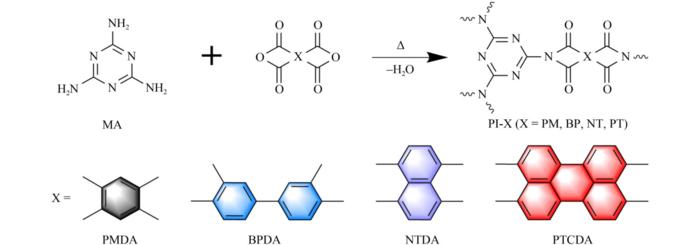
Illustration of the PI synthesis process

Credit: HIGHER EDUCATION PRESS

Polyimide (PI) has emerged as a promising organic photocatalyst owing to its distinct advantages of high visible-light response, facile synthesis, molecularly tunable donor-acceptor structure, and excellent physicochemical stability. However, the synthesis of high-quality PI photoelectrode remains a challenge, and photoelectrochemical (PEC) water splitting for PI has been less studied.


A research group of Huiyan Zhang and Sheng Chu from Southeast University prepared PI films by a simple spin-coating method for the first time. They adopted four dianhydrides with different conjugate sizes of aromatic unit (phenyl, biphenyl, naphthalene, perylene) to construct the corresponding D-A PI photoelectrodes, named PI-PM, PI-BP, PI-NT, and PI-PT, respectively. Their PEC properties were investigated, and the influence of the conjugate size of aromatic unit (phenyl, biphenyl, naphthalene, perylene) of electron acceptor on PEC performance was studied.


It was found that the fused ring was prominent in improving the light absorption capacity of PI, but excessive fused rings were unfavorable for the photogenerated charge separation. Of all the samples, the PI-NT film exhibits the highest photocurrent response, which is ascribed to its wide-range light absorption, efficient charge separation and transport, and strong photooxidation capacity. However, the photocurrent response of the PI film presented here needs to be improved for efficient PEC water splitting, which can be enhanced by catalyst modification (e.g., elemental doping, and composite engineering) or optimizing the preparation method of films in subsequent work.


This work is not only a starting point of PI films for PEC water splitting, but also an enlightenment for the rational design of polymer photocatalysts for efficient PEC applications.


Journal

Frontiers in Energy

DOI

10.1007/s11708-023-0910-8

Method of Research

Experimental study

Subject of Research

Not applicable

Article Title

Enhanced photoelectrochemical water splitting with a donor-acceptor polyimide

Article Publication Date

29-Nov-2023

Share12Tweet8Share2ShareShareShare2

Related Posts

AI and Physics Collaborate to Design Advanced Hydrogen Storage Materials

June 25, 2026

International Team Including Dresden Scientists Develops Novel Designer Proteins for Advanced Study of Living Tissue

June 25, 2026

New Study Uncovers Key Factors Driving Water Chemistry in Nanoscale Environments

June 25, 2026

Plasma Technology Extends Catalyst Lifespan in Hydrogen Production

June 24, 2026

POPULAR NEWS

  • Saying Goodbye to PGY-6: Pediatric Fellowship Realities

    103 shares
    Share 41 Tweet 26
  • Multi-Hospital Study Reveals Long Covid Burden Is Twice as High as Current Estimates

    92 shares
    Share 36 Tweet 23
  • Detection of EDCs in Breast Milk and Infant Urine Up to Six Months Highlights Early Exposure Risks

    77 shares
    Share 31 Tweet 19
  • New Drug Candidate Developed at McMaster Shows Potential for Treating Brain Cancer

    58 shares
    Share 23 Tweet 15

About

We bring you the latest biotechnology news from best research centers and universities around the world. Check our website.

Follow us

Recent News

Tracking Lanthanide-Labeled Microplastics in Plants

POSTECH Researchers Slash Cost of Reconstituted Cell-Free Systems by 95%

AI and Physics Collaborate to Design Advanced Hydrogen Storage Materials

Subscribe to Blog via Email

Success! An email was just sent to confirm your subscription. Please find the email now and click 'Confirm' to start subscribing.

Join 82 other subscribers
  • Contact Us

Bioengineer.org © Copyright 2023 All Rights Reserved.

Welcome Back!

Login to your account below

Forgotten Password?

Retrieve your password

Please enter your username or email address to reset your password.

Log In
No Result
View All Result
  • Homepages
    • Home Page 1
    • Home Page 2
  • News
  • National
  • Business
  • Health
  • Lifestyle
  • Science

Bioengineer.org © Copyright 2023 All Rights Reserved.