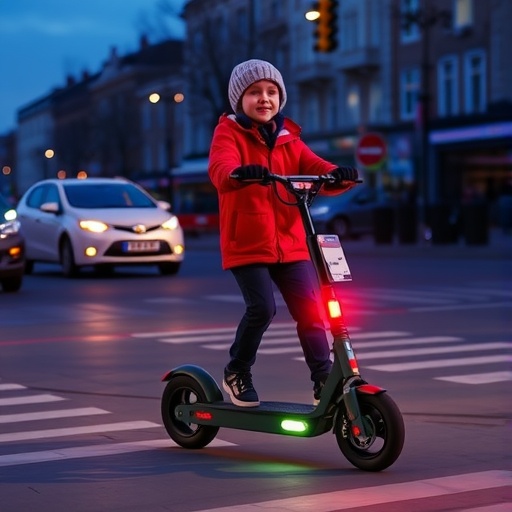
E-scooters are emerging as a significant source of serious injury among children in England, according to a six-year study of emergency admissions at three major trauma centres. Researchers identified 477 paediatric patients injured in e-scooter incidents between January 2019 and December 2024, while the number of cases increased from fewer than 10 in 2019 to almost 150 in 2024. The findings, published online in the Emergency Medicine Journal, suggest that children are increasingly exposed to vehicles designed primarily for adult riders, often without adequate safety equipment or clear understanding of road regulations.
The average age of the injured children was just 12, with half between 10 and 13 years old. Boys accounted for 64.5% of cases. Most injuries—95%—were sustained by the person riding the e-scooter, while 5% involved pedestrians struck by one. Four out of five incidents involved privately owned scooters rather than vehicles supplied through official rental schemes. This distinction is important in the United Kingdom, where rental e-scooters may be used only under regulated trial conditions, while privately owned e-scooters cannot legally be ridden on public roads or public land.
The study examined emergency care records from children’s major trauma centres in Liverpool, Manchester and Sheffield. Liverpool and Manchester participate in the government’s e-scooter rental trials, whereas Sheffield does not, providing researchers with data from areas with different levels of exposure to regulated rental schemes. The analysis covers a period in which e-scooters became increasingly visible on urban streets, partly because they offer inexpensive, rapid and convenient short-distance transport. Their growing availability, however, has occurred alongside uncertainty about enforcement, ownership, age restrictions and the safety expectations applied to young riders.
Falls were responsible for 75% of the recorded incidents, making loss of balance the dominant mechanism of injury. Nearly 11.5% of cases resulted from collisions with motor vehicles, while other incidents involved impacts with stationary objects or pedestrians. More than half of all injuries occurred on public land: 22% on public roads and 30% on public footpaths or in parks. These locations create different hazards. Roads expose riders to moving traffic, whereas pavements and parks increase the likelihood of conflicts with pedestrians and unexpected obstacles. Children, who may have limited experience judging speed, stopping distance and traffic movement, can be particularly vulnerable in both environments.
The injury pattern reflects the physics of an unprotected rider being thrown forward or sideways. Injuries to the arms and legs were most common, affecting approximately 36% to 40% of patients. However, head injuries accounted for 24% of cases and facial injuries for 18.5%. Less than 2% of riders were reported to have been wearing a helmet when injured. Around one in 10 head injuries was serious enough to require diagnostic imaging, hospital admission and, in some cases, surgery. Helmets cannot prevent every type of trauma, but they can reduce the energy transmitted to the skull during an impact and may lower the risk of severe brain injury.
The need for hospital resources was substantial. Nearly 64.5% of the children underwent at least one form of imaging, including X-rays, computed tomography or ultrasound scans. About 13.5% were admitted to hospital, and 7% required surgery. Among the most seriously injured patients, 48% had been involved in a collision with a car or a stationary object. These figures indicate that e-scooter injuries are not limited to minor cuts and bruises. A short journey can generate enough kinetic energy to produce fractures, facial trauma, internal injury or traumatic brain injury, particularly when a rider is travelling at speed and has no protective structure around the body.
The researchers also found a strong association between injury and socioeconomic disadvantage. Three quarters of the injured children lived in areas classified among the most socially and economically deprived in England. The study does not establish that deprivation directly causes e-scooter injuries, but the pattern may reflect differences in transport access, road environments, recreational space, supervision and exposure to privately owned scooters. It also suggests that prevention campaigns should be designed with local communities rather than relying solely on general warnings. Targeted education through schools, youth organisations, councils and road-safety programmes could help children understand braking, visibility, traffic interactions and the dangers of carrying passengers or riding in unsuitable areas.
The legal landscape adds another layer of risk. Government rental trials, launched in England in July 2020 during the COVID-19 pandemic, generally restrict riders to those aged 16 and over and impose requirements on approved vehicles and operating areas. Privately owned scooters, by contrast, remain largely unregulated in everyday use, even though children and teenagers frequently ride them. The researchers argue that retailers should provide clearer information about the law and that policymakers should consider measures such as speed limiters, stronger regulation of private scooters and mandatory helmet use. Since 2019, e-scooters have been linked to 59 reported deaths in the United Kingdom, adding urgency to the debate.
The investigators acknowledge that their findings come from only three trauma centres and may not represent the national burden of injury. In addition, a software change restricted Manchester’s data collection to 2023 and 2024, meaning that the total number of cases may be higher than reported. Even with these limitations, the steady rise in presentations and the severity of some injuries point to a growing public-health challenge. The researchers call for improved reporting, clearer public messaging and a review of current legislation. They also suggest adapting proven bicycle-safety education schemes for e-scooter users, combining technical safeguards, responsible retail practices and practical instruction before further injuries become an established consequence of children’s increasingly common use of electric transport.
Subject of Research: People
Article Title: Paediatric electric-scooter injuries: an emerging public health crisis?
News Publication Date: 11-Aug-2026
Web References: https://doi.org/10.1136/emermed-2026-215992
References: Emergency Medicine Journal, DOI: 10.1136/emermed-2026-215992
Keywords
e-scooters, children, adolescents, traumatic injury, head injury, road safety, electric transport, paediatric trauma, helmets, public health
Tags: childhood trauma from e-scooterse-scooter injury in childrene-scooter safety concernsemergency admissions for e-scooter accidentsimpact of e-scooters oninjury demographics among childreninjury prevention in childhood e-scooter uselegal regulations for e-scooter usepediatric e-scooter accidentsprivate vs. rental e-scooter risksrise in e-scooter injuries in Englandroad safety for young e-scooter riders