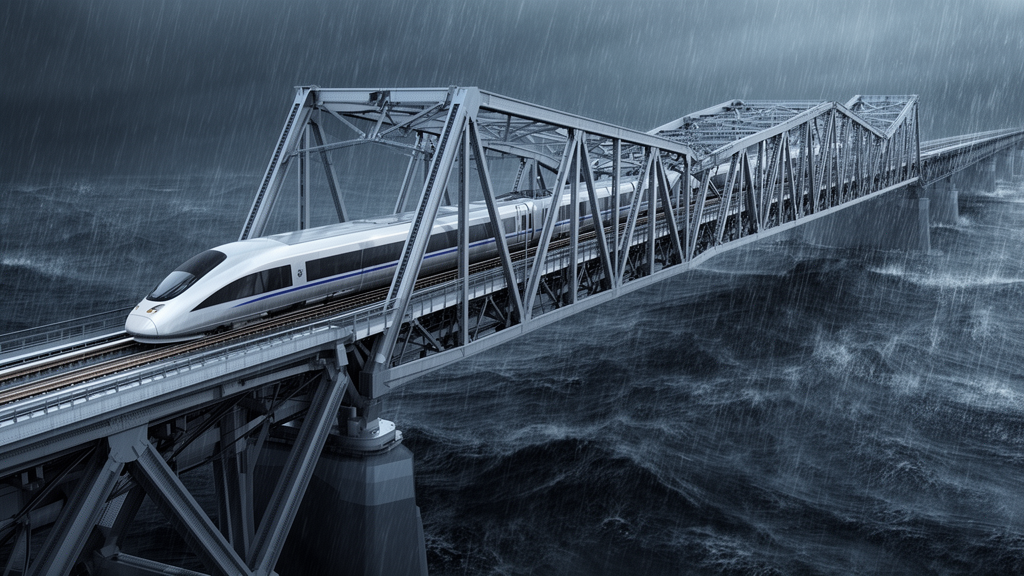
A research team specializing in structural mechanics and transportation infrastructure has formulated a general three-dimensional finite element dynamics framework designed to resolve the complex kinematic constraints and contact mechanics governing railway vehicle–bridge interaction. Published in Railway Engineering Science by investigators Pablo Antolin, Khanh Nguyen, and José M. Goicolea, the study introduces an integrated computational formulation capable of simulating extreme operational conditions where trains encounter significant lateral disturbances from severe crosswinds or seismic activity. By implementing nonlinear wheel–rail contact conditions within a unified system of dynamic equations, the framework captures the transitions between tight rolling contact, lateral flange impact, and complete wheel lift without resorting to traditional infinitesimal displacement simplifications.
Dynamic interaction between moving rail vehicles and bridge superstructures represents an essential consideration in modern infrastructure development, particularly as railway operators push toward higher operational speeds and civil engineers design longer, more flexible viaduct spans. Historically, numerical modeling strategies have divided this vehicle–bridge interaction into uncoupled systems that iterate compatibility conditions at each discrete time step, or monolithic formulations that solve vehicle and bridge equations simultaneously. However, many existing monolithic finite element formulations rely on simplified structural geometries, assume idealized wheel-rail paths, or remain confined to specialized research software that cannot easily interface with general commercial engineering platforms. The new framework directly addresses this limitation by deploying an absolute coordinate formulation that can be introduced into general-purpose finite element software packages such as Abaqus through dedicated multipoint constraint subroutines.
The structural core of the vehicle–bridge system is governed by dynamic equilibrium equations that balance mass inertia, structural damping, deformation stresses, and external aerodynamic or seismic excitations against the nonlinear contact forces acting across the wheel–rail interface. In the structural domain, the viaduct deck and supports are discretized using finite elements, while the passenger vehicle is defined as a three-dimensional multibody system comprising car bodies, bogies, and wheelsets connected through primary and secondary suspension stages. Rather than treating the wheels as permanently adhered to the rails or constrained to linear horizontal conicities, the dynamic system accommodates geometric nonlinearities and transient separations. This capability ensures that high-frequency vibrations induced by bridge deformations propagate directly through the interaction equations, altering instantaneous contact geometries and vehicle stability metrics in real time.
To couple the moving train to the flexible bridge without requiring continuous remeshing or ad hoc interface assumptions, the investigators introduced a kinematic constraint system based on three virtual nodes defined for each wheelset. A central virtual node travels along the track longitudinal axis at the train velocity, representing the midpoint of the track cross-section relative to the structural beam elements. Two auxiliary virtual nodes are positioned at the centroids of the right and left rails in the same transversal plane. These massless kinematic markers establish rigid geometric relationships that track the translational and rotational displacements of the underlying deck. Furthermore, this multi-node arrangement enables direct inclusion of vertical, lateral, and rotational track irregularities and cant deficiencies directly into the kinematic constraints, permitting realistic rail surface geometry to influence vehicle dynamics.
Contact geometry detection forms the secondary pillar of the computational method, employing a fully three-dimensional reconstruction of the interacting bodies from their actual transverse profiles. Rail geometry is formed by extruding the two-dimensional cross-section along the longitudinal track alignment, while the wheel surface is modeled by revolving its profile around the wheelset axle, effectively generating a series of consecutive truncated conical envelopes. During dynamic analysis, the algorithm tracks potential intersections between the extruded rail lines and the wheel cones online at each time increment. By solving closed-form quadratic intersection formulas, the software extracts the penetrations and surface normals across the interface, applying cubic-spline interpolation across the discrete sampling points to eliminate artificial numerical grid-locking and high-frequency discretization noise that typically plague discrete penetration searches.
Once geometric penetrations are established, the framework resolves normal and tangential contact stresses using a decoupled multi-Hertzian approach and Kalker creepage mechanics. Because lateral vehicle displacement frequently causes contact patches to split across the rail head and flange or merge into irregular non-parabolic geometries, a single classical Hertzian ellipse cannot accurately represent the interface. The researchers evaluate virtual elastic compression at each local penetration maximum to determine local normal contact forces and elliptical contact patches. Tangential traction and spin creep moments are subsequently evaluated by interpolating precalculated lookup tables generated with Kalker’s exact three-dimensional rolling contact formulation, known as USETAB. These contact forces and moments are directly assembled into the global dynamic system, capturing longitudinal, lateral, and spin creepages as functions of instantaneous wheel and rail velocities.
The contact formulation was initially verified against the standardized Manchester Contact Benchmark, an established international reference suite specifically created to evaluate wheel–rail interaction codes. In benchmark Case A, the researchers analyzed an S1002 wheel profile interacting with a UIC60 rail under a static vertical axle load of 20 kilonewtons across varying lateral displacements and yaw angles. In sub-case evaluations exploring pure normal contact and quasi-static tangential creepage, the proposed model closely replicated benchmark contact patch positions, rolling radius differences, and contact angles predicted by established commercial and academic packages such as GENSYS, VAMPIRE, and CONTACT. Crucially, when lateral displacements exceeded 6 millimeters and initiated flange contact, the algorithm accurately reproduced the rapid jump in contact angles and the sharp escalation in longitudinal creepage, matching non-Hertzian benchmark trends.
The bridge structure comprised six 50-meter spans supported by five piers ranging from 20 to 60 meters in height, discretized with shear-deformable Timoshenko beam elements representing prestressed concrete. To create a rigorous test case for numerical stability and constraint enforcement, the mechanical cross-section properties of the bridge were deliberately calibrated to exhibit exceptionally high lateral bending flexibility, far exceeding standard regulatory serviceability thresholds. The simulated vehicle, representative of a Siemens Velaro high-speed train, traversed the leeward track of the viaduct at a constant forward speed of 200 kilometers per hour.
Aerodynamic loading was introduced through a deterministic Chinese hat wind gust formulation, generating a stationary spatial wind profile along the bridge length with an average velocity of 25 meters per second and a peak gust velocity of 35.17 meters per second centered over the third bridge pier. As the passenger vehicle navigated this localized wind zone, aerodynamic drag, lift, and overturning moments acted simultaneously on the moving train bodies and the bridge deck. In the comparative baseline simulation where the bridge was modeled as completely rigid, vehicle contact forces fluctuated moderately under aerodynamic pressure. However, when structural flexibility was fully activated, deck torsion and lateral bending magnified the dynamic wheel unloading phenomena, introducing high-frequency force oscillations and stark force transitions at the entrance and exit abutments.
The flexible bridge simulation revealed critical safety-related dynamic behaviors, notably around the fourth viaduct span where lateral bridge deflections reached their maximum values. In this region, vertical contact forces on the windward wheels of the leading bogie dropped to zero, signaling that the wheels had completely separated from the rail head in an extreme wheel-lift condition. Evaluation of vehicle safety metrics confirmed the severe influence of bridge flexibility: while the wheel-climb derailment metric defined by the Nadal formula dropped to zero due to vanishing contact forces, the bogie offload coefficient breached the standard safety limit of 0.9 across both rigid and flexible scenarios, with structural deformation notably worsening peak car body lateral and vertical accelerations.
The authors emphasized that the extreme deformations observed in the bridge case study do not reflect standard railway operating conditions, as real-world railway bridges are designed with much higher lateral stiffness to restrict deck movement within strict design limits. Instead, the severe bridge flexibility was intentionally introduced as an exacting numerical benchmark to prove that the proposed absolute coordinate kinematic formulation and multi-Hertzian contact algorithms maintain numerical convergence and stability even through continuous loss and recovery of wheel–rail contact. The numerical results demonstrate that omitting bridge flexibility from crosswind aerodynamic analyses can lead to significant underestimations of vehicle unloading risks, highlighting the necessity of integrated three-dimensional models when assessing high-speed rail safety over long viaducts.
While detailed quantitative benchmarking of computational execution times and hardware scalability against alternative multibody formulations remains slated for future investigations, the current study establishes a mathematically consistent, robust framework for simulating severe railway dynamics. By providing a dependable mechanism for modeling large lateral shifts and contact separations within widely accessible finite element software, the method offers transportation engineers a versatile tool for safeguarding high-speed rail operations against complex environmental hazards.
Subject of Research: Three-dimensional finite element modeling of railway vehicle–bridge dynamic interaction and nonlinear wheel–rail contact under aerodynamic loads
Article Title: A general and robust 3D finite element dynamics framework for railway vehicle–bridge interaction with nonlinear wheel–rail contact modeling
Article References: Antolin, P., Nguyen, K., & Goicolea, J. M. (2026). A general and robust 3D finite element dynamics framework for railway vehicle–bridge interaction with nonlinear wheel–rail contact modeling. Railway Engineering Science. https://doi.org/10.1007/s40534-026-00435-6
Image Credits: AI Generated
DOI: 10.1007/s40534-026-00435-6
Keywords: railway engineering, vehicle-bridge interaction, finite element method, wheel-rail contact, multibody dynamics, aerodynamic loads, wind gust modeling, wheel unloading, derailment safety, Abaqus subroutines, Manchester contact benchmark, Timoshenko beam elements, Nadal safety index, offload coefficient, absolute coordinates, kinematic constraints, multi-Hertzian contact, Kalker creep theory
News Source: Denise Maddox. (November 23, 2026). Engineers Model High-Speed Train Derailment Risks on Flexible Bridges During Storms. Scienmag.