• HOME
  • NEWS
  • EXPLORE
    • CAREER
      • Companies
      • Jobs
    • EVENTS
    • iGEM
      • News
      • Team
    • PHOTOS
    • VIDEO
    • WIKI
  • BLOG
  • COMMUNITY
    • FACEBOOK
    • INSTAGRAM
    • TWITTER
Tuesday, May 12, 2026
BIOENGINEER.ORG
No Result
View All Result
  • Login
  • HOME
  • NEWS
  • EXPLORE
    • CAREER
      • Companies
      • Jobs
        • Lecturer
        • PhD Studentship
        • Postdoc
        • Research Assistant
    • EVENTS
    • iGEM
      • News
      • Team
    • PHOTOS
    • VIDEO
    • WIKI
  • BLOG
  • COMMUNITY
    • FACEBOOK
    • INSTAGRAM
    • TWITTER
  • HOME
  • NEWS
  • EXPLORE
    • CAREER
      • Companies
      • Jobs
        • Lecturer
        • PhD Studentship
        • Postdoc
        • Research Assistant
    • EVENTS
    • iGEM
      • News
      • Team
    • PHOTOS
    • VIDEO
    • WIKI
  • BLOG
  • COMMUNITY
    • FACEBOOK
    • INSTAGRAM
    • TWITTER
No Result
View All Result
Bioengineer.org
No Result
View All Result
Home NEWS Science News Health

Engineers develop low-cost, high-accuracy GPS-like system for flexible medical robots

Bioengineer by Bioengineer
May 18, 2020
in Health
Reading Time: 3 mins read
0
IMAGE
Share on FacebookShare on TwitterShare on LinkedinShare on RedditShare on Telegram

IMAGE

Credit: David Baillot/University of California San Diego

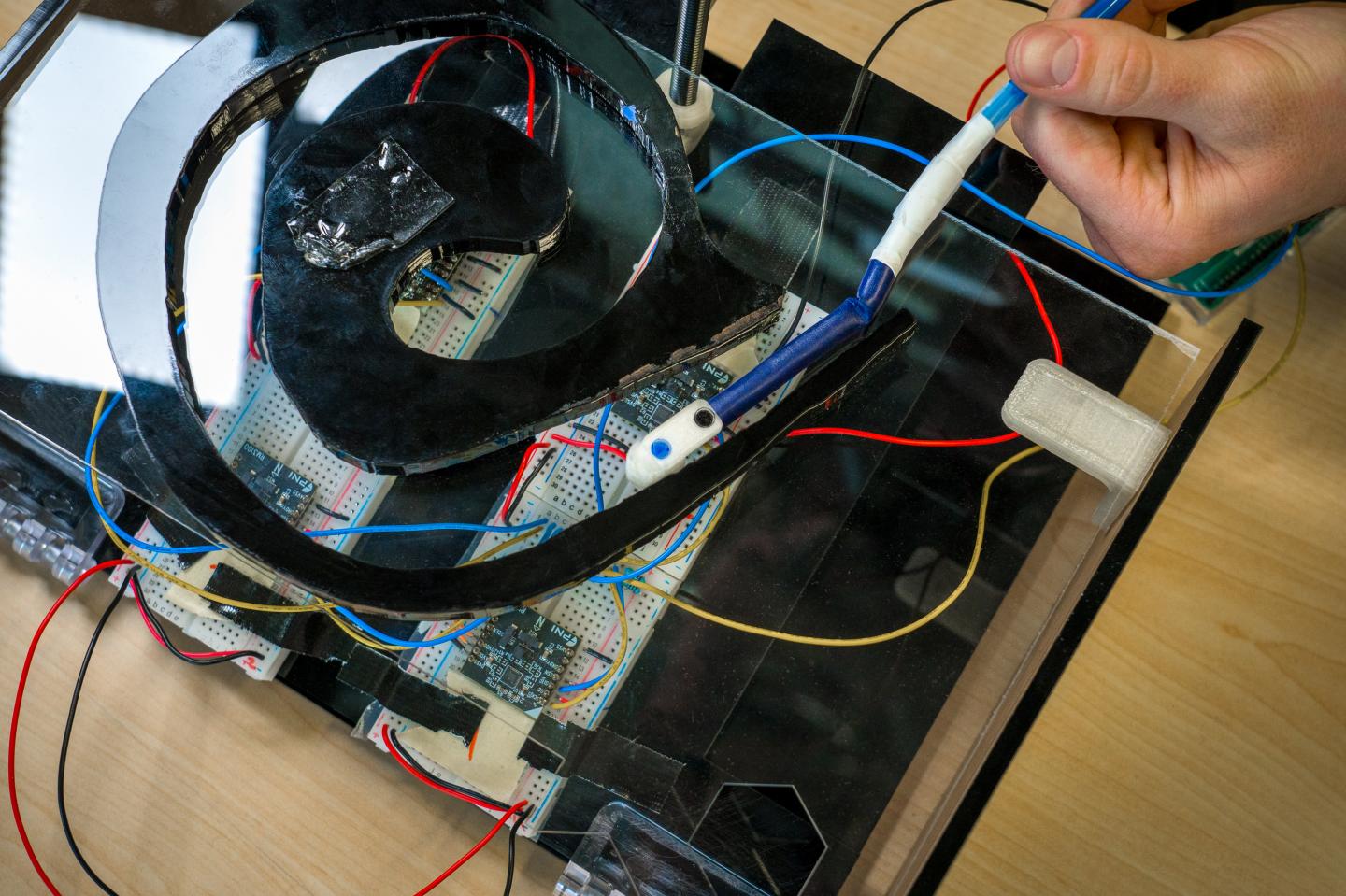
Roboticists at the University of California San Diego have developed an affordable, easy to use system to track the location of flexible surgical robots inside the human body. The system performs as well as current state of the art methods, but is much less expensive. Many current methods also require exposure to radiation, while this system does not.

The system was developed by Tania Morimoto, a professor of mechanical engineering at the Jacobs School of Engineering at UC San Diego, and mechanical engineering Ph.D. student Connor Watson. Their findings are published in the April 2020 issue of IEEE Robotics and Automation Letters.

“Continuum medical robots work really well in highly constrained environments inside the body,” Morimoto said. “They’re inherently safer and more compliant than rigid tools. But it becomes a lot harder to track their location and their shape inside the body. And so if we are able track them more easily that would be a great benefit both to patients and surgeons.”

The researchers embedded a magnet in the tip of a flexible robot that can be used in delicate places inside the body, such as arterial passages in the brain. “We worked with a growing robot, which is a robot made of a very thin nylon that we invert, almost like a sock, and pressurize with a fluid which causes the robot to grow,” Watson said. Because the robot is soft and moves by growing, it has very little impact on its surroundings, making it ideal for use in medical settings.

The researchers then used existing magnet localization methods, which work very much like GPS, to develop a computer model that predicts the robot’s location. GPS satellites ping smartphones and based on how long it takes for the signal to arrive, the GPS receiver in the smartphone can determine where the cell phone is. Similarly, researchers know how strong the magnetic field should be around the magnet embedded in the robot. They rely on four sensors that are carefully spaced around the area where the robot operates to measure the magnetic field strength. Based on how strong the field is, they are able to determine where the tip of the robot is.

The whole system, including the robot, magnets and magnet localization setup, costs around $100.

Morimoto and Watson went a step further. They then trained a neural network to learn the difference between what the sensors were reading and what the model said the sensors should be reading. As a result, they improved localization accuracy to track the tip of the robot.

“Ideally we are hoping that our localization tools can help improve these kinds of growing robot technologies. We want to push this research forward so that we can test our system in a clinical setting and eventually translate it into clinical use,” Morimoto said.

###

Permanent Magnet-Based Localization for Growing Robots in Medical Applications

Connor Watson and Tania Morimoto, Department of Mechanical and Aerospace Engineering, UC San Diego

IEEE Robotics and Automation Letters: https://bit.ly/MorimotoICRA2020paper

Video: https://bit.ly/MorimotoICRA2020video

Media Contact
Ioana Patringenaru
[email protected]

Related Journal Article

http://dx.doi.org/10.1109/LRA.2020.2972890

Tags: Biomedical/Environmental/Chemical EngineeringMedicine/HealthRobotry/Artificial IntelligenceSurgery
Share12Tweet8Share2ShareShareShare2

Related Posts

Medicaid Expansion Reduces Mortality in Young Adults with Kidney Failure

May 11, 2026

CRISPR Technology Shows Promise in Inhibiting Hepatitis E Virus

May 11, 2026

Mapping Ocular Bioenergetics: Insights into TCA Cycle Intermediates and Gender Differences in Eye Tissues

May 11, 2026

Telemedicine Does Not Drive Higher Medical Utilization or Health Care Costs, Study Finds

May 11, 2026
Please login to join discussion

POPULAR NEWS

  • Research Indicates Potential Connection Between Prenatal Medication Exposure and Elevated Autism Risk

    841 shares
    Share 336 Tweet 210
  • New Study Reveals Plants Can Detect the Sound of Rain

    728 shares
    Share 290 Tweet 182
  • Salmonella Haem Blocks Macrophages, Boosts Infection

    62 shares
    Share 25 Tweet 16
  • Breastmilk Balances E. coli and Beneficial Bacteria in Infant Gut Microbiomes

    57 shares
    Share 23 Tweet 14

About

We bring you the latest biotechnology news from best research centers and universities around the world. Check our website.

Follow us

Recent News

Humans and Zebra Finches Share Similar Speech Learning Techniques #ASA190

New Study Uncovers How Fungal Parasites Attack Strawberries and Raspberries

City of Hope Researchers to Present Groundbreaking Immunotherapy and Precision Medicine Advances Across Multiple Cancer Types at ASCO 2026

Subscribe to Blog via Email

Enter your email address to subscribe to this blog and receive notifications of new posts by email.

Join 82 other subscribers
  • Contact Us

Bioengineer.org © Copyright 2023 All Rights Reserved.

Welcome Back!

Login to your account below

Forgotten Password?

Retrieve your password

Please enter your username or email address to reset your password.

Log In
No Result
View All Result
  • Homepages
    • Home Page 1
    • Home Page 2
  • News
  • National
  • Business
  • Health
  • Lifestyle
  • Science

Bioengineer.org © Copyright 2023 All Rights Reserved.