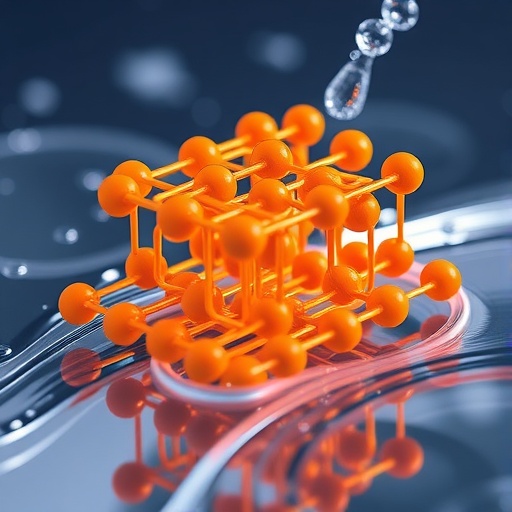
A new cobalt-based electrode that can split water for hydrogen production while surviving hundreds of hours of demanding operation could help address one of green energy’s most persistent engineering challenges. Researchers at Jilin Normal University have developed a self-supported catalyst that combines cobalt hydroxide, ruthenium and boron, achieving high activity for both hydrogen and oxygen evolution in alkaline water.
The electrode, known as Co-B@Co(OH)₂-Ru/NF, or Co-B@CRN, was created using a mild boron reduction process at room temperature. Unlike many catalyst fabrication methods that require high temperatures, complex solvents or lengthy processing, this approach introduces boron into a cobalt hydroxide–ruthenium structure under comparatively gentle conditions. The resulting material is directly integrated with nickel foam, creating a conductive, three-dimensional electrode that can be used without additional binders.
The development targets a major weakness of cobalt-based hydroxide catalysts. Co(OH)₂ is attractive because cobalt is far less expensive and more abundant than many precious metals, but the material can degrade during electrolysis. Strongly alkaline solutions, high electrical currents and the repeated oxidation and reduction of active sites can trigger structural collapse and chemical dissolution. As cobalt leaches from the electrode, catalytic performance declines and the material becomes increasingly unreliable for long-term hydrogen production.
In the new design, boron plays a critical structural and electronic role. The researchers report direct evidence for Co–B bonding, together with a mixed-valence state of cobalt, based on X-ray absorption near-edge structure and extended X-ray absorption fine structure measurements. These techniques probe the oxidation state and local atomic environment of a material, allowing the team to identify how cobalt is coordinated and how boron is incorporated into the catalyst framework.
The Co–B bonds also reshape the electronic structure of the cobalt sites. Density functional theory calculations indicate strong hybridization between cobalt d orbitals and boron p orbitals. This interaction shifts the cobalt d-band center downward, changing how the surface binds reaction intermediates. In electrocatalysis, the position of the d-band center is closely linked to the strength of adsorption between a catalyst and molecules or ions involved in a reaction. By moderating these interactions, the boron-induced electronic shift can make active sites less vulnerable to unwanted restructuring and metal dissolution.
The electrode also contains ruthenium nanocrystals, which work together with the amorphous Co–B phase and cobalt hydroxide. Ruthenium is highly active for hydrogen evolution, particularly in alkaline environments where water molecules must first be dissociated before hydrogen can form. The researchers propose that the heterointerface between ruthenium and the boron-modified cobalt component accelerates this water-dissociation step. At the same time, the surrounding structure helps prevent ruthenium from becoming excessively oxidized, preserving its catalytic function during prolonged operation.
The performance figures are striking. At a current density of 10 milliamperes per square centimetre, the electrode requires an overpotential of only 20 millivolts to drive the hydrogen evolution reaction. For the oxygen evolution reaction, it requires 160 millivolts at the same current density. Overpotential is the extra voltage needed beyond the thermodynamic minimum for a reaction to proceed; lower values generally indicate more efficient catalysis and reduced energy losses.
Durability tests revealed an equally important advantage. The Co-B@CRN electrode operated for more than 400 hours at 10 milliamperes per square centimetre, with only minor potential degradation. Even at the much higher current density of 200 milliamperes per square centimetre, it remained functional for over 270 hours. When the same material was used as both electrodes in a two-electrode alkaline electrolyzer, the system reached 10 milliamperes per square centimetre at a cell voltage of just 1.40 volts and maintained stable water-splitting performance for more than 240 hours.
These results point to a possible way of overcoming the traditional trade-off between catalytic activity and operational lifetime. Highly active catalysts often contain unstable surface sites, while more durable materials can be slower or require greater electrical input. In the Co-B@CRN architecture, the researchers believe that boron stabilizes cobalt through strong main-group-element–metal bonds, while the ruthenium heterointerface improves reaction kinetics. The combination creates a catalyst that is both chemically resilient and highly responsive under alkaline electrolysis conditions.
The team led by Wei Jiang expects the synthesis strategy to be adaptable beyond the present cobalt-based system. By using boron to regulate electronic structure, coordination chemistry and local phase composition, researchers may be able to stabilize other transition-metal catalysts without relying heavily on precious metals. The work, published in Nano Research, offers a scalable direction for designing electrodes capable of sustained operation in renewable hydrogen systems, where low cost, high current performance and long service life are all essential.
Subject of Research: Boron-engineered cobalt hydroxide–ruthenium electrode for durable bifunctional electrocatalytic water splitting
Article Title: Enhanced electrode stability over engineering Co-B bonds in Co(OH)₂-Ru heterostructure for electrocatalytic water splitting
News Publication Date: 21 July 2026
Web References: https://doi.org/10.26599/NR.2026.94908760; Nano Research
References: Yu, X. et al., “Enhanced electrode stability over engineering Co-B bonds in Co(OH)₂-Ru heterostructure for electrocatalytic water splitting,” Nano Research, DOI: 10.26599/NR.2026.94908760.
Image Credits: Yu, X. et al., original image of the manuscript.
Keywords
Green hydrogen, water splitting, electrocatalysis, cobalt hydroxide, ruthenium nanocrystals, boron reduction, Co–B bonds, hydrogen evolution reaction, oxygen evolution reaction, alkaline electrolysis, durable electrodes
Tags: boron doping in electrocatalystsCo-B@Co(OH)₂-Ru/NF catalystcobalt hydroxide-based water electrolysiscobalt-boron-ruthenium compositecostenhanced electrode stability in alkaline waterenvironmentally friendly catalyst fabrication methodslong-term stability of water electrolyzersrenewable hydrogen production technologyruthenium-based hydrogen evolution catalystsself-supported water-splitting electrodesthree-dimensional electrode design for water splittingwater-splitting electrocatalysis