Climate change is intensifying drought and soil salinity, two stresses that together account for a large share of global crop losses, and a new review argues that the next defense may lie not in the plant genome alone but in the microbes that surround it. Writing in Discover Plants, Vikas surveys recent advances in engineering plant-microbe symbioses and lays out a roadmap for moving from naturally variable bacterial inoculants to rationally designed microbial communities that can be switched on exactly when crops need them. The review, published as an open-access synthesis of peer-reviewed literature, frames synthetic symbiosis as a theoretical framework and future approach rather than a mature field technology.
The scale of the problem is stark. According to the review, abiotic stress factors, particularly water deficit and excessive soil salinity, are estimated to cause up to seventy percent of global crop losses, with climate models projecting an additional ten percent reduction in baseline yields by the middle of the twenty-first century. Conventional breeding has struggled to improve drought and salinity resilience because these traits are governed by complex, polygenic quantitative trait loci that interact strongly with the environment, and millennia of domestication have narrowed the genetic base of elite cultivars. At the same time, reliance on synthetic fertilizers and excessive irrigation has accelerated secondary soil salinization and depleted freshwater aquifers.
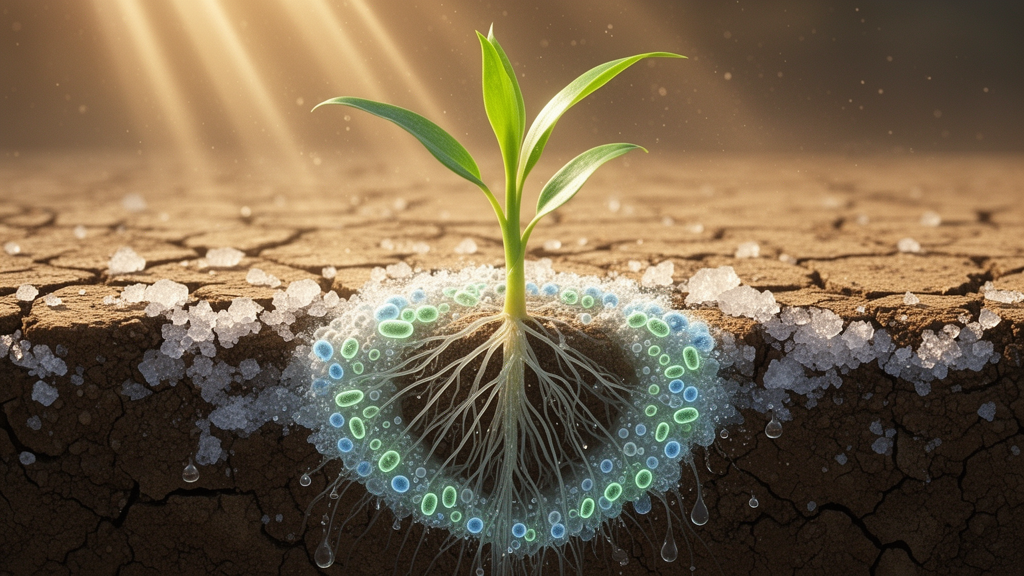
The review situates this work within the holobiont concept, which treats the plant and its associated microbial communities as a single ecological and evolutionary unit. The rhizosphere, the narrow zone of soil around the roots, and the internal endosphere harbor dense networks of bacteria, fungi, and archaea that cycle nutrients, modulate host hormones, and prime defense pathways. Under severe stress, plants actively reprogram their root exudation to recruit beneficial taxa, effectively outsourcing part of their stress response to the soil microbiome. Yet spontaneous assembly of wild-type microbiomes in agricultural soils is stochastic and unstable, which the author identifies as the key motivation for moving toward predictive, mechanistic engineering.
A central contribution of the review is a careful taxonomy of intervention levels: natural plant microbiomes, plant-growth-promoting rhizobacteria, defined synthetic microbial communities, engineered microbiomes, and true synthetic symbioses. The author stresses that not all synthetic communities qualify as synthetic symbioses. A wild-type Bacillus strain that produces extracellular polymeric substances or ACC deaminase is effective stress mitigation, but it is not a synthetic symbiosis. A true synthetic symbiosis, as defined here, requires designed communication between partners, engineered functional complementarity, reciprocal resource exchange, ecological stability, and long-term maintenance of mutual benefit—novel mutualistic circuits that do not exist in nature.
The mechanistic core of the review describes three primary molecular pathways through which engineered symbioses are expected to mitigate abiotic stress. The first modifies root architecture through targeted microbial auxin overproduction. The second induces osmotic adjustment and delays senescence via engineered microbial trehalose synthesis and ACC deaminase activity; ACC deaminase intercepts the ethylene precursor ACC exuded by roots, cleaving it into ammonia and alpha-ketobutyrate, thereby truncating the destructive secondary ethylene peak that halts root elongation and triggers chlorosis. The third activates antioxidant defenses through reactive oxygen species scavenging. Supporting evidence includes a genetic deconvolution experiment in which wild-type EPS-producing Bacillus amyloliquefaciens FZB42 conferred drought tolerance on Arabidopsis thaliana, while an epsC knockout mutant failed to protect and showed impaired root colonization.
Synthetic microbial communities, or SynComs, occupy the middle ground between single-strain inoculants and full synthetic symbiosis. These are bottom-up assemblies of characterized isolates with mapped functional genotypes, designed around metabolic division of labor rather than mere taxonomic co-occurrence. An optimized drought-resilient SynCom might combine an EPS-producing Bacillus to modify soil hydrology, a competitive Pseudomonas with powerful siderophores to outcompete pathogens for iron, and an ACC deaminase-secreting Variovorax tuned to quench host ethylene. Bioprospecting extremophiles has proven especially productive: SynComs derived from the root core microbes of Caragana korshinskii, a xerophytic shrub from the arid deserts of northern China, conferred drought-tolerance phenotypes on unrelated crops including wheat and temperate forestry seedlings, suggesting that desert survival traits are modular and transferable.
The most ambitious proposals involve rewriting the chemistry of the rhizosphere itself. In the biased rhizosphere concept, the host crop would be genetically modified to exude a specific, non-natural carbon substrate such as a rhizopine, while the target beneficial microbe carries the exclusive metabolic operon needed to catabolize it. Rhizopines are opine-like aminocyclitol compounds naturally synthesized by only a few bacterial strains, such as Sinorhizobium meliloti, during nitrogen fixation inside legume nodules, where they grant kin rhizobia a decisive competitive advantage. Synthetic sensors could link rhizopine detection to the expression of stress-alleviating payloads like ACC deaminase, EPS, or even nitrogenase activity, creating a locked, closed-loop mutualism. The review is explicit that transplanting the complete rhizopine biosynthesis machinery into cereal genomes remains a future technological hurdle, not an achieved result.
Deeper physical integration would target the Common Symbiosis Signaling Pathway, an ancient genetic cascade governing both arbuscular mycorrhizal associations and rhizobial nodulation. Perception of microbial Nod or Myc factors triggers oscillatory calcium spiking in the host nucleus, decoded by the kinase CCaMK, which activates the transcription factor CYCLOPS and upregulates Nodule Inception regulators. Single-cell transcriptomic atlases have identified cell-type-specific regulatory modules that appear transferable to unrelated cereal crops, and researchers aim to place core regulators like NIN under stress-inducible synthetic promoters so that deep endophytic colonization occurs only under severe drought triggers. The review cautions that the multiplexed genetic editing required to orchestrate this pathway in non-leguminous cereals currently confines it to theoretical modeling and early laboratory proof-of-concept.
Enabling tools are advancing rapidly. Multiplexed CRISPR/Cas methodologies have dismantled the genetic redundancy barrier in polyploid crops: researchers have mutated 107 of 109 members of the caffeic acid O-methyltransferase gene family in sugarcane, knocked out up to 35 members of the alpha-gliadin family in bread wheat, and individually targeted up to 743 genes in maize. For salinity, coordinated editing of HKT transporters and SOS pathways could retrieve sodium from the xylem while extruding it from root epidermal cells. Logic-gated synthetic promoters built from ABA-responsive and dehydration-responsive elements would ensure that massive engineered responses switch on only when specific thresholds of dehydration or sodium toxicity are breached, avoiding the yield drag imposed by constitutive expression.
Translational challenges remain formidable. Laboratory performance does not predict field performance, where colonization failure stems from environmental variability and fierce competition with native microbiota. Formulation stability, storage, and delivery systems must protect cellular viability during transport, and regulatory approval pathways for engineered agricultural microbes are complex and unprecedented. Ecological risks include horizontal gene transfer of synthetic traits to wild microbiomes and evolutionary loss of engineered payloads under the metabolic burden they impose. Proposed biocontainment measures include CRISPR-based kill switches triggered by environmental cues and synthetic auxotrophy, such as phosphite-dependent strains that starve without an exogenous nutrient rare in natural soils. The review concludes that while synthetic symbiosis is in its experimental infancy, overcoming formulation challenges and biosafety regulation could ultimately secure crop yields in deteriorating environments.
Subject of Research: Engineering synthetic plant-microbe symbioses to improve drought and salinity tolerance in crops
Article Title: Engineering synthetic plant microbiome symbioses for drought and salinity resilience
Article References: Vikas (2026). Engineering synthetic plant microbiome symbioses for drought and salinity resilience. Discover Plants, 3(1), Article 514. https://doi.org/10.1007/s44372-026-00998-y
Image Credits: AI Generated
DOI: 10.1007/s44372-026-00998-y
Keywords: synthetic symbiosis, plant microbiome, SynComs, drought stress, salinity stress, ACC deaminase, rhizopines, CRISPR multiplexing, biocontainment, PGPR, holobiont, agricultural biotechnology
News Source: Drew Townsend. (November 9, 2026). Engineered plant-microbe symbioses could shield crops from drought and salt. Scienmag.