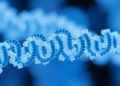
A genetically engineered yeast is producing a laboratory-made version of human type III collagen that folds into the same distinctive triple-helix architecture as natural collagen and assembles into fibrils with the characteristic banding pattern seen in native tissue. In a study published in Applied Microbiology and Biotechnology, researchers report that their engineered strain of Komagataella phaffii generated 430 milligrams of recombinant human type III collagen procollagen per liter in a 5-liter fed-batch bioreactor. The result could help address a longstanding challenge in biomaterials science: making full-length, biologically active human collagen without relying on animal tissues.
Collagen is the most abundant structural protein in mammals, forming a resilient molecular framework in skin, blood vessels, tendons, organs and the extracellular matrix surrounding cells. Type III collagen is a fibrillar collagen that often occurs alongside type I collagen and contributes to the flexibility and integrity of soft tissues. Its value in medicine extends beyond simple structural support. Collagen-based materials can provide scaffolds for wound healing, tissue engineering, regenerative medicine and cell culture because cells recognize and interact with the protein’s molecular surfaces. Yet obtaining human type III collagen in useful quantities is difficult, while collagen extracted from animals can vary between batches and may carry risks associated with immune reactions, contamination or species-specific biological differences.
The central engineering problem is that collagen is not merely a long protein chain that can be produced and purified. The collagen molecule must undergo a series of chemical and structural processing steps before it becomes functional. Three collagen α chains wind around one another to form a right-handed triple helix, a configuration stabilized by a repeating amino-acid sequence rich in glycine and proline. Many of the proline residues must first be converted into hydroxyproline by enzymes known as prolyl 4-hydroxylases. This post-translational modification strengthens the triple helix and helps determine whether newly synthesized collagen can fold correctly, remain stable and assemble into higher-order fibrils.
To recreate that process in yeast, Zhijian Ni and colleagues redesigned the N-terminal and C-terminal propeptides attached to the human type III collagen α1 chain. These terminal regions are normally involved in controlling collagen assembly and secretion. The researchers altered them rationally while preserving the chain’s intrinsic ability to form a triple helix. The strategy was intended to make the protein more compatible with the host microorganism’s production machinery without sacrificing the structural behavior that distinguishes authentic human collagen from incomplete or improperly folded recombinant fragments.
The team then tuned the yeast’s enzymatic environment to increase proline hydroxylation. Their approach combined human P4Hαβ, a form of prolyl 4-hydroxylase containing alpha and beta components, with BaP4H, a prolyl 4-hydroxylase derived from Bacillus anthracis. Working together, the enzymes raised the measured hydroxyproline level of the recombinant product to 52.88 percent. That modification enabled the collagen chains to assemble into stable homotrimeric procollagen molecules larger than 300 kilodaltons. Procollagen is the soluble precursor of mature collagen; after secretion and further processing, its molecules can align and organize into the fibrils that provide mechanical strength in tissues.
Improving molecular quality was only part of the challenge. The researchers also had to increase the amount of protein made and successfully transported through the yeast cell. They screened strains carrying different numbers of copies of the collagen-production construct, because adding copies of a gene can increase output but can also place stress on the cell or disrupt the balance between synthesis, folding and secretion. The team additionally replaced the signal sequence that directs the nascent protein through the secretory pathway. Among the signal sequences tested, Ost1 produced the strongest improvement. Signal sequences function like molecular routing labels, guiding newly made proteins into the endoplasmic reticulum, where many secreted proteins fold and undergo processing.
The investigators further co-expressed molecular chaperones, proteins that help other proteins fold correctly and prevent them from aggregating inside the cell. Their experiments included BCY1 and ERO1, among other factors. ERO1 supports the formation and maintenance of disulfide bonds in the endoplasmic reticulum, while chaperone systems help manage the burden created when a cell is pushed to manufacture large amounts of a complex secreted protein. By combining enzyme engineering, strain selection, signal-sequence substitution and folding assistance, the researchers created a production system that reached 430 milligrams of recombinant type III collagen procollagen per liter in a 5-liter fed-batch bioreactor. Fed-batch cultivation gradually supplies nutrients during growth, allowing microbial cultures to maintain productive conditions for longer than a simple batch culture.
The purified protein also displayed several features expected of functional collagen. Thermal analysis gave it a melting temperature of 38.87 degrees Celsius, indicating that the triple helix remained stable within a biologically relevant temperature range, although its thermal behavior is not identical to that of every native collagen preparation. The protein self-assembled into fibrils showing a D-banding pattern, the repeating nanoscale striations created when collagen molecules align with a characteristic axial stagger. D-banding is an important structural signature because it reflects organized fibril formation rather than random protein aggregation. The findings suggest that the engineered yeast produced collagen capable of progressing beyond molecular folding to a higher level of tissue-like organization.
In cell-based biological assays, the recombinant collagen promoted cell proliferation, adhesion and migration at levels comparable to natural collagen. These behaviors are essential for many possible biomedical uses. Adhesion allows cells to attach to a scaffold, proliferation supports the expansion of cell populations, and migration is central to wound repair and tissue remodeling. The results do not by themselves establish that the material is ready for implantation or clinical treatment, since those applications require extensive testing of purity, immunogenicity, mechanical performance, degradation, sterilization and manufacturing consistency. Nevertheless, they indicate that the yeast-derived material retained biological cues that cells can detect and use.
The work offers a potentially sustainable route to human collagen production, but its most important advance may be the integration of several solutions into one manufacturing platform. Earlier recombinant systems have often struggled with incomplete collagen chains, insufficient hydroxylation, poor secretion or unstable folding. By addressing these bottlenecks together, the researchers produced full-length type III collagen with the molecular organization needed for fibril formation and measurable cell activity. The study was supported in part by the Guangzhou Postdoctoral Research Project and a major research and development program of Guangzhou Trauer Biotechnology, with cultivation assistance from Qi Da’s team. Further scale-up will be needed to determine whether the 5-liter result can translate efficiently to industrial bioreactors, where oxygen transfer, viscosity, nutrient gradients and purification costs become more demanding. If those hurdles can be overcome, engineered K. phaffii could become a practical source of animal-free human collagen for regenerative medicine, advanced biomaterials and controlled laboratory models of human tissue.
Subject of Research: Recombinant full-length human type III collagen produced in engineered Komagataella phaffii
Subject of Research: Biology
Article Title: Enhanced biosynthesis of full-length triple-helical human type III collagen in engineered Komagataella phaffii
Article References: Ni, Z., Yu, X., Da, Q., Wu, X., Wei, Z., Hu, Y., Xiao, Y., Ye, C., & Deng, C. (2026). Enhanced biosynthesis of full-length triple-helical human type III collagen in engineered Komagataella phaffii. Applied Microbiology and Biotechnology. https://doi.org/10.1007/s00253-026-13996-7
Image Credits: AI Generated
DOI: 10.1007/s00253-026-13996-7
Keywords: human type III collagen, Komagataella phaffii, recombinant collagen, prolyl 4-hydroxylase, triple helix, procollagen, fibril assembly, tissue engineering
Cite Scienmag News
APA MLA Chicago
Alden T. (August 29, 2026). Engineered Komagataella phaffii Boosts Full-Length Human Type III Collagen Production. Scienmag. https://scienmag.com/engineered-komagataella-phaffii-boosts-full-length-human-type-iii-collagen-production/
Alden T. “Engineered Komagataella phaffii Boosts Full-Length Human Type III Collagen Production.” Scienmag, 29 August 2026, https://scienmag.com/engineered-komagataella-phaffii-boosts-full-length-human-type-iii-collagen-production/. Accessed 29 August 2026.
Alden T. “Engineered Komagataella phaffii Boosts Full-Length Human Type III Collagen Production.” Scienmag. August 29, 2026. https://scienmag.com/engineered-komagataella-phaffii-boosts-full-length-human-type-iii-collagen-production/
Copy citation Download RIS
Tags: advances in biomaterials scienceanimal-free collagen productionapplications of collagen in wound healingbioreactor production of human collagenbioreactor-based collagen expressioncollagen fibril assembly in biotechnologycollagen scaffolds for regenerative medicinecollagen’s role in tissue engineering and regenerative medicineengineered yeast for human collagen productionfull-length human collagen synthesisfull-length human type III collagen synthesisgenetically engineered yeastgenetically engineered yeast for tissue engineeringKomagataella phaffiiKomagataella phaffii recombinant collagenmicrobial biomanufacturing of collagenmicrobial expression systems for collagenovercoming animal tissue variability in collagenproduction of biologically active human collagenrecombinant human type III collagen productionstructural properties of type III collagen