AMES, Iowa – Materials engineers don’t like to see line defects in functional materials.
The structural flaws along a one-dimensional line of atoms generally degrades performance of electrical materials. So, as a research paper published today by the journal Science reports, these linear defects, or dislocations, “are usually avoided at all costs.”
But sometimes, a team of researchers from Europe, Iowa State University and the U.S. Department of Energy’s Ames Laboratory report in that paper, engineering those defects in some oxide crystals can actually increase electrical performance.
The research team – led by Jürgen Rödel and Jurij Koruza of the Technical University of Darmstadt in Germany – found certain defects produce significant improvements in two key measurements of electrical performance in barium titanate, a crystalline ceramic material.
“By introducing these defects into the material, we can change, modify or improve the material’s functional properties,” said Xiaoli Tan, an Iowa State professor of materials science and engineering and a longtime research collaborator with Rödel.
In this case, the engineered defects led to a five-fold increase in dielectric properties (that restrict the flow of current) and a 19-fold increase in piezoelectric properties (that internally generates an electric field when subject to mechanical stress), Tan said.
Special tools for special measurements
In addition to Tan, two other Iowa State researchers helped the project’s international research team explore fundamental materials questions: Lin Zhou, a scientist in materials science and engineering and the U.S. Department of Energy’s Ames Laboratory; and Binzhi Liu, a doctoral student in materials science and engineering.
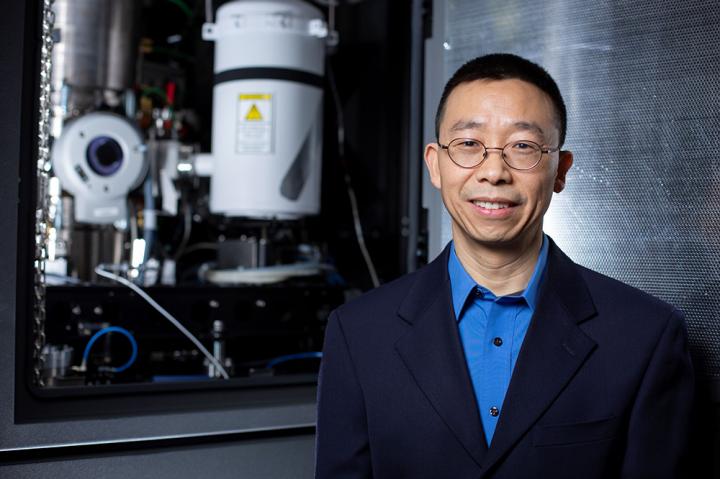
With support from the National Science Foundation, the three contributed their expertise in transmission electron microscopy – technology that can show the structures and features of materials by shooting a beam of electrons through thin samples and recording an image. The images have much higher resolution than light microscopy and can show fine details down to the scale of individual atoms.
Key to the project was the Ames Laboratory’s Sensitive Instrument Facility built in cooperation with Iowa State. The building was built in 2015 with nearly $10 million from the Department of Energy. It provides a vibration- and static-free environment for electron microscopy at the highest possible resolutions.
“It’s a state-of-the-art electron microscopy facility,” Zhou said. “It provides an ultra-stable environment so we can achieve atom-level images of material and at the same time acquire chemical information.
“It’s a great platform for research and educating the next generation of materials scientists.”
A better material for capacitors?
For this project, the electron microscopy team quantified the evidence that line defects in a crystalline material can boost electrical performance, Liu said.
The numbers showed that “the dislocations can significantly alter the behavior of other fine features in the material,” Liu said.
Tan said the finding could have big implications for the electrical capacitor industry.
There are hundreds of capacitors in your cell phone and the market for them is huge, Tan said. The ceramic material tested in this project has been widely used in capacitors, but the defect-induced boost in electrical performance could make it better. It is also lead-free and less-toxic than other material options.
And so, the researchers wrote, these engineered line defects could turn into “a different suite of tools to tailor functional materials.” And this “functional harvesting” could be good for our electronics, and even our environment and health.
###
Read the paper
“Control of polarization in bulk ferroelectrics by mechanical dislocation imprint,” Science, May, 28, 2021.
The research team
Iowa State University: Xiaoli Tan, Binzhi Liu
Iowa State/Ames Laboratory: Lin Zhou
Technical University of Darmstadt, Germany: Marion Höfling, Xiandong Zhou, Enrico Bruder, Fangping Zhuo, Bai-Xiang Xu, Karsten Durst, Jurij Koruza, Jürgen Rödel
EPFL, the Swiss Federal Institute of Technology in Lausanne: Lukas Riemer, Dragan Damjanovic
Delft University of Technology, Netherlands: Pedro Groszewicz
Media Contact
Xiaoli Tan, Materials Science and Engineering
[email protected]
Original Source
https:/
Related Journal Article
http://dx.