• HOME
  • NEWS
  • EXPLORE
    • CAREER
      • Companies
      • Jobs
    • EVENTS
    • iGEM
      • News
      • Team
    • PHOTOS
    • VIDEO
    • WIKI
  • BLOG
  • COMMUNITY
    • FACEBOOK
    • INSTAGRAM
    • TWITTER
Friday, June 5, 2026
BIOENGINEER.ORG
No Result
View All Result
  • Login
  • HOME
  • NEWS
  • EXPLORE
    • CAREER
      • Companies
      • Jobs
        • Lecturer
        • PhD Studentship
        • Postdoc
        • Research Assistant
    • EVENTS
    • iGEM
      • News
      • Team
    • PHOTOS
    • VIDEO
    • WIKI
  • BLOG
  • COMMUNITY
    • FACEBOOK
    • INSTAGRAM
    • TWITTER
  • HOME
  • NEWS
  • EXPLORE
    • CAREER
      • Companies
      • Jobs
        • Lecturer
        • PhD Studentship
        • Postdoc
        • Research Assistant
    • EVENTS
    • iGEM
      • News
      • Team
    • PHOTOS
    • VIDEO
    • WIKI
  • BLOG
  • COMMUNITY
    • FACEBOOK
    • INSTAGRAM
    • TWITTER
No Result
View All Result
Bioengineer.org
No Result
View All Result
Home NEWS Science News Chemistry

Engineered bacterial biofilms immobilizing nanoparticles enable diverse catalytic applications

Bioengineer by Bioengineer
September 20, 2019
in Chemistry
Reading Time: 3 mins read
0
IMAGE
Share on FacebookShare on TwitterShare on LinkedinShare on RedditShare on Telegram

IMAGE

Credit: ©Science China Press

Nano-scale objects (1 – 100 nm) are desirable nano-catalysts featured with more catalytic active sites due to higher surface-area-to-volume ratios. The nano-scale nature brings several attendant challenges such as leakage of nano-catalysts to ambient environment and difficulties in reusing nanocatalysts over repeated reaction cycles. A major strategy for addressing these challenges has been the immobilization of nano-objects on various substrates via a variety of technological approaches. However, inorganic and bio-derived or bio-inspired substrates obviously lack “biology-only” attributes like self-regeneration, cellular-growth-based scalability, and the ability of cells to biosynthesize complex enzymes, substrates, co-enzymes, or other required reagents or reaction components in situ. Moreover, studies that have immobilized nano-objects directly on cell surfaces have reported damage to cells.

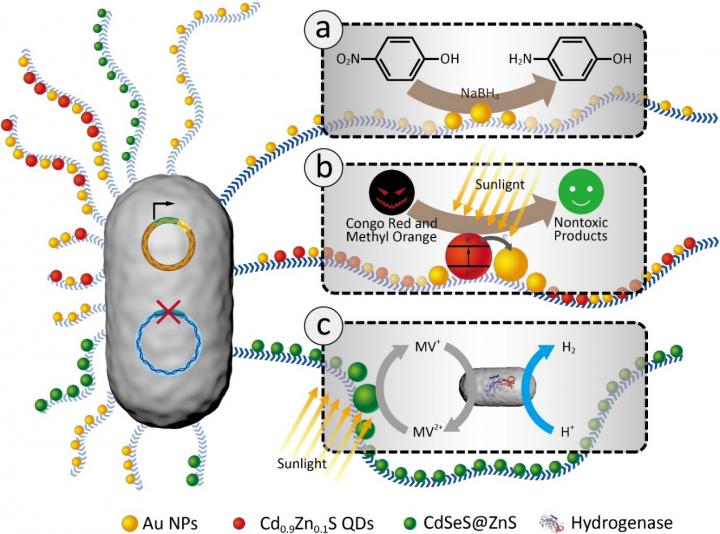
The Zhong group from the Materials and Physical Biology Division, at ShanghaiTech University has made a major conceptual advance in developing a new abiotic/biotic interface towards the integration and immobilization of nanoscale objects with living cells for catalysis. Very briefly, they successfully showed how engineered amyloid monomers expressed, secreted and assembled in the extracellular matrix of living Escherichia coli (E. coli) biofilms can be harnessed to anchor functional nano-scale catalysts to make highly efficient, scalable, tunable, and reusable living catalyst systems. In their proof-of-concept studies, they have demonstrated three simple catalytic systems, including biofilm-anchored gold nanoparticles to degrade the pollutant p-nitrophenol, biofilm-anchored hybrid Cd0.9Zn0.1S quantum dots (QDs) and gold nanoparticles to efficiently degrade organic dyes, and biofilm-anchored CdSeS@ZnS QDs in a dual bacterial strain semi-artificial photosynthesis system for hydrogen production. As revealed in their studies, the extracellular matrix in biofilms indeed provides an ideal milieu for interfacing and anchoring nano-objects for direct catalysis and for their integration with the metabolism of living cells: even after multiple rounds of reactions, nano-catalysts were still robustly anchored to biofilms and the E. coli cells were still alive for easy regeneration. Importantly, such an approach would open up the extremely powerful and unique attributes of living systems.

There is a large diversity of bacterial biofilms with different functionalities in nature, and their study thus lays the conceptual foundation for coupling the uniquely dynamic properties and capacities of these living materials with the highly reactive nanoparticles to innovatively solve challenges in bioremediation, bioconversion, and energy. Their research will spur further research for creating more efficient and industrially important reaction systems by building and integrating more intricate biofilms/inorganic hybrid catalytic systems.

###

See the article:

Xinyu Wang†, Jiahua Pu†, Yi Liu, Fang Ba, Mengkui Cui, Ke Li, Yu Xie, Yan Nie, Qixi Mi, Tao Li, Lingli Liu, Manzhou Zhu, Chao Zhong

Immobilization of functional nano-objects in living engineered bacterial biofilms for catalytic applications

https://doi.org/10.1093/nsr/nwz104

The National Science Review is the first comprehensive scholarly journal released in English in China that is aimed at linking the country’s rapidly advancing community of scientists with the global frontiers of science and technology. The journal also aims to shine a worldwide spotlight on scientific research advances across China.

Media Contact
Chao Zhong
[email protected]

Related Journal Article

http://dx.doi.org/10.1093/nsr/nwz104

Tags: Chemistry/Physics/Materials Sciences
Share12Tweet8Share2ShareShareShare2

Related Posts

Biochar and Beneficial Fungi Collaborate to Rehabilitate Soils Degraded by Coal Mining — Chemistry

Biochar and Beneficial Fungi Collaborate to Rehabilitate Soils Degraded by Coal Mining

June 4, 2026
Boston University Partners with National Science Foundation Institute to Advance Frontiers in Physics and AI — Chemistry

Boston University Partners with National Science Foundation Institute to Advance Frontiers in Physics and AI

June 4, 2026

JWST Successfully Measures Mass of Dormant Black Hole from the Early Universe for the First Time

June 4, 2026

Commonwealth Fusion Systems Leverages SPARC Insights to Publish Five Peer-Reviewed Papers Validating ARC Fusion Power Plant Physics

June 4, 2026
Please login to join discussion

POPULAR NEWS

  • ESMO 2025: mRNA COVID Vaccines Enhance Efficacy of Cancer Immunotherapy

    321 shares
    Share 128 Tweet 80
  • Multi-Hospital Study Reveals Long Covid Burden Is Twice as High as Current Estimates

    88 shares
    Share 35 Tweet 22
  • Saying Goodbye to PGY-6: Pediatric Fellowship Realities

    76 shares
    Share 30 Tweet 19
  • Common Food Preservatives Associated with Elevated Blood Pressure and Increased Heart Disease Risk

    57 shares
    Share 23 Tweet 14

About

We bring you the latest biotechnology news from best research centers and universities around the world. Check our website.

Follow us

Recent News

Respiratory and Feeding Milestones in Late Preterm Infants

Here’s a revised version of your headline for a science magazine post: “After Years of Searching, We Discovered ‘The Heaven Sword’ — East Asia’s Tallest Tree”

Evaluating Neuroprotective Drugs in Neonatal Rodent Brain Injury

Subscribe to Blog via Email

Success! An email was just sent to confirm your subscription. Please find the email now and click 'Confirm' to start subscribing.

Join 82 other subscribers
  • Contact Us

Bioengineer.org © Copyright 2023 All Rights Reserved.

Welcome Back!

Login to your account below

Forgotten Password?

Retrieve your password

Please enter your username or email address to reset your password.

Log In
No Result
View All Result
  • Homepages
    • Home Page 1
    • Home Page 2
  • News
  • National
  • Business
  • Health
  • Lifestyle
  • Science

Bioengineer.org © Copyright 2023 All Rights Reserved.