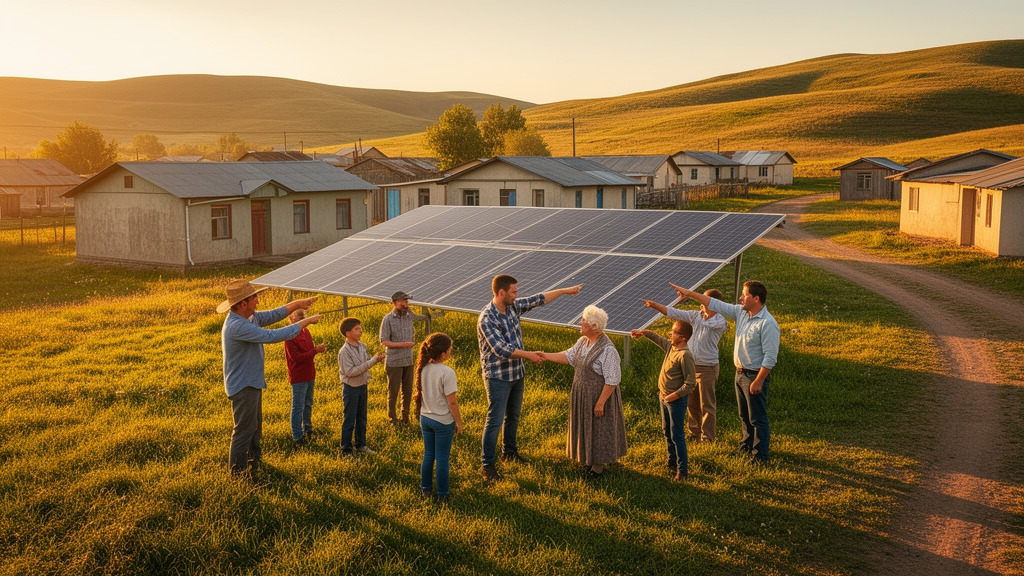
Rural America holds some of the nation’s richest renewable energy resources, yet many of these communities still struggle with unreliable service, volatile fuel prices, and deep economic insecurity. A new Perspective published on 19 February 2026 in Frontiers in Sustainable Energy Policy argues that this paradox is not primarily a technology problem. According to authors Lacour M. Ayompe of the University of California, Irvine, and Long Pham of University College Cork in Ireland, the decisive factor is governance: who owns, controls, and benefits from emerging energy systems. Their analysis, drawing on a narrative synthesis of more than fifty community-driven solar, wind, biomass, and cooperative initiatives active between 2015 and 2024, concludes that Energy Democracy, anchored in participation, ownership, equity, and sustainability, offers a more durable path to rural revitalization than hardware deployment alone.
The evidence base is striking in its consistency. Ayompe and Pham reviewed academic and gray literature on community-driven energy projects across the United States, supplementing the U.S. focus with selective international examples to show that the relationship between local governance and project acceptance is a fundamental socio-technical dynamic rather than an American anomaly. Across solar arrays, wind farms, biomass facilities, and cooperative utilities, the pattern held: economic gains, social acceptance, and environmental improvements emerged not from the machines themselves but from institutional arrangements that supported local agency. Where communities could shape, own, and benefit from projects, transitions succeeded. Where they could not, even technically sound installations met resistance.
Ownership emerged as one of the strongest predictors of positive outcomes. Cooperative and municipal models reinvest revenue locally, generating broader economic spillovers than developer-led projects. Solar and biomass initiatives reduced household energy costs and strengthened energy security, while job creation followed a similar logic: employment grew when communities participated directly in governance, whereas externally controlled projects produced limited or short-term employment. When residents hold ownership stakes or voting rights, the authors found, they are more likely to support projects and reinvest benefits locally. Ownership, in this framing, functions as a governance tool that anchors transitions in local identity, giving communities authority over pricing, siting, and benefit distribution in ways that align with agricultural preservation and long-term planning.
Social acceptance, meanwhile, proved inseparable from process design. Initiatives that embedded participation through public meetings, cooperative membership, or advisory committees reported higher trust and long-term support, because these structures allowed residents to influence siting and negotiate benefits. Wind projects illustrate the consequences of weak governance: despite generating tax revenue, many face resistance rooted in landscape change and noise concerns. Utility-scale solar encounters similar tensions when farmland is displaced. The authors emphasize that conflict arises not from the technologies themselves but from governance arrangements that marginalize local voices, a problem deepened in regions with histories of environmental harm or extractive industry dominance, where skepticism toward outside developers runs high.
The concept of socio-technical fit adds a technical dimension to the argument. Technologies interact with rural economies and landscapes in distinct ways, and mismatches breed backlash. Solar’s modularity enables deployment in communities with limited technical capacity, though large-scale installations can trigger land-use conflict. Wind delivers strong environmental benefits but requires transmission infrastructure that many rural regions lack. Biomass aligns naturally with agricultural economies but depends on reliable feedstock supply chains and logistics. The clearest example of alignment is agrivoltaics, a dual-use model that integrates energy production with farming on the same land. Transitions falter, the authors argue, when technologies are deployed without regard for local capacity, resource conditions, or cultural values.
Energy Democracy reframes rural energy projects as civic institutions rather than mere infrastructure. Ayompe and Pham contend that the pillars of participation and ownership operate as functional mechanisms, not just values: they reduce transaction costs in the form of conflict and increase economic retention. Public meetings and informational sessions alone rarely translate into meaningful influence; participation without authority does little to build trust or legitimacy. The framework addresses distrust by embedding accountability mechanisms into governance structures, ensuring communities shape rather than merely respond to energy development. Projects that embed community authority through cooperatives, municipal utilities, or structured participation achieve higher acceptance and more durable benefits, while developer-led models that limit local input often encounter resistance.
The authors also confront a common objection head-on: the assumption that community involvement slows climate action. Their evidence suggests the opposite. While engagement may lengthen early planning, it reduces long-term delays caused by litigation, siting disputes, and social resistance. Projects that invest early in democratic governance move more smoothly through permitting and face fewer appeals. In their memorable phrasing, “slow is smooth, and smooth becomes fast.” Democratic governance, they conclude, is not a barrier to speed but a prerequisite for avoiding the costly slowdowns associated with top-down development, a finding with significant implications for how policymakers weigh engagement costs against deployment timelines.
Current policy frameworks, however, are ill-suited to this vision. Federal and state programs typically reward megawatts installed through tax credits and procurement mandates, favoring large developers over community-led initiatives and doing little to support community ownership or participatory governance. The authors propose treating governance as infrastructure, arguing that participatory institutions and benefit-sharing mechanisms are as essential as transmission lines. Their policy roadmap includes “Smart Zoning” to mitigate land-use conflicts, reformed siting and permitting with early-stage consultation, rural siting councils, and binding benefit-sharing agreements, expanded loan guarantees and low-interest financing for cooperative ownership, long-term feedstock contracts for biomass supply chains, targeted grid modernization to address rural transmission and interconnection constraints, and simplified permitting pathways with technical assistance to level the playing field for small communities.
The authors are candid about implementation challenges. Limited administrative capacity and fiscal resources hinder effective project management in many rural areas. Local control does not guarantee equity: without well-designed participatory structures, initiatives risk capture by local elites and the reproduction of existing power asymmetries. Participatory processes can slow early planning, trading deployment speed for legitimacy and durable community support. Robust capacity building, they argue, is therefore essential to prevent exclusion and ensure that energy democracy delivers genuine empowerment rather than reinforcing structural inequities, a caution that distinguishes their analysis from uncritical advocacy for local control.
The Perspective closes with a call for empirical validation. Future research should prioritize longitudinal comparative studies measuring specific outcomes such as permitting duration, litigation rates, and local economic retention across different governance models, quantifying what the authors call “governance dividends” to move the field from conceptual framing to evidence-based policy design. The stakes extend well beyond academia: as the United States accelerates its clean energy transition, rural communities will play a decisive role, and the authors argue that rural revival will not emerge from hardware alone but from institutions that empower communities to direct their own transitions, negotiate trade-offs, and capture long-term value. The opportunity, they write, is unmistakable: a rural energy future defined not by extraction or imposition, but by agency, ownership, and collective possibility.
Subject of Research: Energy Democracy and Rural Energy Transitions
Article Title: Beyond technology: why energy democracy is the engine of rural revival
Article References: Ayompe, L. M., & Pham, L. (2026). Beyond technology: why energy democracy is the engine of rural revival. Frontiers in Sustainable Energy Policy, 5, Article 1788325. https://doi.org/10.3389/fsuep.2026.1788325
Image Credits: AI Generated
DOI: 10.3389/fsuep.2026.1788325
Keywords: energy democracy, rural energy, community ownership, renewable energy policy, participatory governance, socio-technical systems, rural resilience, just transition, Beyond, technology, energy, democracy
News Source: Denise Maddox. (October 17, 2026). Energy democracy, not hardware, drives rural revival, study argues. Scienmag.