A modified surgical approach combining arthroscopic-assisted uni-portal spinal surgery with the bridge-crane decompression technique demonstrated technical feasibility and preliminary canal decompression in a retrospective series of 17 patients with severe short-segment thoracic ossification of the ligamentum flavum. Reporting in the European Journal of Medical Research, investigators evaluated the preliminary clinical and radiographic outcomes of applying non-coaxial endoscopic visualization to elevate and stabilize the ossified complex through a limited posterior exposure.
In the single-center cohort, researchers evaluated patients presenting with symptomatic myelopathy and one- or two-segment ossification exhibiting an anteroposterior occupying rate exceeding 50 percent. The objective of the study was to describe the technical modification and evaluate its initial procedural feasibility and patient outcomes.
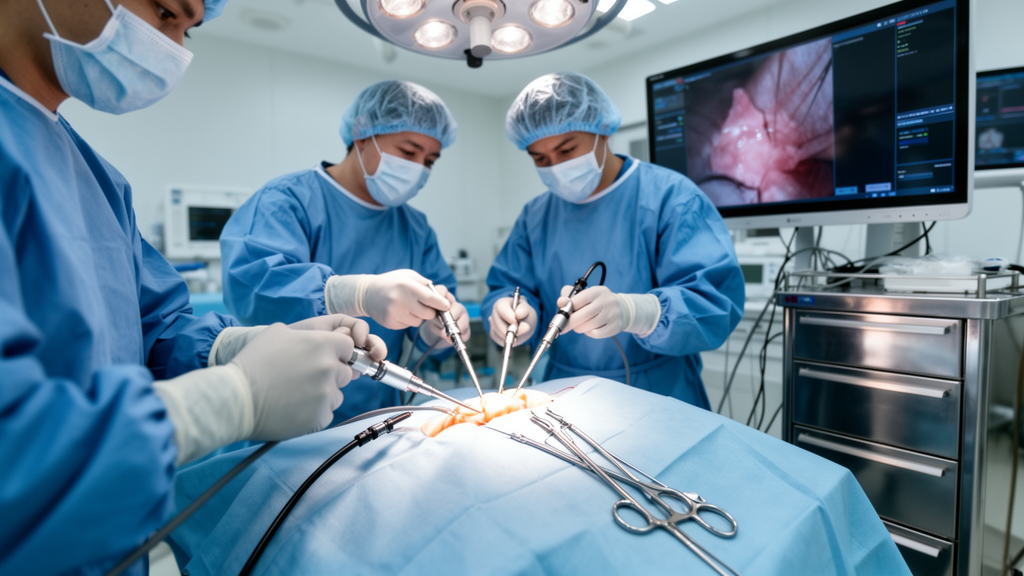
During the intervention, surgical teams accessed the affected thoracic level using an arthroscopic-assisted uni-portal endoscopic system. The lamina–ossified ligamentum flavum complex was systematically released under non-coaxial endoscopic visualization. Rather than complete surgical excision, the complex was elevated with a lifting suture and anchored to the cranial lamina or spinous-process base using a small plate, proceeding without caudal instrumentation or supplementary bone grafting.
Patients underwent clinical evaluations and computed tomography imaging preoperatively, on postoperative days 2 to 4, and across a mean follow-up period of 12.5 months, ranging from 6 to 22 months. Statistical comparisons over time were conducted utilizing Friedman tests alongside Wilcoxon signed-rank tests with Holm correction to determine changes in spinal cord spacing, canal encroachment, pain levels, and functional recovery.
Radiographic measurements revealed marked reductions in canal compromise following the procedure. The mean reserve space for the cord at the edge decreased from 66.6 percent preoperatively to 13.2 percent on postoperative days 2 to 4, remaining at 13.3 percent at final follow-up. Concurrently, the anteroposterior occupying rate dropped from a preoperative mean of 73.8 percent to 21.5 percent shortly after surgery and remained stable at 21.5 percent at the final assessment.
Neurological and pain assessments showed consistent postoperative functional gains despite temporary early discomfort. Median modified Japanese Orthopaedic Association scores improved from 10 points preoperatively to 17 points in the early postoperative window and reached 18 points at final follow-up. Median visual analogue scale pain scores initially increased from 3 points preoperatively to 5 points on postoperative days 2 to 4 before declining to 1 point at final evaluation.
Observed procedural complications were limited within the evaluated cohort. One patient developed immediate postoperative lower-limb weakness, experiencing a decrease in muscle strength from grade 3 preoperatively to grade 2 upon emergence from anesthesia, which subsequently improved to grade 4 by postoperative day 2. The investigators documented no occurrences of cerebrospinal fluid leakage or intraspinal hematoma formation throughout the perioperative or follow-up periods.
The researchers concluded that larger prospective comparative studies are required to more fully evaluate safety profiles, functional outcomes, and long-term mechanical stability of the plate fixation.
Subject of Research: Endoscopic bridge-crane decompression for severe thoracic ossification of the ligamentum flavum
Article Title: Arthroscopic-assisted uni-portal spinal surgery (AUSS) combined with the bridge-crane technique for severe thoracic ossification of the ligamentum flavum: a preliminary retrospective case series
Article References: Niu, Z., Zhao, Q., Zhang, X., Zhang, Z., Wang, Z., Song, E., Sun, K., Zhang, B., Shi, J., & Sun, J. (2026). Arthroscopic-assisted uni-portal spinal surgery (AUSS) combined with the bridge-crane technique for severe thoracic ossification of the ligamentum flavum: a preliminary retrospective case series. European Journal of Medical Research. https://doi.org/10.1186/s40001-026-05455-w
Image Credits: AI Generated
DOI: 10.1186/s40001-026-05455-w
Keywords: thoracic ossification of the ligamentum flavum, spinal surgery, endoscopic decompression, arthroscopic-assisted uni-portal spinal surgery, bridge-crane technique, thoracic myelopathy, ligamentum flavum, spinal canal decompression, lamina elevation, minimally invasive spine surgery, modified Japanese Orthopaedic Association score, visual analogue scale, computed tomography, retrospective case series, reserve space for the cord at the edge, anteroposterior occupying rate
News Source: Ophelia Keating. (November 20, 2026). Endoscopic Bridge-Crane Technique Shows Technical Feasibility in Thoracic Spinal Ossification. Scienmag.