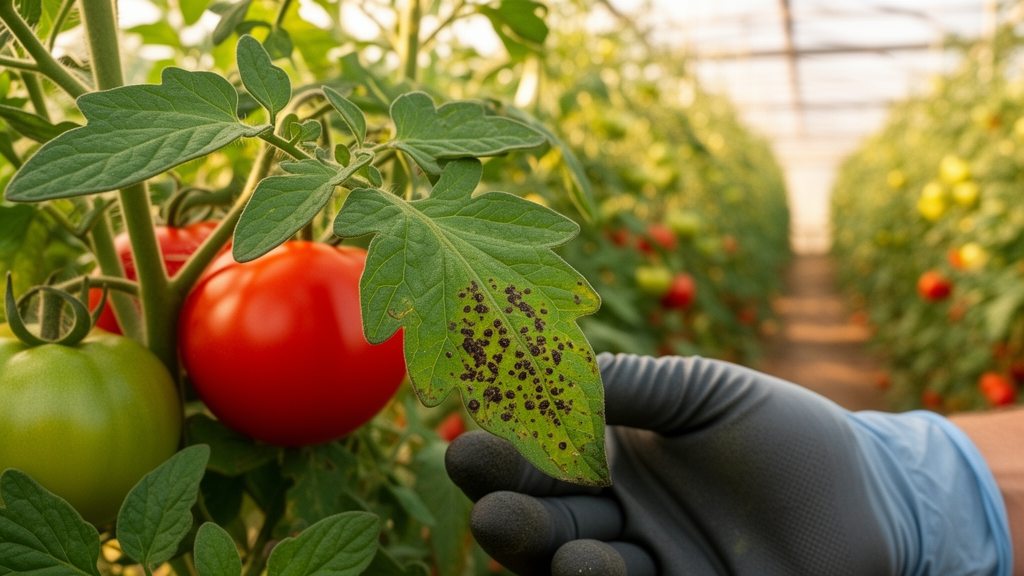
Bacterial speck, a foliar disease of tomato caused by the bacterium Pseudomonas syringae pv. tomato (Pst), has long frustrated growers because copper compounds and antibiotics often fail as the pathogen rapidly develops resistance while retaining high habitat fitness. A new open-access study published on 10 April 2026 in the Egyptian Journal of Biological Pest Control reports that two endophytic Bacillus strains isolated from healthy tomato plants significantly reduced disease severity in greenhouse trials, offering a potential sustainable alternative to chemical bactericides within integrated disease management strategies.
Researchers Munirah F. Aldayel and Nashwwa M. A. Sallam screened fifteen bacterial isolates collected from various healthy tomato plants, obtained from the culture collection of the Laboratory of Phytopathology at King Abdulaziz University in Saudi Arabia. In dual culture tests on Tryptic Soy Agar, the isolates displayed a broad range of antibacterial activity against Pst, with inhibition zones ranging from 0.17 to 1.33 centimeters and statistically significant differences among treatments at p ≤ 0.05. Isolate KAU7 produced the strongest inhibition, measuring 1.33 ± 0.02 centimeters, which was not significantly different from the streptomycin control at 1.20 ± 0.08 centimeters. Isolates KAU11 and KAU15 also showed significant inhibition, with zones of 1.23 ± 0.19 and 1.18 ± 0.06 centimeters respectively, while a second group comprising KAU12, KAU33, KAU4 and KAU5 showed intermediate activity between 0.80 and 0.92 centimeters. The remaining isolates produced inhibition zones below 0.40 centimeters.
Based on these results, KAU7 and KAU11 were selected as the most promising candidates for molecular identification and mechanistic characterization. Sequencing of the 16S rRNA gene and phylogenetic analysis placed the two isolates within the genus Bacillus, clustering closely with reference strains of Bacillus halotolerans and Bacillus paralicheniformis deposited in NCBI, with sequence similarity of at least 98 percent confirming their identities. This is notable because, according to the authors, the biocontrol capabilities of these two particular endophytic species against Pst had never been systematically reported before.
Biochemical profiling of the two strains revealed several traits associated with both pathogen suppression and plant growth promotion. Both isolates solubilized phosphate, with KAU11 showing very strong activity and KAU7 moderate activity. Siderophore production, which can starve pathogens of iron, was high in KAU7 and moderate in KAU11. Both strains also synthesized indole-3-acetic acid, a plant hormone, with higher generation in KAU11. The authors interpret this combination of direct antagonism, nutrient competition and growth promotion as evidence that disease suppression by these strains is likely multicomponent rather than attributable to a single mechanism.
The greenhouse evaluation used tomato seedlings of the common variety Super Strain B grown in pots. The researchers applied the bacterial suspensions, adjusted to 10⁸ colony-forming units per milliliter, by three delivery methods: foliar spray, seed soaking for ten minutes before sowing, and soil drenching. Each treatment included five replicates of four plants, with sterile water as a negative control, pathogen suspension alone as a positive control, and streptomycin at 0.02 percent as an antibiotic reference. Plants were covered with polythene bags for 48 hours to initiate infection, symptoms appeared after 14 days, and disease severity was scored on a 0 to 3 scale based on the number of spots per leaflet. The experiment was repeated twice.
The untreated inoculated plants developed disease severity of 90 to 92 percent, confirming successful pathogen establishment. Both Bacillus treatments significantly reduced severity compared with the infected untreated control. B. paralicheniformis performed best, holding severity to 32 percent under foliar spray, 45 percent under soil drench and 39 percent under seed treatment, a reduction range the abstract reports as 32 to 45 percent depending on application method. B. halotolerans reduced severity to between 45 and 63 percent depending on the method. Streptomycin remained the most effective treatment overall, maintaining severity at 15 to 20 percent, so both biocontrol strains, while significant, were less effective than the antibiotic.
The treatments also enhanced plant growth. Pst infection caused a dramatic reduction in plant vigor, with inoculated control plants recording the lowest fresh weights of 2.4 to 3.0 grams and dry weights of 0.9 to 1.2 grams per plant. B. halotolerans-treated plants nearly attained the fresh weights of healthy control plants, which ranged from 6.2 to 7.2 grams, and streptomycin treatment produced biomass levels comparable to B. halotolerans. B. paralicheniformis also enhanced growth but yielded slightly lower fresh and dry weights than B. halotolerans.
Defense-related enzyme activity provided a possible explanation for part of the disease suppression. Fifteen days after treatment, peroxidase activity was significantly induced in all treated plants and in both healthy and infected controls. B. paralicheniformis showed the highest peroxidase levels, reaching up to 3.23 micrograms per milligram of protein, especially through foliar spray and seed treatment. Polyphenol oxidase followed a similar pattern, with B. halotolerans producing the strongest induction at 1.5 to 1.7 micrograms per milligram of protein, while B. paralicheniformis also significantly increased the enzyme relative to all controls and streptomycin produced a moderate enhancement. These enzymes contribute to plant defense through lignification, oxidative crosslinking of cell wall proteins and the synthesis of antimicrobial phenolic compounds, and the authors suggest that induced systemic resistance acts as a complementary mechanism to the direct antagonism of the strains.
The authors are careful to frame these findings as preliminary. They note that biocontrol agents currently marketed in Europe generally provide only partial and rarely complete protection, and that biological control typically produces a symptomatic rather than curative effect. Greenhouse and pot experiments cannot capture the variability of open-field conditions, so extrapolation to commercial production requires validation through multi-location field testing and formulation studies. They also caution that enzyme induction is not a definite guarantee of resistance: the strength and timing of defense responses, cross-talk between salicylic acid, jasmonic acid and ethylene signaling pathways, and the potential metabolic costs of prolonged oxidative defense activation all warrant further investigation using gene-specific markers.
Within those limits, the study broadens the spectrum of Bacillus species known to hold potential against bacterial speck and highlights endophytic bacteria, which reside within internal plant tissues without causing disease, as an understudied source of biocontrol agents. Internal colonization may give endophytes a closer association with host tissues and more persistent antagonism than surface colonizers. The authors conclude that deploying these strains in commercial tomato production will require additional research on formulation, persistence, field efficacy and interactions with indigenous microbiota, but that B. halotolerans and B. paralicheniformis represent promising candidates for growers seeking residue-free, sustainable alternatives to chemical bactericides.
Subject of Research: Endophytic Bacillus strains as biocontrol agents against bacterial speck disease of tomato
Article Title: Using certain endophytic bacteria as biocontrol agents against bacterial speck disease of tomato
Article References: Aldayel, M. F., & Sallam, N. M. A. (2026). Using certain endophytic bacteria as biocontrol agents against bacterial speck disease of tomato. Egyptian Journal of Biological Pest Control, 36(1), Article 18. https://doi.org/10.1186/s41938-026-00896-1
Image Credits: AI Generated
DOI: 10.1186/s41938-026-00896-1
Keywords: bacterial speck, tomato, Pseudomonas syringae pv. tomato, Bacillus halotolerans, Bacillus paralicheniformis, endophytic bacteria, biocontrol agents, greenhouse trial, plant growth promotion, defense enzymes, peroxidase, polyphenol oxidase
News Source: Drew Townsend. (October 29, 2026). Endophytic Bacillus Strains Suppress Bacterial Speck Disease in Tomato. Scienmag.