A clinical report published in Frontiers in Cardiovascular Medicine demonstrates that infectious intracranial aneurysms within the posterior cerebral circulation can emerge dynamically following acute ischemic stroke in infective endocarditis, even after initial vascular imaging shows no abnormalities. Investigators documented the clinical progression of a twenty-seven-year-old woman who experienced an acute ischemic stroke and was subsequently diagnosed with severe mitral endocarditis and evolving aneurysms at the basilar tip and left posterior cerebral artery. The case details a complex sequence in which cerebral infarction preceded visible aneurysmal dilatation, illustrating how septic emboli compromise arterial architecture over time. Accompanied by a literature review of thirty-seven patients across thirty reports, the investigation underscores the necessity of maintaining diagnostic suspicion and repeating cerebrovascular evaluations before undertaking open cardiac surgery under cardiopulmonary bypass.
The patient presented to a primary hospital with acute right-sided numbness and weakness, diplopia, and aphasia, following a one-week history of fever reaching 38.6 degrees Celsius, sore throat, and headache. Her background was negative for cardiovascular disease, prior infective endocarditis, recent dental or invasive procedures, intravenous drug use, or immunosuppression. At initial evaluation, she was alert with a National Institutes of Health Stroke Scale score of 3. Emergency non-contrast computed tomography, computed tomography angiography, and perfusion imaging revealed no intracranial hemorrhage, large-vessel occlusion, or perfusion deficits. Intravenous alteplase was administered at thirty-nine milligrams 2.5 hours after symptom onset in accordance with acute stroke protocols. Following thrombolytic administration, high fever and coma developed, prompting blood culture collection and urgent transfer to West China Hospital at Sichuan University for neurocritical management.
Upon arrival, the comatose patient demonstrated round, equal pupils with sluggish light reflexes, unassessable limb strength, and absent pathological reflexes. Vital signs showed a blood pressure of 114 over 71 millimeters of mercury and a heart rate of ninety-eight beats per minute, with an apical holosystolic blowing murmur. Inadequate spontaneous ventilation required endotracheal intubation and mechanical ventilation for seven days, with metaraminol administered for hemodynamic support. Emergency non-contrast cranial computed tomography suggested subarachnoid hemorrhage, which remained stable on hospital day three. Lumbar puncture performed on day three yielded bloody cerebrospinal fluid containing over 20,000 times ten to the sixth red blood cells per liter, confirming subarachnoid hemorrhage, while cerebrospinal fluid cultures remained sterile.
Three blood cultures obtained during hospitalization yielded no bacterial growth; the first, collected on day one, was reported negative on day five. However, on hospital day six, the pre-transfer blood culture results became available, identifying Streptococcus gordonii susceptible to penicillin, ampicillin, ceftriaxone, meropenem, levofloxacin, and vancomycin. Meropenem was subsequently replaced with intravenous penicillin at six million units every six hours. Concurrently, blood metagenomic next-generation sequencing detected Enterococcus faecium, prompting the infectious diseases team to add adjunctive intravenous clindamycin at 0.6 grams every six hours. Magnetic resonance imaging conducted on hospital day seven, following extubation and clinical stabilization, revealed a recent infarct in the left thalamus.
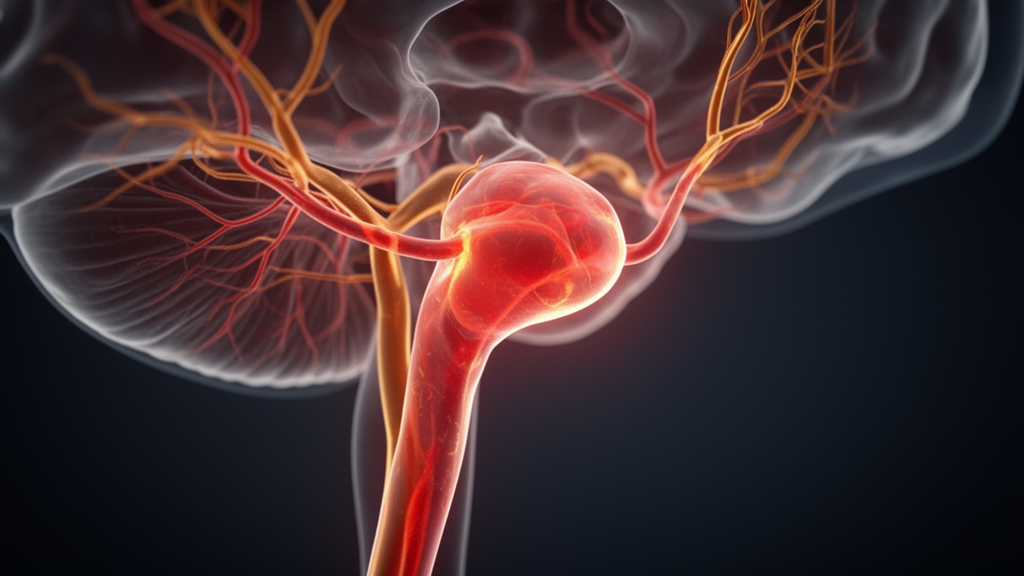
Repeat computed tomography angiography performed on hospital day seventeen for preoperative cerebrovascular assessment demonstrated newly detectable aneurysms at the basilar artery tip and the left posterior cerebral artery P1 segment. Confirmatory digital subtraction angiography performed on hospital day twenty-three delineated a 6.1-millimeter by 6.1-millimeter basilar-tip aneurysm with a 2.5-millimeter neck, alongside a 3.4-millimeter by 2.1-millimeter left posterior cerebral artery P1 aneurysm. Endovascular simple coil embolization was performed on day twenty-three using an Excelsior SL-10 microcatheter without stent assistance. Four Complex Fill coils and one Complex Xtrasoft coil were placed in the basilar-tip aneurysm, while one Helical Xtrasoft coil was deployed in the left P1 aneurysm, achieving complete occlusion and preserving parent-artery patency.
Severe mitral regurgitation and the substantial embolic hazards of the twenty-one-millimeter vegetation necessitated cardiac surgical repair once the cerebrovascular lesions were definitively stabilized. On hospital day thirty, seven days following successful endovascular embolization, the patient underwent mitral valve repair under cardiopulmonary bypass with systemic heparinization. Intraoperative exploration revealed active vegetations, leaflet perforation, and structural defects in the A2 and P2 segments. Surgeons performed comprehensive debridement, direct closure of the A2 defect, posterior leaflet reconstruction, and implantation of a twenty-eight-millimeter annuloplasty ring, avoiding bioprosthetic replacement. Intraoperative transesophageal echocardiography confirmed restored leaflet coaptation with only mild residual regurgitation. Metagenomic sequencing of the excised vegetation identified 22,426 reads of Streptococcus gordonii, with a relative abundance of 53.03 percent, confirming the microbiological diagnosis without detecting additional pathogens. On postoperative day one, penicillin was replaced with intravenous ceftriaxone at two grams every twelve hours, maintained for eight weeks postoperatively.
The patient completed an overall antibiotic course lasting approximately twelve weeks and achieved a favorable clinical recovery. At her three-month follow-up evaluation, she was independently ambulatory with right-sided limb strength restored to 5/5, and transthoracic echocardiography showed no significant abnormalities, although follow-up digital subtraction angiography had not yet been performed. The authors noted that neurological complications occur in roughly twenty-five percent of left-sided infective endocarditis episodes in large multicenter cohorts, with mitral valve involvement and Staphylococcus aureus infection serving as independent risk factors. While staphylococci predominate in modern endocarditis registries, oral streptococci including Streptococcus gordonii remain significant causative pathogens capable of producing severe valvular destruction and septic cerebral embolization. Infectious intracranial aneurysms represent rare complications detected in approximately one percent of infective endocarditis cases within prospective cohorts, though their true incidence may be underestimated in the absence of systematic routine cerebrovascular imaging.
Pathophysiologically, septic embolization provides a direct mechanistic bridge linking cerebral infarction to delayed aneurysm formation. When septic emboli dislodge from infected cardiac vegetations, they can occlude cerebral arteries and seed bacterial infection into the vessel wall. This microbial infiltration provokes transmural arteritis, degrading structural components of the vessel wall and resulting in progressive dilatation. In published magnetic resonance imaging series, ischemic lesions were localized to the anatomical distribution of six out of thirty-three infectious intracranial aneurysms. Serial angiographic literature further confirms aneurysm development at arterial sites previously occupied by septic occlusions, including the basilar apex. Anatomically, the posterior cerebral artery P1 segments arise directly from the basilar bifurcation and give origin to the thalamoperforating arteries. In this patient, this vascular relationship accounts for the regional coexistence of the left thalamic infarct and the basilar-tip and P1 aneurysms through impaired perforator perfusion and local arterial wall infection.
The accompanying review of thirty-seven patients across thirty published reports from 1989 to 2026 revealed that posterior circulation involvement is exceptionally rare, documented in only seven individuals, with basilar artery involvement identified in four cases. In several reviewed cases, initial neurovascular imaging was similarly negative despite preceding ischemic strokes. Wang and colleagues described brainstem and cerebellar infarction followed by the emergence of multiple basilar aneurysms that were not present on initial computed tomography angiography. Similarly, a cohort study of 115 patients with left-sided infective endocarditis identified five patients whose initial magnetic resonance angiography failed to show aneurysms that were subsequently detected by computed tomography or digital subtraction angiography. Angiographic literature also demonstrates that intracranial hemorrhage strongly correlates with aneurysm presence; infectious intracranial aneurysms were detected in approximately twenty-two percent of endocarditis patients presenting with intracranial hemorrhage, compared to only one percent of those without bleeding.
The case report highlights significant dangers associated with administering intravenous thrombolysis in the setting of unrecognized infective endocarditis. Thrombolysis in endocarditis-related stroke can precipitate intracranial bleeding from cerebral vessels compromised by septic arteritis. A nationwide observational study reported post-thrombolytic intracerebral hemorrhage in twenty percent of patients with endocarditis-associated ischemic stroke, compared to 6.5 percent among patients without endocarditis. Consequently, European Stroke Organisation guidelines recommend against intravenous thrombolysis in patients with known or suspected infective endocarditis. The presence of acute fever, cardiac murmurs, or systemic signs of infection in stroke patients demands comprehensive evaluation for an infectious embolic source before thrombolytic therapies are considered. In this patient, endocarditis was recognized only after post-alteplase neurological deterioration and subarachnoid hemorrhage, emphasizing that clinical signs of infection must prompt caution and targeted cardiovascular assessment during emergency stroke triage.
Finally, the clinical course underscores management strategies and limitations governing infectious intracranial aneurysms. Relying exclusively on antibiotic therapy poses risks; an observational study noted angiographic resolution in only twenty-eight percent of unruptured aneurysms, while a prospective cohort observed rupture in eight of twenty-five patients, and another cohort reported medical management failure in fifteen of thirty-one aneurysms. European Society of Cardiology guidelines recommend intervention for enlarging aneurysms and endorse preoperative endovascular treatment before cardiac valve surgery, supported by series documenting no post-surgical intracranial hemorrhages among twenty patients treated endovascularly prior to cardiac operations. Staging endovascular coiling prior to heparinized bypass successfully protected this patient. The authors acknowledged study limitations: a single case report cannot determine the optimal interval between coiling and valve surgery, the link between infarction and aneurysms relies on anatomical and temporal association, and long-term durability requires verification through future angiography.
Subject of Research: Clinical course and staged management of posterior circulation infectious intracranial aneurysms in infective endocarditis
Article Title: Case Report: Thalamic infarction and evolving posterior circulation infectious aneurysms in infective endocarditis
Article References: Hu, H., Ma, Y., Wang, Z., Shang, R., Ji, M., Wang, T., Tao, S., & Zhang, C. (2026). Case Report: Thalamic infarction and evolving posterior circulation infectious aneurysms in infective endocarditis. Frontiers in Cardiovascular Medicine, 13, Article 2018267. https://doi.org/10.3389/fcvm.2026.2018267
Image Credits: AI Generated
DOI: 10.3389/fcvm.2026.2018267
Keywords: infectious intracranial aneurysms, infective endocarditis, Streptococcus gordonii, posterior circulation, thalamic infarction, subarachnoid hemorrhage, intravenous thrombolysis, alteplase, coil embolization, mitral valve repair, digital subtraction angiography, computed tomography angiography, basilar tip aneurysm, posterior cerebral artery, septic cerebral embolism, metagenomic next-generation sequencing, cardiopulmonary bypass
News Source: Cassandra Pierce. (November 26, 2026). Endocarditis Case Reveals Delayed Posterior Circulation Aneurysms After Stroke Thrombolysis. Scienmag.