A research team led by Anant Kumar, Salam Maheshkumar Singh, Akshay Kumar, Supravat Bairagya, Bhupendra M. Ghodki, and Prem Prakash Srivastav has demonstrated that microencapsulating okra mucilage within a cassava starch matrix creates an effective, heat-stable clarifying agent for sugarcane juice and jaggery production. The study, published in Food Production, Processing and Nutrition, addresses critical processing challenges in the traditional sweetener sector, where raw sugarcane juice requires thorough clarification to remove suspended colloidal impurities, plant waxes, proteins, and insoluble debris before concentration. By encapsulating bioactive mucilage extracted from both the fruit and peduncle tissues of okra (Abelmoschus esculentus L.) via freeze-drying, the researchers produced a shelf-stable powder that significantly altered the clarifying dynamics of heated juice. When introduced at an optimal dosage of one gram per liter during rapid ohmic heating, the encapsulated mucilage achieved a forty-five percent improvement in clarification efficiency, increasing total scum removal by 1.45-fold relative to untreated control samples. Simultaneously, the formulation suppressed the vigorous foaming characteristic of boiling cane juice, cutting foam capacity from an initial 410 percent down to 250 percent at one gram per liter and 130 percent at two grams per liter, establishing a sustainable, plant-derived alternative to synthetic clarifying agents.
Clarification represents an essential unit operation in jaggery and sugar manufacture, as freshly crushed juice extracted from Saccharum officinarum is an intricate, highly perishable aqueous dispersion rich in sucrose, glucose, and fructose alongside suspended solids and organic acids. Without rapid destabilization and removal of colloidal particles, these non-sugar impurities degrade the clarity, coloration, taste, and keeping quality of the final processed jaggery. While synthetic chemical clarifiers are conventionally deployed to accelerate sedimentation and scum formation, growing consumer demand for additive-free foods has stimulated interest in biodegradable, non-toxic plant hydrocolloids. Fresh okra mucilage has long been recognized as a functional coagulant due to its viscous, water-soluble polysaccharide chains; however, its practical application has been constrained by severe raw material perishability, seasonal harvesting windows, and rapid thermal breakdown under open-pan boiling. To circumvent these industrial hurdles, the authors evaluated microencapsulation using cassava starch as a protective wall material. Cassava starch offers a relatively low amylose content of approximately twenty percent, facilitating swift, efficient core release upon thermal exposure while shielding sensitive phytochemical constituents during storage, thereby transforming perishable botanical extracts into free-flowing, accurately dosable powders suitable for year-round manufacturing.
To establish the most efficient source of raw hydrocolloids, the researchers systematically compared three distinct extraction protocols across both okra fruits (prepared without peduncles) and excised peduncles cut into segments measuring one to 1.5 centimeters. The first protocol, conventional solvent precipitation, involved soaking diced tissues in water at a 1:10 sample-to-water ratio for six hours to hydrate and soften plant structures, filtering the suspension through muslin cloth, precipitating the mucilage with an equal volume of ethanol for thirty minutes, purifying the collected floccules with acetone, and drying the residue at 30 degrees Celsius for 24 hours. This conventional method yielded an extraction recovery of only 1.00 percent for both fruit and peduncle tissues, limited by incomplete cell wall disruption. Implementing a grinding-centrifugation approach with centrifugation at 4000 revolutions per minute for ten minutes improved recovery to 3.50 percent for fruit and 2.03 percent for peduncle. Crucially, an ultrasonic water bath-assisted extraction performed at 35 degrees Celsius for thirty minutes achieved the highest mucilage yields, reaching 11.67 percent in fruit and 10.03 percent in peduncles. The acoustic cavitation generated by ultrasonic waves disrupted tough botanical cell walls through transient micro-bubble implosions, releasing intracellular polysaccharides without inflicting structural degradation and reducing processing time.
Subsequent proximate composition analyses of the isolated mucilage powders confirmed pronounced compositional divergences between the reproductive fruit pods and the structural peduncle tissues. Okra fruit mucilage exhibited substantially higher crude protein levels than peduncle mucilage, reflecting the metabolic demands and nutrient storage dedicated to seed development, whereas the peduncle displayed significantly lower protein fractions. Conversely, peduncle tissues registered higher crude fat concentrations, consistent with their role in vascular transport and energetic storage for vegetative support, while the fruit concentrated water-soluble saccharides. Because the peduncle serves as a rigid physical support column for the hanging pod, it contained substantially greater crude fiber concentrations composed predominantly of cellulose and lignin. The fruit mucilage, by contrast, yielded significantly less crude fiber, aligned with its softer, animal-dispersed biological role. Moisture content was also noticeably higher in the vascular peduncle than in the fruit tissue. Carbohydrate estimations derived from AOAC international standard protocols revealed that fruit mucilage accumulated higher overall carbohydrate percentages, representing concentrated reservoirs of functional starches and pectic polysaccharides, whereas the peduncle contained a denser proportion of insoluble structural matter and reduced soluble sugars.
Microencapsulation of the isolated mucilage powders was carried out by dispersing either fruit or peduncle mucilage with cassava starch in distilled water at a 1:10 core-to-wall weight ratio, utilizing water volume equal to five times the mass of the starch carrier. Each dispersion was homogenized by magnetic stirring at 300 revolutions per minute for fifteen minutes at ambient room temperature, transferred to deep freezing at minus 80 degrees Celsius for 48 hours, and subsequently lyophilized in a freeze dryer maintained at minus 35 degrees Celsius under a controlled vacuum of 0.1 millibar for 24 hours. The resulting friable cakes were gently milled with a mortar and pestle into uniform powders. Quantitative spectrophotometric analysis conducted at a wavelength of 490 nanometers following ethyl acetate phase separation indicated an encapsulation efficiency of 61 plus or minus two percent for the fruit mucilage, compared to 56 plus or minus three percent for the peduncle mucilage. The superior entrapment efficiency achieved with fruit mucilage was attributed to its higher concentration of soluble, highly branched polysaccharide chains, which established tighter intermolecular cross-linking and cohesive interactions with the gelatinized cassava starch wall matrix.
Microstructural and crystallographic evaluations demonstrated profound structural reorganization following lyophilized encapsulation. X-ray diffraction diffractograms of native okra mucilage exhibited broad, diffuse amorphous halos centered at a diffraction angle of 2 theta equals 21 degrees, corresponding to low baseline crystallinities of 33.52 percent for raw fruit mucilage and 29.02 percent for native peduncle mucilage. Following cassava starch microencapsulation, the diffractograms exhibited two prominent, sharp diffraction peaks located near 19 degrees and 24 degrees 2 theta, reflecting significantly heightened long-range molecular ordering. Crystallinity increased to 55.23 percent in the encapsulated fruit sample and surged to 78.25 percent in the encapsulated peduncle formulation, demonstrating strong composite matrix formation. These crystallographic shifts were corroborated by field emission gun-scanning electron microscopy, which revealed that native, unencapsulated mucilage particles possessed rough, disordered, loosely aggregated, and irregular amorphous surfaces devoid of definite boundaries. In contrast, the microencapsulated formulations displayed well-defined spherical or semispherical particle morphologies featuring smooth outer surface topographies, verifying that the gelatinized cassava starch wall envelope had uniformly surrounded and entrapped the core biopolymers into discrete, robust microcapsules.
Thermophysical assessments confirmed that composite microencapsulation substantially improved thermal stability and altered heat transfer dynamics relative to raw mucilage. Measured via transient line heat source analysis, encapsulated peduncle mucilage exhibited the highest volumetric heat capacity at 0.881 megajoules per cubic meter-kelvin, whereas raw fruit mucilage registered the lowest value at 0.820 megajoules per cubic meter-kelvin. Encapsulated fruit mucilage recorded the highest thermal diffusivity at 0.292 square millimeters per second, compared to just 0.154 square millimeters per second in native fruit, alongside a leading thermal conductivity of 0.302 watts per meter-kelvin and the lowest thermal resistivity at 330.8 degrees Celsius-centimeter per watt. Native fruit mucilage demonstrated sluggish heat conduction, recording a low conductivity of 0.127 watts per meter-kelvin and a high resistivity of 790.3 degrees Celsius-centimeter per watt. Differential scanning calorimetry established that encapsulation elevated the glass transition temperature, reaching 74.8 degrees Celsius in the encapsulated composite, while lifting peak thermal degradation temperatures to 94.69 degrees Celsius for encapsulated fruit and 93.5 degrees Celsius for encapsulated peduncle, with final degradation completing at 149.34 and 151.7 degrees Celsius, respectively. Phase transition enthalpy decreased from 400.8 joules per gram in raw fruit to 309.2 joules per gram post-encapsulation, shifting toward cassava starch characteristics.
Chromatographic characterization of carbohydrate profiles through ultra-performance liquid chromatography using refractive index and diode array detection provided molecular insight into the primary constituents driving coagulation. Hydrolyzed oven-dried okra mucilage displayed a dominant chromatographic peak at a retention time of 7.67 minutes corresponding to polygalacturonic acid, which accounted for 44.04 percent of the total peak area. A second major peak eluting at 10.340 minutes constituted 40.65 percent of the total area, representing a co-eluting mixture of rhamnose and arabinose monosaccharide fractions characteristic of pectic rhamnogalacturonan branches. Sucrose was detected at 13.320 minutes with 5.67 percent area, while mannose eluted at 18.370 minutes with 6.94 percent area. Analysis of hydrolyzed cassava starch confirmed glucan breakdown into D-glucose at 13.614 minutes (51.41 percent area) and residual maltose at 48.59 minutes (48.59 percent area). Non-hydrolyzed native cassava starch displayed native free sugars including D-glucose at 8.505 minutes (74.56 percent), a co-eluting xylose and xylulose fraction at 10.381 minutes (22.20 percent), maltose at 12.686 minutes (0.70 percent), and trehalose at 13.266 minutes (2.54 percent area), underscoring the structural stability of the carrier.
Complementary liquid chromatography-mass spectrometry and Fourier-transform infrared spectroscopy identified the bioactive polyphenols and functional groups preserved within the microcapsules. LC-MS profiling identified quinic acid, shikimic acid, chlorogenic acid, and p-coumaroylquinic acid in native fruit, along with key flavonoid glycosides including quercetin-3-O-glucoside, quercetin-3-malonylglucoside, rutin, and high-molecular-weight rhamnogalacturonan-I fragments. Peduncle extracts shared similar phenolic acids alongside feruloylquinic acid and quercetin derivatives. Encapsulated fruit mucilage retained substantial monosaccharide concentrations alongside intact quercetin-3-O-glucoside and rutin, while encapsulated peduncle preserved catechin, epigallocatechin gallate, and rutin within rhamnose-rich polysaccharide matrices. FTIR spectroscopy displayed hallmark saccharide absorption bands, including hydroxyl O-H stretching vibrations centered at 3430 reciprocal centimeters, aliphatic C-H stretching vibrations at 2931 reciprocal centimeters, and amide contributions at 1646 reciprocal centimeters. Additional bands at 1425 and 1375 reciprocal centimeters corresponded to CH2 asymmetric bending and C-O stretching of alcohols and ethers, while dense fingerprint bands between 1200 and 900 reciprocal centimeters reflected C-O-H bending and C-O and C-C skeletal stretchings across native mucilage, microcapsules, and jaggery blends.
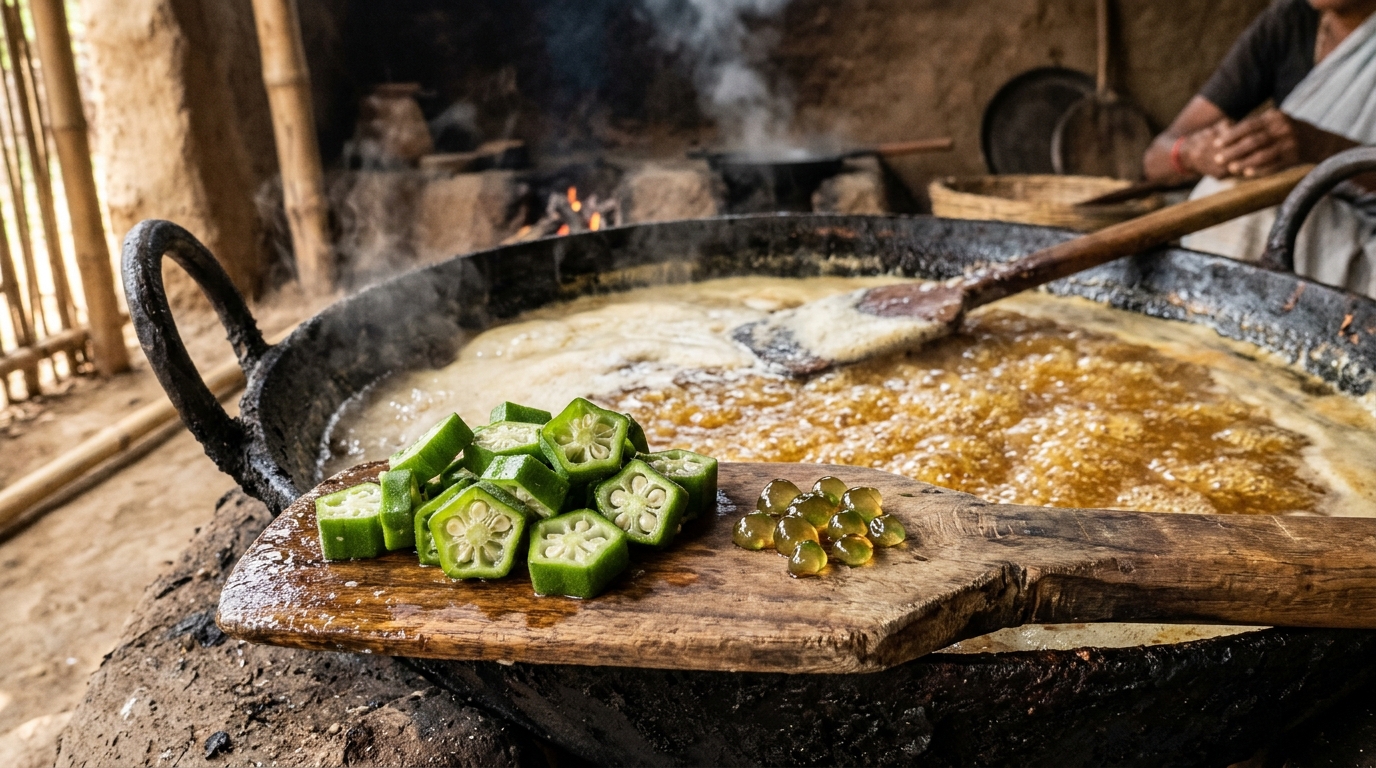
The practical clarifying performance of the microencapsulated mucilage was ultimately demonstrated in ohmic heating experiments involving two liters of raw sugarcane juice heated rapidly to 96 to 100 degrees Celsius within two minutes. Untreated control juice generated extensive foam, exhibiting an initial foaming capacity of 410 percent and a foam stability of 48 percent after one hour of standing, driven by endogenous surface-active molecules. Dosing encapsulated fruit mucilage at one gram per liter sharply reduced foaming capacity to 250 percent and foam stability to 13 percent, while a two-gram-per-liter concentration further lowered capacity to 130 percent and stability to five percent, an effect caused by elevated system viscosity and weak interfacial strength at air-water boundaries. Crucially, the one-gram-per-liter dosage boosted scum removal efficiency from 3.1 percent weight-by-weight in controls up to 4.5 percent weight-by-weight, marking a 1.45-fold increase in impurity capture. This separation was driven by synergistic charge-charge neutralization of anionic polysaccharides against juice waxes and proteins, cationic bridging by multivalent metal ions, and extended polymer chain entrapment within the heated medium, providing an effective bio-based processing method for sustainable commercial jaggery manufacture.
Subject of Research: Microencapsulation of okra mucilage for sugarcane juice clarification
Article Title: Microencapsulation of okra mucilage: extraction, characterization, and potential application in jaggery processing
Article References: Kumar, A., Singh, S. M., Kumar, A., Bairagya, S., Ghodki, B. M., & Srivastav, P. P. (2026). Microencapsulation of okra mucilage: extraction, characterization, and potential application in jaggery processing. Food Production, Processing and Nutrition, 8(1), Article 86. https://doi.org/10.1186/s43014-026-00439-z
Image Credits: AI Generated
DOI: 10.1186/s43014-026-00439-z
Keywords: okra mucilage, microencapsulation, cassava starch, jaggery processing, sugarcane juice clarification, food technology, ultrasonic extraction, bioactive polysaccharides, okra, mucilage, extraction, characterization
News Source: Alan Morgan. (November 7, 2026). Encapsulated Okra Mucilage Improves Clarification and Foam Control in Jaggery Processing. Scienmag.