Credit: WVU
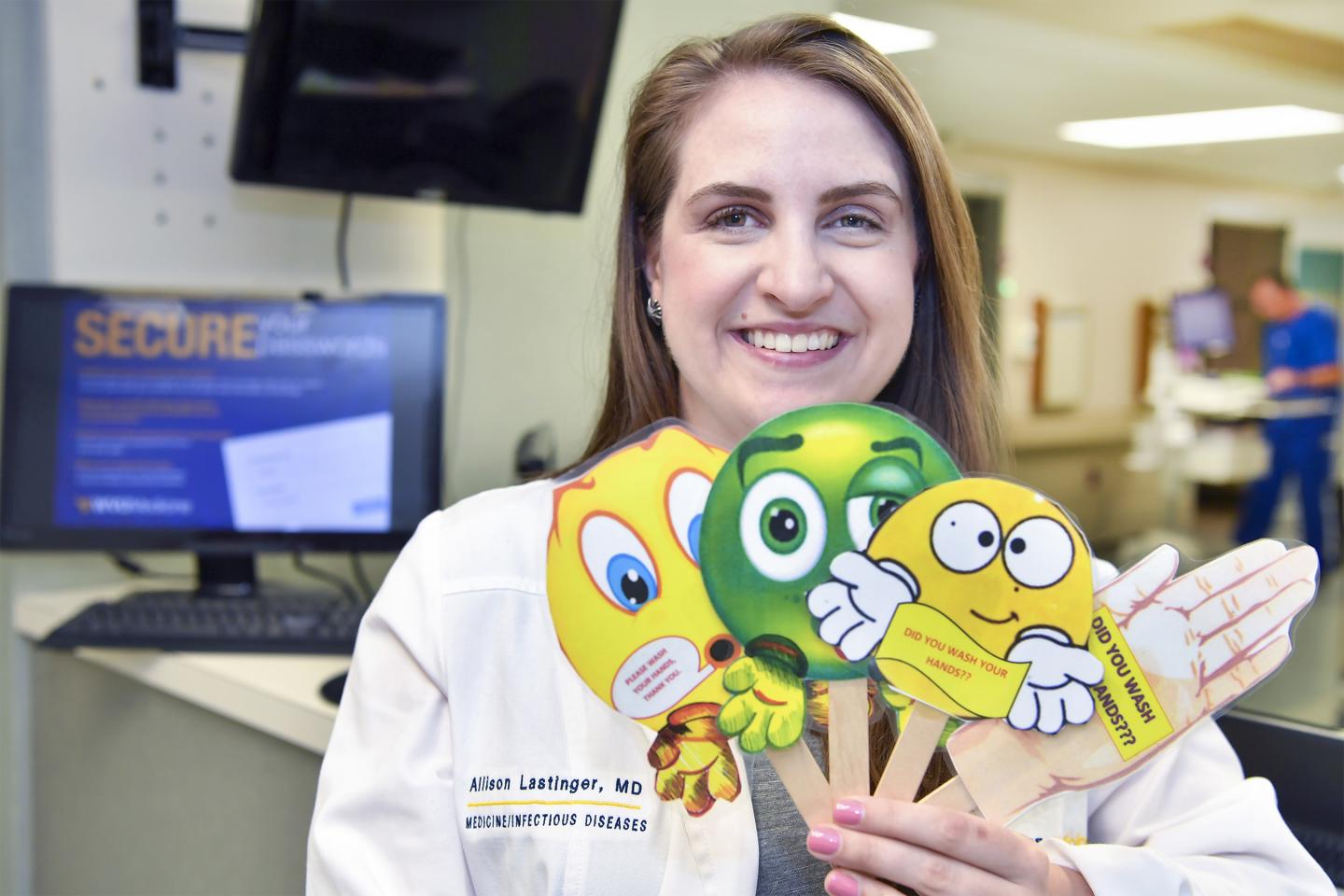
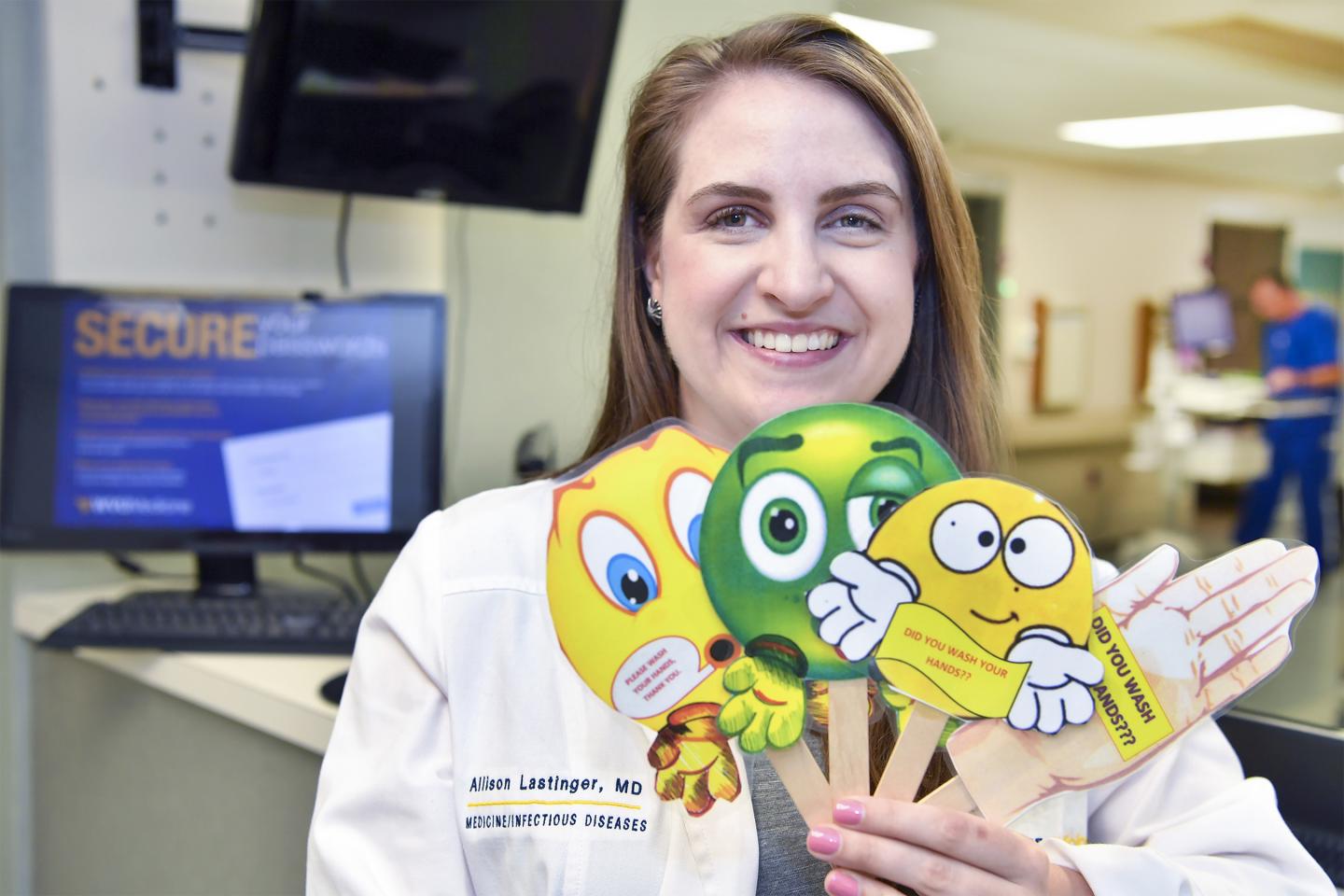
Arlington, VA, Aug. 15, 2017 – Armed with new tools, patients and parents felt empowered to remind healthcare providers to perform hand hygiene, successfully improving compliance rates, but just over half of physicians felt that patients should be reminding providers, according to a new study published in the August issue of the American Journal of Infection Control, the official journal of the Association for Professionals in Infection Control and Epidemiology (APIC).
Healthcare-associated infections (HAIs) contribute to significant rates of illness and mortality, with an estimated five to ten percent of patients admitted to acute care hospitals in the United States acquiring an HAI. Most HAIs are preventable, and the single most effective measure to reduce HAIs is hand hygiene.
Allison Lastinger, MD, of the West Virginia University (WVU) School of Medicine, led a multidisciplinary research team that performed a cross-sectional survey of parents of hospitalized children, adult patients, and primary care physicians at the WVU Medicine J.W. Ruby Memorial Hospital, a 645-bed tertiary care teaching hospital in Morgantown, WV. Using an anonymous, self-administered questionnaire, the multidisciplinary research team — which included Kayeromi Gomez, PhD, of the WVU School of Public Health, Ellen Manegold, BA, of the WVU Department of Psychology, and Rashida Khakoo, MD, of the WVU School of Medicine — examined their attitudes toward a new patient empowerment tool (PET) at the hospital. The parent and patient surveys were distributed from December 2015 to June 2016; the physician survey was distributed in November 2015.
"Patient involvement is increasingly recognized as an important component of hand hygiene improvement strategies," said Linda Greene, RN, MPS, CIC, FAPIC, 2017 APIC president. "Organizations must realize that patients and families are an important part of the healthcare team, and their involvement in hand hygiene campaigns should be encouraged."
A total of 222 adult patients and parents completed the survey (108 adult patients and 114 parents). Most adult patients (64 percent) and parents (70 percent) said the PET made them feel more in control of their care. Most parents (77 percent for physicians and 81.4 percent for nurses) and adult patients (64.8 percent for physicians and 71.2 percent for nurses) felt comfortable using the PET to remind healthcare workers to perform hand hygiene. Researchers noted, however, that parents were nearly 20 percent more likely than adult patients to speak up if a physician did not perform hand hygiene. In Ruby Memorial Hospital, hand hygiene rates increased from 48 percent in 2015 to approximately 75 percent in 2016 as a result of the hospital's multipronged initiative to increase handwashing rates among its healthcare providers. "Forty-eight percent is pretty standard," said lead study author Dr. Lastinger, "so 75 percent is phenomenal."
Among 89 healthcare provider responses (29 residents and 60 attending physicians), only 54.9 percent felt that patients should be involved in reminding providers to perform hand hygiene. Overall, physicians indicated that they would prefer a patient make the request verbally, rather than using the PET to remind them to perform hand hygiene.
Of the physicians who did not support patient involvement, 37 percent felt that it was not the patient's responsibility to remind physicians to perform hand hygiene; 16 percent felt that it was embarrassing to the doctor; and 13 percent felt that it would have a negative impact on the patient-physician relationship.
While a number of studies have examined the role of patient involvement in healthcare worker hand hygiene, few have examined the role of family members in reminding healthcare providers to perform hand hygiene. However, the study notes that if patient involvement is to be successful, healthcare workers must accept it as helpful and not as a threat, which proved to be somewhat of an obstacle in this instance.
"Based on the results of this study, patient empowerment appears to be an effective strategy to facilitate healthcare workers' adherence to hand hygiene, but acceptance of the PET by providers remains a challenge," said Lastinger. "Barriers to hand hygiene adherence among healthcare providers should be identified and addressed."
###
Visit http://www.apic.org for more resources on proper hand hygiene.
Media Contact
Andrea Fetchko
[email protected]
202-683-3193
@elseviernews
http://www.elsevier.com
Related Journal Article
http://dx.doi.org/10.1016/j.ajic.2017.02.010