• HOME
  • NEWS
  • EXPLORE
    • CAREER
      • Companies
      • Jobs
    • EVENTS
    • iGEM
      • News
      • Team
    • PHOTOS
    • VIDEO
    • WIKI
  • BLOG
  • COMMUNITY
    • FACEBOOK
    • INSTAGRAM
    • TWITTER
Sunday, May 10, 2026
BIOENGINEER.ORG
No Result
View All Result
  • Login
  • HOME
  • NEWS
  • EXPLORE
    • CAREER
      • Companies
      • Jobs
        • Lecturer
        • PhD Studentship
        • Postdoc
        • Research Assistant
    • EVENTS
    • iGEM
      • News
      • Team
    • PHOTOS
    • VIDEO
    • WIKI
  • BLOG
  • COMMUNITY
    • FACEBOOK
    • INSTAGRAM
    • TWITTER
  • HOME
  • NEWS
  • EXPLORE
    • CAREER
      • Companies
      • Jobs
        • Lecturer
        • PhD Studentship
        • Postdoc
        • Research Assistant
    • EVENTS
    • iGEM
      • News
      • Team
    • PHOTOS
    • VIDEO
    • WIKI
  • BLOG
  • COMMUNITY
    • FACEBOOK
    • INSTAGRAM
    • TWITTER
No Result
View All Result
Bioengineer.org
No Result
View All Result
Home NEWS Science News Chemistry

Emerging device by the fusion of IGZO and ferroelectric-HfO2

Bioengineer by Bioengineer
June 18, 2019
in Chemistry
Reading Time: 2 mins read
0
IMAGE
Share on FacebookShare on TwitterShare on LinkedinShare on RedditShare on Telegram

Next generation memory with low-power, high-speed, and high capacity
IMAGE

Credit: Masaharu Kobayashi

As a part of JST PRESTO program, Associate professor Masaharu Kobayashi, Institute of Industrial Science, the University of Tokyo, has developed a ferroelectric FET (FeFET) with ferroelectric-HfO2 and ultrathin IGZO channel. Nearly ideal subthreshold swing (SS) and mobility higher than poly-silicon channel have been demonstrated.

FeFET is a promising memory device because of its low-power, high-speed and high-capacity. After the discovery of CMOS-compatible ferroelectric-HfO2 material, FeFET has been attracting more attentions than ever before. For even higher memory capacity, 3D vertical stack structure has been proposed as shown in Fig. 1(a).

For 3D vertical stack structure, poly-silicon is typically used as a channel material. However, poly-silicon has very low mobility in nanometer thickness region due to grain boundaries and extrinsic defects. Moreover, poly-silicon forms a low-k interfacial layer with ferroelectric-HfO2 gate insulator. This results in voltage loss and charge trapping which prevents low voltage operation and degrades reliability, respectively as shown in Fig. 1(b).

To solve these problems, in this study, we proposed a ferroelectric-HfO2 based FeFET with ultrathin IGZO channel. IGZO is a metal-oxide semiconductor and can avoid low-k interfacial layer with ferroelectric HfO2 gate insulator. Moreover, since IGZO is N-type semiconductor and typically used in junctionless transistor operation, charge trapping, which seriously happens in inversion mode operation, can be avoided as shown in Fig. 1(b).

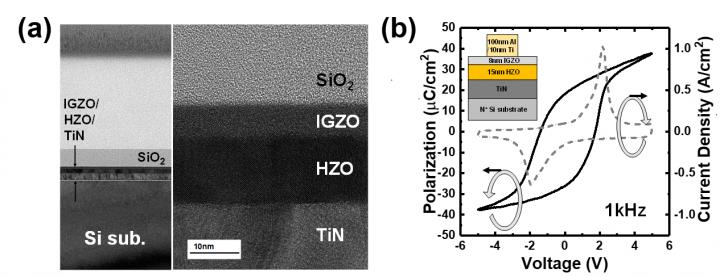
First, we systematically investigated optimum IGZO channel thickness. As IGZO thickness decreases, SS is reduced and threshold voltage (Vth) increases. To realize steep SS and normally-off operation, 8nm was chosen. Next, we fabricated TiN/HfZrO2/IGZO capacitor. HfZrO2 is the ferroelectric layer. Cross-sectional TEM image shows that each layer was uniformly formed as shown in Fig. 2(a). GIXRD spectrum was taken and ferroelectric phase was confirmed. By electrical characterization, we confirmed clear ferroelectric property with IGZO capping on HfZrO2 as shown in Fig. 2(b). It should be noted that, in the current device design, back-gate is needed with buried oxide to fix body potential. Without back-gate, body potential is floating and voltage cannot be sufficiently applied on ferroelectric-HfO2 gate insulator, which was confirmed by TCAD simulation. Based on these device design, we fabricated a FeFET with ferroelectric-HfO2 and ultrathin IGZO channel. Fig. 3(a) shows the measured drain-current versus gate-voltage after applying write and erase pulse voltages. 0.5V memory window and nearly ideal SS of 60mV/dec was obtained. In addition, field-effect mobility is about 10cm2/Vs as shown in Fig. 3(b), which can be higher than poly-silicon at the same thickness.

The achievements in this study will open a new path for realizing low-voltage and highly reliable FeFET with 3D vertical stack structure. This leads to enabling ultralow power IoT edge devices, deploying highly sophisticated network system, and thus providing more strategic social services utilizing big data.

###

This work was presented in VLSI Technology Symposium 2019 on June 11th in 2019, which was held in Kyoto, Japan.

Media Contact
Masaharu Kobayashi
[email protected]

Original Source

http://www.jst.go.jp/pr/announce/20190610/index_e.html

Tags: Electrical Engineering/ElectronicsResearch/DevelopmentSuperconductors/SemiconductorsTechnology/Engineering/Computer ScienceTheory/Design
Share12Tweet8Share2ShareShareShare2

Related Posts

Miniature Sensor Uses Light to Detect Touch — Chemistry

Miniature Sensor Uses Light to Detect Touch

May 8, 2026
Iron Minerals Determine Whether Dissolved Organic Matter Fuels Microbes or Becomes Long-Term Carbon Storage — Chemistry

Iron Minerals Determine Whether Dissolved Organic Matter Fuels Microbes or Becomes Long-Term Carbon Storage

May 8, 2026

Kate Evans Appointed Associate Lab Director for Biological and Environmental Systems Science at ORNL

May 8, 2026

Advancing Multiscale Modeling and Overcoming Operational Challenges in Autothermal COâ‚‚-to-Methanol Reactors

May 8, 2026
Please login to join discussion

POPULAR NEWS

  • Research Indicates Potential Connection Between Prenatal Medication Exposure and Elevated Autism Risk

    840 shares
    Share 336 Tweet 210
  • New Study Reveals Plants Can Detect the Sound of Rain

    727 shares
    Share 290 Tweet 181
  • Scientists Investigate Possible Connection Between COVID-19 and Increased Lung Cancer Risk

    68 shares
    Share 27 Tweet 17
  • Salmonella Haem Blocks Macrophages, Boosts Infection

    61 shares
    Share 24 Tweet 15

About

We bring you the latest biotechnology news from best research centers and universities around the world. Check our website.

Follow us

Recent News

Evaluating Digoxin Use in Patients with Symptomatic Rheumatic Heart Disease

Evaluating the Effectiveness and Safety of Digitalis Glycosides in Treating Heart Failure

Urdu Fall Risk Questionnaire Adapted for Elderly

Subscribe to Blog via Email

Success! An email was just sent to confirm your subscription. Please find the email now and click 'Confirm' to start subscribing.

Join 82 other subscribers
  • Contact Us

Bioengineer.org © Copyright 2023 All Rights Reserved.

Welcome Back!

Login to your account below

Forgotten Password?

Retrieve your password

Please enter your username or email address to reset your password.

Log In
No Result
View All Result
  • Homepages
    • Home Page 1
    • Home Page 2
  • News
  • National
  • Business
  • Health
  • Lifestyle
  • Science

Bioengineer.org © Copyright 2023 All Rights Reserved.