


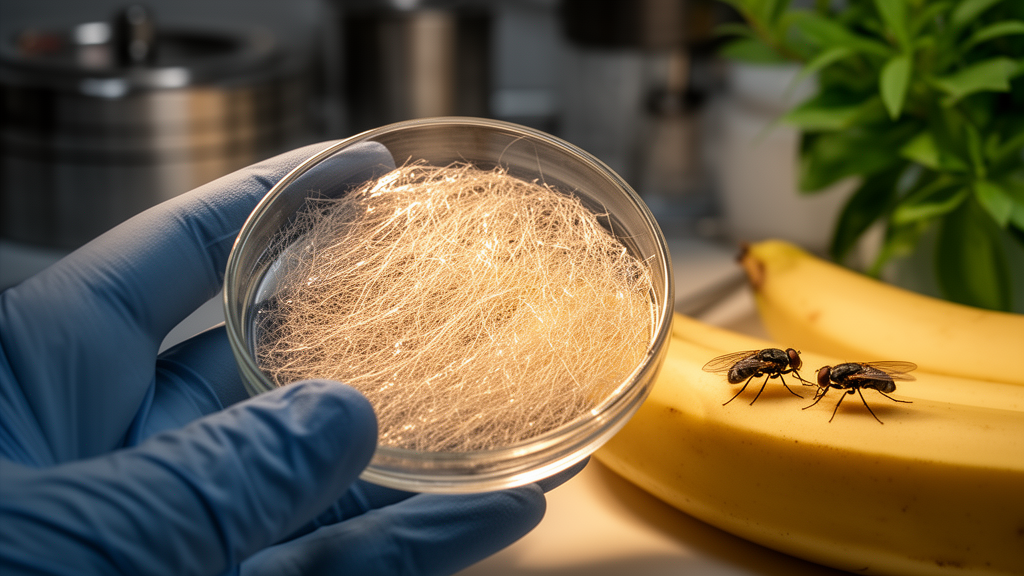
Fruit flies in the family Tephritidae are among the most economically damaging insect pests on Earth, and a newly published review argues that a combination of two unlikely ingredients—yeast and electrospun nanofibers—could form the basis of a more sustainable way to manage them. The article, published in Biotechnology for Sustainable Materials, does not report new field experiments. Instead, it synthesizes existing knowledge about yeast metabolism, genetic engineering of yeast, and electrospinning technology, and lays out a conceptual framework for wrapping living yeast cells inside ultrathin polymer fibers that release attractant vapors slowly over weeks rather than hours.
The scale of the problem the authors describe is substantial. Of the more than 5,000 described fruit fly species, roughly 200 are of major economic importance, and over 250 are classified as quarantine pests in regions such as the European Union. Key destructive species include the Mediterranean fruit fly (Ceratitis capitata), the Oriental fruit fly (Bactrocera dorsalis), the Mexican fruit fly (Anastrepha ludens), and the Olive fruit fly (Bactrocera oleae). Damage extends beyond direct crop losses to quarantine restrictions, costly pre-export treatments, and the use of infested areas as reservoirs for further pest spread. Global losses in major fruit crops caused by fruit flies are estimated to exceed US $3 billion annually, with regional estimates including roughly US $242 million per year from the Mediterranean fruit fly in Brazil and up to 85% yield losses in mango production reported in parts of West Africa.
Current management strategies include pest-resistant crops, field sanitation, the sterile insect technique, and attractant-based traps. Male-specific lures such as methyl eugenol and cue lure reduce mating opportunities, while broader-spectrum food attractants target both sexes. But the review identifies a persistent weakness: the active compounds in many attractants are volatile and unstable under variable field conditions such as rain, humidity, temperature swings, and sunlight. This instability forces frequent reapplication, raising costs and labor while limiting sustained control. One study cited in the review found that yeast-based attractants for the spotted-wing Drosophila lost their efficacy within a few hours of direct sunlight exposure.
Yeasts themselves are central to the proposed solution because of their long-standing ecological relationship with fruit flies. Yeasts such as Saccharomyces and Candida produce volatile organic compounds during fermentation that mimic natural cues associated with food sources and oviposition sites, thereby attracting the insects. Compounds with demonstrated attractant activity include 2-phenethyl alcohol, ethanol, and acetic acid, and yeast-derived volatiles have also been reported to increase female sexual receptivity in some studies. Because yeast volatiles are generally non-toxic to higher organisms, the authors describe them as biologically safe candidates for bait-based control. The challenge is that yeast volatile output changes significantly with the yeast’s growth phase and environmental conditions, which is precisely the problem a controlled-release carrier is meant to address.
Electrospinning, the fabrication technique at the heart of the proposal, uses electrostatic forces to draw polymer solutions into continuous fibers at the nano- and microscale. By adjusting voltage, flow rate, solvent type, and collector design, researchers can engineer fiber diameter, porosity, and morphology. Variants such as coaxial electrospinning, which produces core–shell fibers for precise release control, and emulsion electrospinning, which can encapsulate both hydrophilic and lipophilic agents simultaneously, extend the technique’s flexibility. The resulting mats have a high surface area-to-volume ratio and high porosity, properties the review argues make them ideal for encapsulating living cells while still allowing nutrient and gas exchange.
Encapsulation within a nanofiber matrix would protect yeast cells from a range of environmental stressors. The review details how severe desiccation denatures proteins and collapses cellular membranes, how ultraviolet radiation induces DNA damage through pyrimidine dimer formation, and how extreme pH shifts disrupt the tightly regulated intracellular pH of 6.8 to 7.2 that yeast require. The dense, porous fiber network physically immobilizes cells and limits their exposure to these insults, partially absorbing or scattering UV light and slowing moisture loss. Evidence from related systems supports the concept: bacteria and bacteriophages encapsulated in polyvinyl alcohol fibers have retained viability after electrospinning, and Bifidobacterium animalis Bb12 in PVA fibers remained viable for up to 40 days at ambient temperature and 130 days refrigerated.
The technique is not without biological costs, however. During electrospinning, yeast cells experience high electric fields, shear forces during solution extrusion, and solvent exposure, causing their normal ellipsoidal shape to deform into oblate spheroids. In one cited study, immobilized yeast cells remained metabolically active for seven days despite morphological changes, yet viability was limited to 40%. Solvent choice emerges as the most critical parameter: common electrospinning solvents such as chloroform, dichloromethane, dimethylformamide, and dimethyl sulfoxide pose risks to cellular integrity, pushing researchers toward greener alternatives like aqueous ethanol, which itself carries complications because residual ethanol can compromise probiotic viability in zein-based systems. Alginate blended with polyethylene oxide offers a biocompatible alternative, though pure alginate is difficult to electrospin without carrier polymers.
Beyond simple attractants, the review surveys genetically engineered yeasts that could be paired with nanofiber delivery. Saccharomyces cerevisiae expressing double-stranded RNA targeting a tubulin gene in Drosophila suzukii impaired locomotion, survival, and reproductive fitness in that fly. Engineered yeasts carrying pheromone biosynthesis genes from the Oriental fruit moth replicated the moth’s pheromone pathway, and a Yarrowia lipolytica strain producing pheromones proved effective for trapping the cotton bollworm. Yeasts engineered with codling moth granulovirus reduced the survival of Cydia pomonella larvae, suggesting carrier roles for entomopathogenic agents. The authors also describe ‘attract-and-kill’ and ‘attract-and-infect’ configurations in which nanofiber-encapsulated yeast lures flies toward co-encapsulated insecticides or entomopathogenic fungi such as Beauveria bassiana, potentially reducing broad-spectrum pesticide use.
Economic and ecological questions remain open. Industrial-scale electrospinning units currently cost between US $200,000 and US $500,000, and biopolymers such as polylactic acid can carry raw material costs roughly twice those of synthetic alternatives like polypropylene. On the other hand, studies cited in the review report that encapsulated bait allowed farmers to reduce application frequency from once every 3 to 5 days to once every 2 to 4 weeks. Ecotoxicological concerns include the persistence of synthetic polymers that may contribute to microplastic pollution if degradation is incomplete, and the possible effects of released engineered yeast strains on indigenous microbial communities, including potential horizontal gene transfer. The authors call for environmental fate studies, life-cycle assessments, and stringent risk assessments for genetically modified strains.
The review closes by framing yeast-based nanofibers as a promising but unproven platform. Proposed deployment formats include sprayable mats that form biodegradable films on leaves and fruits, patches, and trap inserts that release volatiles over extended periods. Future research directions include optimizing encapsulation protocols, validating field performance, combining nanofibers with 3D-printed architectures, integrating miniaturized sensors for real-time monitoring of attractant release, and applying machine learning to tame electrospinning’s sensitivity to process parameters—one cited artificial neural network model predicted optimal conditions with a root mean square error of 7.77%. Until field trials demonstrate that the conceptual framework translates into reliable, scalable pest control, the technology remains, by the authors’ own assessment, a well-grounded proposal awaiting validation rather than a ready-made solution for global fruit production.
Subject of Research: A review of yeast-based electrospun nanofiber technologies for sustainable fruit fly pest management
Article Title: Yeast-based nanofibers technologies for sustainable fruit fly pest management: a review
Article References: Ramniwas, S., Kumar, G., & Kumar, R. (2025). Yeast-based nanofibers technologies for sustainable fruit fly pest management: a review. Biotechnology for Sustainable Materials, 2(1), Article 27. https://doi.org/10.1186/s44316-025-00045-y
Image Credits: AI Generated
DOI: 10.1186/s44316-025-00045-y
Keywords: fruit flies, yeast, electrospinning, nanofibers, pest management, volatile organic compounds, attract-and-kill, Tephritidae, biodegradable polymers, genetic engineering, sustainable agriculture, Yeast-based
News Source: Denise Maddox. (October 30, 2026). Electrospun Yeast Nanofibers Could Offer Eco-Friendly Fruit Fly Control. Scienmag.



