• HOME
  • NEWS
  • EXPLORE
    • CAREER
      • Companies
      • Jobs
    • EVENTS
    • iGEM
      • News
      • Team
    • PHOTOS
    • VIDEO
    • WIKI
  • BLOG
  • COMMUNITY
    • FACEBOOK
    • INSTAGRAM
    • TWITTER
Monday, May 18, 2026
BIOENGINEER.ORG
No Result
View All Result
  • Login
  • HOME
  • NEWS
  • EXPLORE
    • CAREER
      • Companies
      • Jobs
        • Lecturer
        • PhD Studentship
        • Postdoc
        • Research Assistant
    • EVENTS
    • iGEM
      • News
      • Team
    • PHOTOS
    • VIDEO
    • WIKI
  • BLOG
  • COMMUNITY
    • FACEBOOK
    • INSTAGRAM
    • TWITTER
  • HOME
  • NEWS
  • EXPLORE
    • CAREER
      • Companies
      • Jobs
        • Lecturer
        • PhD Studentship
        • Postdoc
        • Research Assistant
    • EVENTS
    • iGEM
      • News
      • Team
    • PHOTOS
    • VIDEO
    • WIKI
  • BLOG
  • COMMUNITY
    • FACEBOOK
    • INSTAGRAM
    • TWITTER
No Result
View All Result
Bioengineer.org
No Result
View All Result
Home NEWS Science News Chemistry

Electronics at the speed of light

Bioengineer by Bioengineer
December 23, 2019
in Chemistry
Reading Time: 3 mins read
0
IMAGE
Share on FacebookShare on TwitterShare on LinkedinShare on RedditShare on Telegram

IMAGE

Credit: University of Konstanz


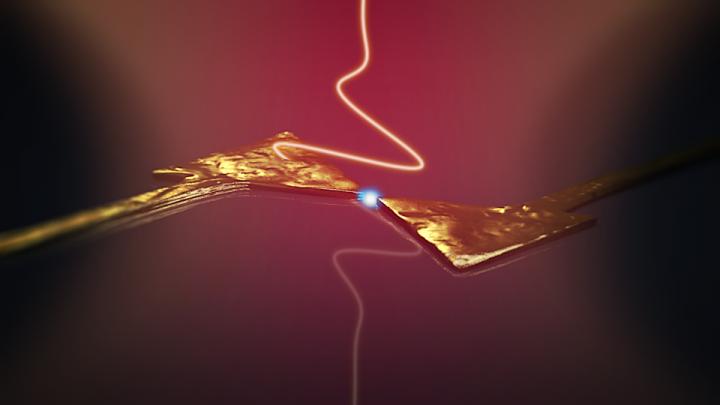
Contemporary electronic components, which are traditionally based on silicon semiconductor technology, can be switched on or off within picoseconds (i.e. 10-12 seconds). Standard mobile phones and computers work at maximum frequencies of several gigahertz (1 GHz = 109 Hz) while individual transistors can approach one terahertz (1 THz = 1012 Hz). Further increasing the speed at which electronic switching devices can be opened or closed using the standard technology has since proven a challenge. A recent series of experiments – conducted at the University of Konstanz and reported in a recent publication in Nature Physics – demonstrates that electrons can be induced to move at sub-femtosecond speeds, i.e. faster than 10-15 seconds, by manipulating them with tailored light waves.

“This may well be the distant future of electronics”, says Alfred Leitenstorfer, Professor of Ultrafast Phenomena and Photonics at the University of Konstanz (Germany) and co-author of the study. “Our experiments with single-cycle light pulses have taken us well into the attosecond range of electron transport”. Leitenstorfer and his team from the Department of Physics and the Center for Applied Photonics (CAP) at the University of Konstanz believe that the future of electronics lies in integrated plasmonic and optoelectronic devices that operate in the single-electron regime at optical – rather than microwave – frequencies.

###

Read the full story on the University of Konstanz’s news website after the embargo has lifted: https://www.uni-konstanz.de/universitaet/aktuelles-und-medien/aktuelle-meldungen/aktuelles/aktuelles/electronics-at-the-speed-of-light-deutsch

Facts:

– International team of researchers including scientists from the University of Konstanz manages to control the ultrafast motion of electrons in a metallic nanocircuit by manipulating them with light.

– New method for speeding up the way electronic devices may be switched in the future.

– Original publication: Markus Ludwig, Garikoitz Aguirregabiria, Felix Ritzowsky, Tobias Rybka, Dana Codruta Marinica, Javier Aizpurua, Andrei G. Borisov, Alfred Leitenstorfer, Daniele Brida, Sub-femtosecond electron transport in a nanoscale gap, Nature Physics, 23 December 2019 (DOI: https://doi.org/10.1038/s41567-019-0745-8, URL: https://www.nature.com/articles/s41567-019-0745-8 (DOI and URL will go live after the embargo ends).

– Funded by the Spanish Ministry of Science, Innovation and Universities (MICINN), Eusko Jaurlaritza (Basque Government), the German Research Foundation (DFG), the EC | EU Framework Programme for Research and Innovation H2020 | H2020 Priority Excellent Science | H2020 European Research Council (H2020 Excellent Science – European Research Council).

– Contact person at the University of Konstanz: Professor Alfred Leitenstorfer, Department of Physics ([email protected]).

Note to editors:

You can download a photo here: https://cms.uni-konstanz.de/fileadmin/pi/fileserver/2019/Bilder/electronics_at_the_speed.png

Caption: Illustration of how electrons can be imagined to move between two arms of a metallic nanoantenna, driven by a single-cycle light wave.

Image: University of Konstanz

Contact:

University of Konstanz

Communications and Marketing

Phone: +49 7531 88-3603

Email: [email protected]

Media Contact
Julia Wandt
[email protected]

Related Journal Article

http://dx.doi.org/10.1038/s41567-019-0745-8

Tags: Atomic/Molecular/Particle PhysicsChemistry/Physics/Materials SciencesElectrical Engineering/ElectronicsNanotechnology/MicromachinesOpticsSuperconductors/SemiconductorsTechnology/Engineering/Computer Science
Share12Tweet8Share2ShareShareShare2

Related Posts

New Drexel Study Reveals Key to Keeping Students on Track in Physics Learning — Chemistry

New Drexel Study Reveals Key to Keeping Students on Track in Physics Learning

May 15, 2026
Reversible Glue Technology Powers Up with Electric Activation — Chemistry

Reversible Glue Technology Powers Up with Electric Activation

May 15, 2026

Sweet as Honey: Unveiling a New Heat Transport Regime in Ultrathin Semiconductors

May 15, 2026

High-Precision Boltzmann Luminescent Nanothermometry Achieved Through Predictive Rules

May 15, 2026
Please login to join discussion

POPULAR NEWS

  • Research Indicates Potential Connection Between Prenatal Medication Exposure and Elevated Autism Risk

    844 shares
    Share 338 Tweet 211
  • New Study Reveals Plants Can Detect the Sound of Rain

    731 shares
    Share 292 Tweet 182
  • Salmonella Haem Blocks Macrophages, Boosts Infection

    62 shares
    Share 25 Tweet 16
  • Breastmilk Balances E. coli and Beneficial Bacteria in Infant Gut Microbiomes

    58 shares
    Share 23 Tweet 15

About

We bring you the latest biotechnology news from best research centers and universities around the world. Check our website.

Follow us

Recent News

Micronutrients Linked to Mood and Psychotic Disorders

AI Tool in Radiotherapy Advances Global Fight to Eradicate Cervical Cancer

Detecting Illicit Bitcoin Transactions with Temporal Graph Learning

Subscribe to Blog via Email

Enter your email address to subscribe to this blog and receive notifications of new posts by email.

Join 82 other subscribers
  • Contact Us

Bioengineer.org © Copyright 2023 All Rights Reserved.

Welcome Back!

Login to your account below

Forgotten Password?

Retrieve your password

Please enter your username or email address to reset your password.

Log In
No Result
View All Result
  • Homepages
    • Home Page 1
    • Home Page 2
  • News
  • National
  • Business
  • Health
  • Lifestyle
  • Science

Bioengineer.org © Copyright 2023 All Rights Reserved.