Harvesting the marine microalgae Isochrysis galbana and Phaeodactylum tricornutum by electroflocculation produced higher biomass recovery and yielded ethanolic extracts with substantially enhanced antibacterial activity compared to conventional centrifugation. Experimental evaluations demonstrated that microalgal extracts recovered via electroflocculation achieved bacterial inhibition rates ranging from 44 percent to 65 percent, markedly outperforming extracts obtained from centrifuged biomass, which exhibited inhibition percentages between 21.43 percent and 40 percent under identical testing parameters.
Microalgae represent primary producers in marine and freshwater environments that generate oxygen through photosynthesis and synthesize high-value bioactive molecules, including phenolic acids, with potential agricultural and pharmacological applications. However, obtaining microalgae biomass at an industrial scale remains a major bottleneck due to low yields and expensive separation processes. Conventional harvesting practices often compromise bioactivity or rely on the addition of organic solvents for chemical flocculation, introducing potential environmental impacts and health risks that hinder scalable cultivation.
The two microalgal species selected for the evaluation, Isochrysis galbana Parke and Phaeodactylum tricornutum Bohlin, are biotechnologically valuable sources of organic compounds, particularly polyunsaturated fatty acids such as eicosapentaenoic acid (EPA), docosahexaenoic acid (DHA), and arachidonic acid (ARA). Furthermore, I. galbana accumulates fucoxanthin, a nutritious pigment recognized for strong antioxidant properties. Centrifugation, while commonly employed, subjects small microalgal cells to high shear forces that cause cell damage, reduce biomass yield, and degrade sensitive target molecules during recovery.
Both microalgae strains were sourced from the microalgae collection at the Biology Institute of the Federal University of Bahia, cataloged under voucher numbers IBLC-013 for I. galbana and IBL-C007 for P. tricornutum, and registered within the National System for Management of Genetic Heritage and Associated Traditional Knowledge. The cultures were cultivated in triplicate within tubular photobioreactors using Conway culture medium, supplemented with 0.32 M sodium silicate for the diatom P. tricornutum. Controlled cultivation conditions maintained a 12-hour photoperiod at a luminosity of 35 micromoles of photons per square meter per second, a temperature of 22 degrees Celsius, neutral pH of 7.0, and continuous aeration, with cell density monitored daily using Neubauer chamber hemocytometer counts.
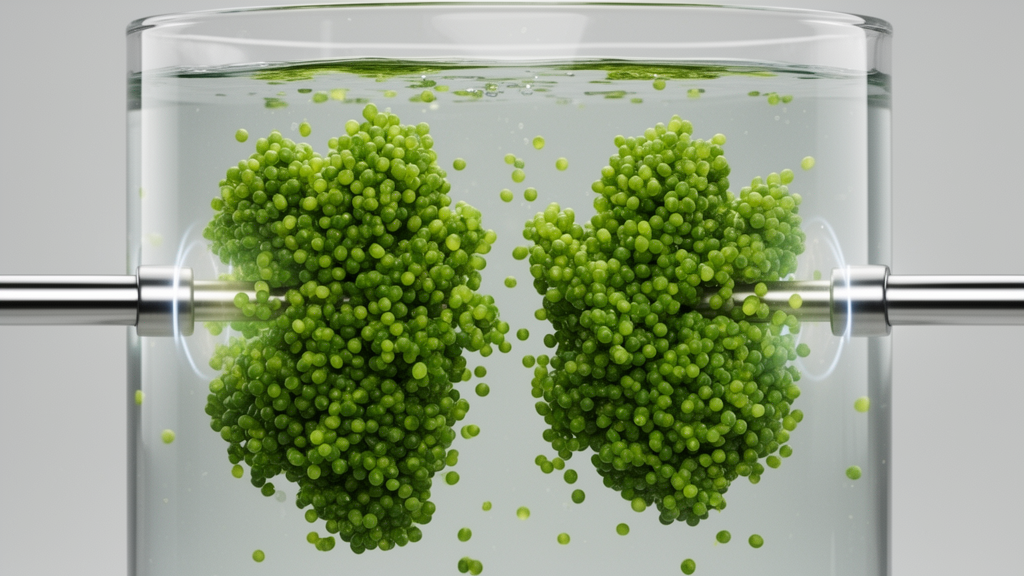
Biomass was harvested at the conclusion of the stationary growth phase to contrast the two separation procedures. Centrifugation was executed using an MPW-351 centrifuge operated at 5000 revolutions per minute for 45 minutes repeatedly until the culture volume was fully processed. In comparison, electroflocculation was conducted by applying a continuous current at 19 volts or 95 watts for 15 minutes utilizing aluminium electrodes, which were chosen after preliminary assessments of various electrode materials and configurations established their recovery efficiency and lack of visible residues in the culture medium. Following separation, cell samples were lyophilized in a freeze dryer and stored at minus 20 degrees Celsius.
Extract preparation was standardized by taking two grams of dry lyophilized biomass from each strain and harvesting condition, suspending it in 100 milliliters of absolute ethyl alcohol, vortexing, and applying two six-minute sonication cycles at 10 percent power. The suspensions underwent continuous agitation for 72 hours and were centrifuged at 5000 revolutions per minute for five minutes to isolate supernatants, a sequence repeated until the biomass was entirely decolorized. The gathered extracts were subsequently concentrated to dryness utilizing a vacuum rotary evaporator.
The antibacterial assessment evaluated five standard bacterial strains from the American Type Culture Collection, comprising three Gram-positive organisms—Staphylococcus aureus ATCC 6598, Bacillus subtilis ATCC 6633, and Bacillus cereus ATCC 0096—and two Gram-negative organisms—Escherichia coli ATCC 94863 and Pseudomonas aeruginosa ATCC 27853. Strains maintained at the State University of Bahia were tested using the disc diffusion method according to the Clinical and Laboratory Standards Institute M2-A8 guideline. Dry extracts were reconstituted in 1 percent dimethyl sulfoxide to a concentration of 10 milligrams per milliliter, and bacterial suspensions calibrated to the 0.5 McFarland standard were inoculated onto Mueller-Hinton agar before applying paper discs impregnated with 10 microliters of extract, with azithromycin and 1 percent dimethyl sulfoxide serving as positive and negative controls respectively.
Antibacterial screening demonstrated that extracts prepared from both microalgae species acted predominantly against Gram-positive bacteria, notably providing the first scientific report of I. galbana extract activity against Bacillus cereus. Antibacterial inhibition against Staphylococcus aureus was nearly doubled in extracts sourced from electroflocculated biomass relative to those obtained through centrifugation. Statistical analysis via one-way analysis of variance and Tukey post hoc testing at p less than 0.05 confirmed that electroflocculation significantly improved the preservation of functional bactericidal properties.
Conversely, susceptibility was sharply restricted among Gram-negative bacteria, with only the centrifuged biomass extract of P. tricornutum exhibiting measurable inhibition against Escherichia coli, while Pseudomonas aeruginosa remained unaffected across all conditions. This resistance pattern aligns with prior observations that the outer membrane of Gram-negative bacteria, rich in saturated fatty acids, restricts the diffusion of antimicrobial agents. The antibacterial effect in microalgae is largely attributed to polyunsaturated fatty acids and molecules like pheophytin A, oleic acid, and linoleic acid, which have been shown to disrupt bacterial lipid metabolism through enzymatic inhibition.
The findings build upon previous demonstrations that electroflocculation neutralizes microalgae cell surface charges via metallic flocculants released from the oxidized anode without requiring chemical additives, causing aggregates to float to the surface. Earlier research documented that electroflocculation increased harvested biomass yields up to fourfold for P. tricornutum and tenfold for I. galbana compared to centrifugation. While centrifugation remains energy-intensive and exposes cells to disruptive shear stresses, electroflocculation provides a non-toxic alternative that reduces degradation of labile compounds.
The study authors highlighted several methodological limitations, noting that antimicrobial activity was assessed at a single extract concentration of 10 milligrams per milliliter, which precludes detailed dose-response comparisons or the establishment of minimum inhibitory concentrations. Overall, the results confirm that electroflocculation serves as an efficient and clean harvesting technology that enhances biomass recovery while preserving the antimicrobial potency of microalgal biocompounds.
In commercial aquaculture operations, these microscopic organisms provide a primary food source, while their substantial protein content positions them as a promising alternative candidate for non-animal protein production.
The biochemical value of microalgal biomass stems from specialized metabolites that play roles across nutrition, agriculture, and pharmacology. The diatom Phaeodactylum tricornutum synthesizes notable concentrations of eicosapentaenoic acid, a compound previously demonstrated to inhibit multidrug-resistant strains of Staphylococcus aureus and exhibit a minimum inhibitory concentration of 18 micrograms per milliliter against Vibrio species. Concurrently, Isochrysis galbana accumulates bioactive constituents including pheophytin A, docosahexaenoic acid, oleic acid, and linoleic acid, which have been documented to generate inhibition zones between 19 and 20 millimeters against Listeria monocytogenes, Staphylococcus aureus, and Bacillus subtilis by impairing bacterial lipid metabolism through enzymatic inhibition.
Electroflocculation addresses these processing constraints by providing an electrolytic alternative that functions entirely without added flocculating chemicals.
While electroflocculation substantially outpaces traditional centrifugation in biomass yield and better preserves bactericidal effectiveness against sensitive bacterial targets, researchers noted distinct trade-offs regarding other functional properties.
Subject of Research: Comparative evaluation of electroflocculation and centrifugation harvesting on microalgal biomass yield and antimicrobial extract potency
Article Title: Influence of harvesting method on biomass yield and antimicrobial activity of Isochrysis galbana and Phaeodactylum tricornutum extracts
Article References: Freitas de Siqueira Junior, E., Fernandez, L. G., Rodrigues, E. D., & da Cunha Lima, S. T. (2026). Influence of harvesting method on biomass yield and antimicrobial activity of Isochrysis galbana and Phaeodactylum tricornutum extracts. Biotechnology Letters, 48(3), Article 70. https://doi.org/10.1007/s10529-026-03741-5
Image Credits: AI Generated
DOI: 10.1007/s10529-026-03741-5
Keywords: Electroflocculation, Microalgae harvesting, Biomass yield, Isochrysis galbana, Phaeodactylum tricornutum, Antibacterial activity, Centrifugation, Staphylococcus aureus, Bacillus cereus, Bacillus subtilis, Escherichia coli, Pseudomonas aeruginosa, Disc diffusion method, Aluminium electrodes, Polyunsaturated fatty acids, Bioactive compounds, Photobioreactors
News Source: Drew Townsend. (November 23, 2026). Electroflocculation Improves Microalgal Biomass Yield and Antibacterial Potency Over Centrifugation. Scienmag.