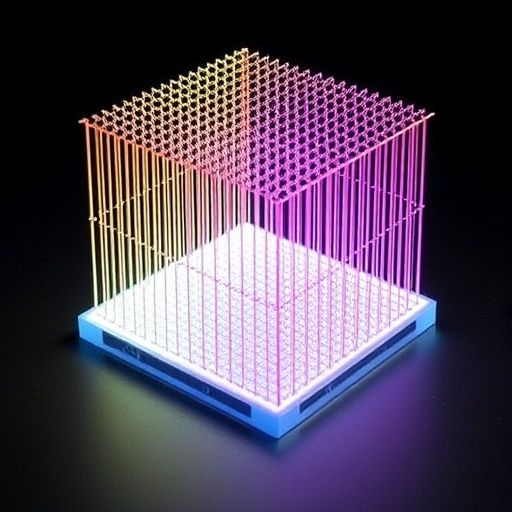
In a groundbreaking advancement in the field of two-dimensional materials and condensed matter physics, researchers from Nanjing University have pioneered an innovative in-situ, on-device electrochemical intercalation technique to finely tune the structural and electronic attributes of molybdenum disulfide (MoS2) thin flakes. This sophisticated method has succeeded in inducing a robust nonlinear Hall effect (NLHE) at ambient conditions, a feat that marks a significant departure from previous approaches constrained by low temperature requirements and delicate control mechanisms.
The nonlinear Hall effect, a member of the Hall effect family, has recently garnered immense scientific interest thanks to its unique ability to generate high-harmonic Hall voltages without necessitating the breaking of time-reversal symmetry. Such characteristics make NLHE a promising phenomenon for numerous technological applications including energy harvesting, wireless communication technologies, and infrared detection devices. Despite its potential, experimentally achieving a pronounced and stable NLHE in two-dimensional transition metal dichalcogenides (TMDs) like MoS2 has proven to be an elusive challenge.
MoS2, as a prototypical 2D TMD, exhibits excellent tunable electronic properties which make it an attractive candidate for next-generation electronics, optoelectronics, and quantum devices. However, the emergence of NLHE demands the precise breaking of inversion symmetry—that is, a symmetry condition that is inherently difficult to maintain or engineer in pristine MoS2 at the device scale. Traditional strategies to induce such symmetry breaking include mechanical strain engineering, twisted bilayer stacking, and external field applications. These methods, however, suffer from issues related to limited scalability, poor reproducibility, and short-term stability, thereby impeding practical implementation.
The innovative solution presented by the Nanjing University team involves the electrochemical intercalation of cetyltrimethylammonium ions (CTA+) directly into the van der Waals gap of the MoS2 thin flakes. This intercalation expands the layer spacing from 0.61 nm to an impressive 1.06 nm, offering unprecedented atomic-layer-level control over the material’s structure while preserving the intrinsic atomic arrangements within the layers. The presence of CTA+ ions within the vdW gap effectively breaks the inversion symmetry, a prerequisite for the emergence of the nonlinear Hall effect.
Beyond the structural transformation, the intercalation process dramatically alters the electronic landscape of MoS2. The infusion of electrons supplied by the CTA+ ions shifts the material’s behavior from a semimetallic regime into a highly conductive metallic state. Quantitatively, the carrier concentration reaches an estimated -6.94 × 10^20 cm^-3, which is a substantial increase that contributes to the robust electrical performance. This carrier density augmentation is crucial for amplifying the nonlinear Hall voltage observed during electrical transport measurements.
At cryogenic temperatures of approximately 10 Kelvin, the researchers recorded a nonlinear Hall voltage perpendicular to the current exceeding 7 microvolts at a current threshold of 100 microamperes. What sets this work apart is that such a nonlinear response remains prominently observable even at room temperature (around 300 Kelvin), signaling a breakthrough in the practical viability of NLHE-based devices. The investigation into the temperature-dependent NLHE signals confirmed that the dominant mechanism underlying this phenomenon is skew scattering—a fundamental scattering process that breaks the symmetry of electron momentum distributions.
This study not only provides a new class of materials demonstrating room-temperature nonlinear Hall effects, but also highlights the potential of electrochemical intercalation as a scalable and controllable route to engineer symmetry and electronic properties in two-dimensional materials. Compared to other reported systems that require complex fabrication or extreme environments, the intercalated MoS2 thin flakes offer chemical stability and established growth processes that favor integration into existing semiconductor technology infrastructures.
The implications of these findings are multifold. NLHE’s inherent rectification properties make it a prime candidate for application in highly efficient photodetectors, energy conversion devices, and spintronic components, where controlling electron spin and charge in low-dimensional systems is key. With further optimization of nonlinear susceptibility particularly at room temperature, new device architectures exploiting the nonlinear transport phenomena could revolutionize sectors ranging from telecommunications to renewable energy technologies.
Future endeavors will logically extend towards exploring a broader range of host and guest materials for intercalation, analyzing how variations in ion species or lattice hosts affect the magnitude and temperature robustness of NLHE. Equally significant is the refinement of electrochemical intercalation parameters—such as electrolyte composition, voltage application, and intercalation duration—to afford fine control over carrier doping levels and symmetry breaking degrees in TMD thin films.
Given the rapid strides in sophisticated thin-film growth technologies, including chemical vapor deposition and molecular beam epitaxy, the scalability challenges for implementing room-temperature NLHE materials at an industrial level appear increasingly surmountable. The merger of precise atomic control via intercalation with mature large-area film growth techniques portends the advent of new classes of highly functional, miniaturized electronic and spintronic devices.
This pioneering research, documented in the international journal Materials Futures, charts a visionary course for the field of nonlinear Hall physics and 2D material engineering. By merging electrochemical methodologies with quantum materials science, it opens unexplored horizons in electronic symmetry manipulation, heralding the next generation of functional nanomaterials with broad technological impact.
Subject of Research:
Article Title: The nonlinear Hall effect induced by electrochemical intercalation in MoS2 thin flake devices
News Publication Date: 2-Feb-2026
Web References: http://dx.doi.org/10.1088/2752-5724/ae31fa
References: Fuwei Zhou, Yu Du, Tianqi Wang, Heng Zhang, Jiajun Li, Wuyi Qi, Yefan Yu, Fucong Fei, Fengqi Song. The nonlinear Hall effect induced by electrochemical intercalation in MoS2 thin flake devices[J]. Materials Futures, 2026, 5(2): 025302. DOI: 10.1088/2752-5724/ae31fa
Image Credits: Fengqi Song, Fucong Fei and Fuwei Zhou from Nanjing University
Keywords
Hall effect, Electrochemistry, Transition metals, Superlattices
Tags: applications of nonlinear Hall effectcondensed matter physics advancementselectrochemical intercalation techniqueenergy harvesting technologieshigh-harmonic Hall voltagesinfrared detection devicesMoS2 thin flake devicesnonlinear Hall effect in MoS2transition metal dichalcogenides propertiestunable electronic properties of MoS2two-dimensional materials researchwireless communication advancements