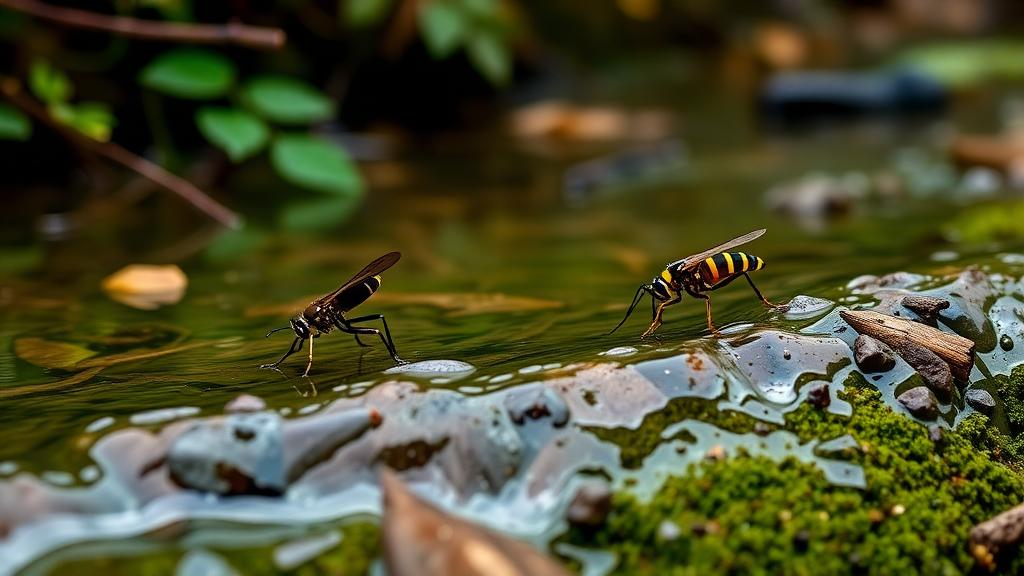
Ecologists have long debated whether natural communities settle into a stable state or drift unpredictably through time. A new study published in PLOS Ecosystems draws on one of the largest standardized stream datasets ever assembled to address that question, and its answer is largely reassuring: most stream insect communities appear to hover around a long-term baseline, wobbling from year to year without ever wandering far from home. The research, led by Daniel J. McGarvey of Virginia Commonwealth University together with a large team of coauthors, tested the loose equilibrium hypothesis using eight consecutive years of benthic insect surveys from 21 streams monitored by the National Ecological Observatory Network, known as NEON, across the United States.
The loose equilibrium hypothesis is a refinement of classical equilibrium thinking in ecology. It predicts that biological assemblages will show modest, essentially random fluctuations from one year to the next, but that over longer periods they will not follow a directed trajectory away from a stable baseline condition. In other words, a community may jitter around its average composition, but it should not march steadily toward a new state unless something fundamental about the environment has changed. This idea matters because it offers a practical benchmark for detecting real ecological trouble: if a community departs directionally from its baseline, that pattern can signal disturbance, degradation, or a shift in environmental drivers rather than ordinary background variability.
Testing such an idea has historically been difficult because it requires long, consistent time series collected with identical methods across many sites. Most ecological datasets span only a few years, use inconsistent sampling designs, or cover single locations, making it hard to distinguish genuine directional change from sampling noise. The NEON stream program solves much of that problem. Since 2016, the network has deployed standardized protocols to sample the insects living on streambeds, the benthic macroinvertebrates that form the ecological backbone of small streams, at dozens of sites spanning wide gradients of climate, geology, and land use. The new analysis harnesses that infrastructure, using data from 2016 through 2023 at 21 stream sites to ask whether insect assemblages behave as the loose equilibrium hypothesis predicts.
The analytical approach is deceptively simple in concept but demanding in execution. For each stream, the researchers constructed a baseline assemblage condition and then quantified how the community moved through compositional space across successive sampling events. Random, non-directional movement among sampling events is the signature of loose equilibrium, while consistent directional movement away from the baseline indicates a departure from that state. Crucially, the team also expanded the traditional method, which typically relies on a single sampling season per year, by incorporating multi-season data. That expansion allowed them to ask a question that previous studies could not: does the season in which you sample influence whether a community appears to be in equilibrium?
The headline result is that loose equilibrium appears to be the norm. Seventeen of the 21 benthic insect assemblages exhibited random, non-directional change among sampling events, exactly the pattern the hypothesis anticipates. These communities fluctuated in composition from year to year, as real ecological communities always do, but their fluctuations did not accumulate into a sustained trend away from their starting point. For the vast majority of the streams examined, the loose equilibrium hypothesis held up under scrutiny, providing some of the strongest multi-site evidence to date that many stream insect assemblages are dynamically stable over nearly a decade of observation.
The four exceptions are where the story becomes especially interesting. Two assemblages showed directional movement away from their baseline condition, a pattern consistent with a genuine ecological transition. The remaining two displayed a different signature: directional movement away from the baseline followed by a return toward it, as though the community had been pushed off course and then recovered. Supplementary data on taxonomy, feeding behavior, and environmental conditions suggest that these four instances of directional change may represent responses to recent disturbances or to altered physicochemical habitat conditions at those sites. In other words, the deviations from equilibrium were not mysterious; they coincided with environmental changes that plausibly could reorganize an insect community, which is precisely what the loose equilibrium framework is designed to flag.
Beyond the equilibrium test itself, the study uncovered a striking seasonal dimension to stream insect dynamics. Distinct seasonal clusters, corresponding to spring, summer, and fall sampling periods, were detected for 13 of the 21 assemblages. This means that in most of these streams, the insect community sampled in spring looks measurably different from the community sampled in summer or fall, reflecting the seasonal life cycles of aquatic insects, in which emergence, reproduction, and recruitment are timed to temperature, flow regimes, and resource availability. Seasonal structure of this kind is well known to freshwater ecologists, but its interaction with long-term equilibrium dynamics had rarely been examined with data of this quality and breadth.
Within those seasonally clustered assemblages, the researchers found an even finer pattern. Eleven of the 13 clustered assemblages contained at least one significantly small cluster, indicating minimal interannual change within that particular season. A spring community, for example, might be nearly identical from one spring to the next even while differing sharply from the summer community at the same site. This tight seasonal repeatability suggests that each season imposes its own predictable environmental template, and the insects respond to that template with remarkable consistency. Such predictability, the authors argue, may be a mechanism that actively supports loose equilibrium rather than merely coexisting with it.
That mechanism forms the conceptual centerpiece of the paper. The researchers hypothesize that seasonally distinct yet predictable environments promote inter-seasonal consistency in assemblage structure, thereby constraining the opportunities for insect assemblages to shift far from their baseline condition. The logic runs as follows: if each season presents a reliable set of conditions, then the species adapted to those conditions reassemble reliably each year, and any drift that begins in one season is effectively reset when the next season’s template takes over. Strong seasonality, in this view, is not a source of instability but a stabilizing rhythm, a metronome that keeps communities tethered to their baselines even as individual years bring droughts, floods, and warm spells. This hypothesis reframes seasonality from a complicating nuisance in long-term monitoring into a potential pillar of community stability.
The implications extend well beyond stream insects. Equilibrium theory has anchored community ecology for a century, but critics have argued that the field’s core concepts are too loosely defined to be tested rigorously, and that apparent stability often dissolves when datasets lengthen or sampling designs improve. By tightening the loose equilibrium concept with a multi-season, multi-site analysis, this study gives ecologists a sharper tool for distinguishing healthy variability from genuine directional change, and it demonstrates that the tool works at continental scale using publicly available NEON data. As climate change alters flow regimes, temperatures, and disturbance frequencies in streams across North America, the ability to detect when an assemblage truly departs from its baseline, rather than merely fluctuating around it, will become increasingly valuable for anticipating future changes in benthic assemblage structure and for managing the freshwater ecosystems that depend on them. The study also offers a model for how large, standardized observatory networks can transform abstract ecological theory into testable, quantitative predictions, turning eight years of routine insect counts into a rigorous stress test of one of ecology’s central ideas about how nature holds together.
Subject of Research: Testing the loose equilibrium hypothesis using multi-season benthic insect assemblage data from National Ecological Observatory Network streams
Article Title: Tightening the loose equilibrium concept: New seasonal insights with benthic insect data from National Ecological Observatory Network streams
Article References: Tightening the loose equilibrium concept: New seasonal insights with benthic insect data from National Ecological Observatory Network streams. (n.d.). https://doi.org/10.1371/journal.pesy.0000037
Image Credits: AI Generated
DOI: 10.1371/journal.pesy.0000037
Keywords: loose equilibrium, benthic macroinvertebrates, stream ecology, NEON, community ecology, equilibrium theory, seasonality, long-term monitoring, aquatic insects, ecological stability, baseline condition, disturbance
News Source: Gavin Prescott. (October 12, 2026). Eight Years of Stream Insect Data Put Ecological Balance to the Test. Scienmag.