


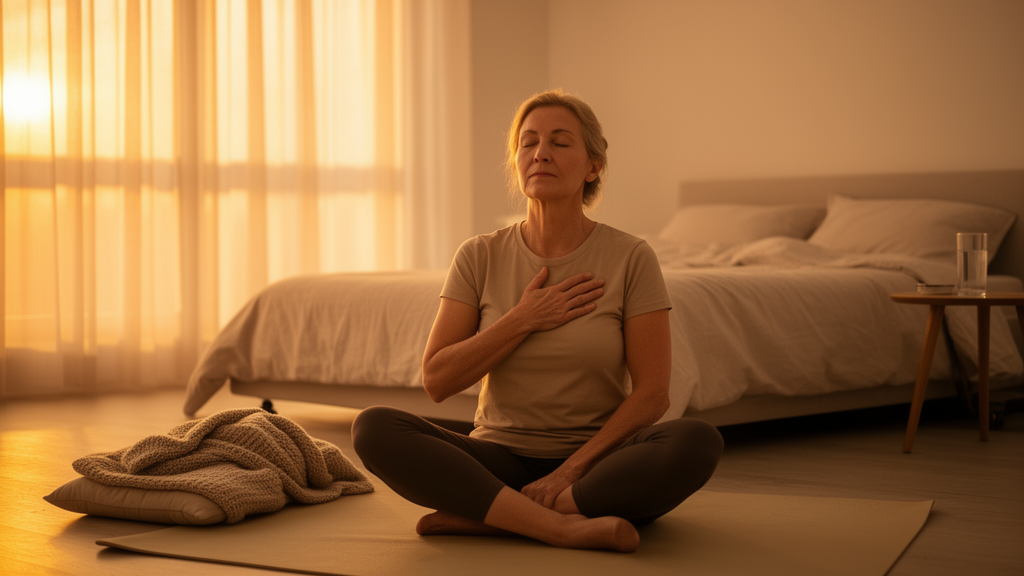
A randomized controlled trial conducted at Istanbul University-Cerrahpasa has found that a structured, home-based breathing program delivered over video call significantly improved sleep quality, daytime sleepiness, fatigue, quality of life, and depression scores in patients with mild to moderate obstructive sleep apnea syndrome. The study, published in BioPsychoSocial Medicine, is the first to examine pranayama, the breath-control component of yoga, applied alone without any additional therapy in this patient group. Over eight weeks, participants who practiced the breathing techniques three times a day saw their Pittsburgh Sleep Quality Index scores fall from an average of 9.12 to 6.88, while patients receiving no intervention showed no improvement.
Obstructive sleep apnea syndrome is a common sleep-related disorder in which the upper airway repeatedly collapses or narrows during sleep. Each event increases the effort required to breathe, generates swings in pressure inside the chest, produces intermittent drops in blood oxygen, and fragments sleep. The characteristic manifestations are loud snoring, excessive daytime sleepiness, and witnessed pauses in breathing. Beyond the disrupted nights, the repeated apneic episodes drive surges of sympathetic nervous system activity, reduce vagal tone, and disturb the normal balance between the two branches of the autonomic nervous system. Patients with the syndrome show diminished heart rate variability, a marker of this autonomic dysfunction that tracks with disease severity.
The standard treatment, nasal continuous positive airway pressure, produces marked improvements in symptoms, but many patients cannot tolerate full-night therapy and compliance rates are poor. This gap motivated the search for approaches that patients tolerate well and can practice anywhere. Pranayama, one of the three classical branches of yoga alongside physical postures and meditation, focuses on voluntary control of breathing. Slow, rhythmic breathing is thought to rebalance autonomic function by enhancing vagal tone and heart rate variability, which is precisely the physiological system disrupted in sleep apnea. Alternate nostril breathing, one of the techniques used in the trial, has been shown to significantly increase parasympathetic tone in healthy adults.
The trial was designed as an open-label, prospective, randomized controlled trial carried out between May and August 2021 in the Chest Diseases Department of the Cerrahpasa Faculty of Medicine Hospital. The researchers recruited patients aged 20 to 60 with mild to moderate disease, defined by an apnea-hypopnea index of 5 to 29 events per hour on overnight polysomnography according to American Academy of Sleep Medicine criteria. Participants needed an internet-capable device and sufficient Turkish literacy. The exclusion criteria screened out patients already using continuous positive airway pressure or a mandibular advancement device, those with additional respiratory diseases such as COPD or asthma, patients requiring hypnotic medication or taking drugs that affect the sympathetic nervous system such as beta-blockers, and people with prior maxillofacial surgery, craniofacial malformations, neurological or psychological disorders, malignancy, decompensated heart failure, diabetes, or severe cognitive impairment.
Forty patients were screened, 38 met the criteria and were randomized with a computer-generated list and sequentially numbered envelopes, and four were lost during follow-up due to non-compliance or missing data. The final analysis included 34 participants, 17 per group, aged 28 to 60, with 10 women and 24 men and a mean age of 46.21 years. Baseline demographics and clinical characteristics were statistically balanced between the groups. The intervention group practiced 15-minute sessions consisting of Ujjayi, Nadish Dhana, and Sukha pranayama, five minutes each, three times daily for eight weeks, plus one supervised 15-minute online session three days a week delivered by WhatsApp video call. Before each session, patients adopted a relaxed seated posture and performed diaphragmatic breathing with a one-to-one inhalation-to-exhalation ratio. A demonstration video and a weekly follow-up chart reviewed by the physiotherapist supported self-guided practice. The control group received no intervention.
Sleep quality, the primary outcome, was measured with the Pittsburgh Sleep Quality Index, a 19-item questionnaire scored from 0 to 21 in which higher values indicate poorer sleep. The intervention group’s scores dropped from 9.12 plus or minus 4.71 to 6.88 plus or minus 4.45, a statistically significant change, whereas the control group showed no improvement and in fact a worsening trend. The between-group difference in the change favored the pranayama group with a p-value below 0.001. Secondary outcomes were assessed at baseline and again after eight weeks through questionnaires administered over WhatsApp video calls, with researchers recording patients’ verbal answers.
Daytime sleepiness, measured on the eight-item Epworth Sleepiness Scale, declined significantly in the intervention group from 9.41 plus or minus 6.15 to 7.41 plus or minus 6.18, while the control group’s scores worsened significantly; the between-group difference was again significant. Fatigue severity on the Fatigue Severity Scale decreased in the intervention group with a mean change of 0.53 plus or minus 0.70, with no significant change among controls and a significant between-group difference. On the Functional Outcomes of Sleep Questionnaire, which captures disease-specific quality of life across general productivity, social outcome, activity level, and vigilance, the intervention group improved markedly, with a total-score change of minus 0.38 plus or minus 0.25 compared with plus 0.14 plus or minus 0.22 in controls, and significant gains in the activity level and vigilance subdomains. Generic quality of life on the Nottingham Health Profile also improved in the pranayama group across emotional reactions, sleep, social isolation, and energy, with significant between-group differences, although the pain subscore did not change significantly.
Psychological outcomes shifted as well. Depression scores on the Hospital Anxiety and Depression Scale fell by 3.06 plus or minus 2.05 in the intervention group, a highly significant within-group change, and anxiety scores decreased by 1.94 plus or minus 3.94, which narrowly missed the threshold for statistical significance within the group. Both the anxiety and depression changes differed significantly between groups. No adverse events or safety concerns requiring discontinuation were reported during the intervention period. The authors suggest that slow, controlled breathing increases vagal tone and suppresses sympathetic activity, reducing the physiological arousal and stress-related hyperactivation commonly seen in sleep apnea, thereby easing sleep fragmentation and improving sleep continuity.
The findings align with earlier, less controlled work: a three-month yoga program including breathing training reduced sleep quality and sleepiness scores in an uncontrolled study, and a randomized trial combining oropharyngeal exercises with pranayama outperformed sham therapy on the same measures. The study has clear limitations that the authors acknowledge. The apnea-hypopnea index was not remeasured after training, so the trial cannot show whether the breathing program changed the underlying respiratory events themselves; the improvements were in patient-reported symptoms and quality-of-life measures. Blinding was also impossible because the same physiotherapist administered both the training and the assessments, and the open-label design leaves room for expectation effects. With 17 completers per group, the sample was modest, and the control group received no intervention rather than an attention-matched comparison. The authors conclude that pranayama was an effective adjunct therapy in these patients and that more randomized controlled trials are needed to confirm its efficacy in obstructive sleep apnea.
Subject of Research: A randomized controlled trial of home-based telerehabilitation pranayama breathing training in mild to moderate obstructive sleep apnea syndrome.
Article Title: The impact of home-based telerehabilitation pranayama on sleep quality and wellbeing in mild to moderate obstructive sleep apnea syndrome. A randomized controlled trial
Article References: Kaçar Akkoç, Z., Demir, R., Mustafaoğlu, R., Önder, Ö. Ö., Naci, B., & Atahan, E. (2026). The impact of home-based telerehabilitation pranayama on sleep quality and wellbeing in mild to moderate obstructive sleep apnea syndrome. A randomized controlled trial. BioPsychoSocial Medicine, 20(1), Article 11. https://doi.org/10.1186/s13030-026-00359-x
Image Credits: AI Generated
DOI: 10.1186/s13030-026-00359-x
Keywords: obstructive sleep apnea, pranayama, randomized controlled trial, sleep quality, telerehabilitation, yoga breathing, daytime sleepiness, fatigue, quality of life, autonomic nervous system, Pittsburgh Sleep Quality Index, complementary therapy
News Source: Glenn Wilkins. (October 30, 2026). Eight Weeks of Home-Based Pranayama Improved Sleep Quality in Sleep Apnea Trial. Scienmag.



