• HOME
  • NEWS
  • EXPLORE
    • CAREER
      • Companies
      • Jobs
    • EVENTS
    • iGEM
      • News
      • Team
    • PHOTOS
    • VIDEO
    • WIKI
  • BLOG
  • COMMUNITY
    • FACEBOOK
    • INSTAGRAM
    • TWITTER
Wednesday, May 20, 2026
BIOENGINEER.ORG
No Result
View All Result
  • Login
  • HOME
  • NEWS
  • EXPLORE
    • CAREER
      • Companies
      • Jobs
        • Lecturer
        • PhD Studentship
        • Postdoc
        • Research Assistant
    • EVENTS
    • iGEM
      • News
      • Team
    • PHOTOS
    • VIDEO
    • WIKI
  • BLOG
  • COMMUNITY
    • FACEBOOK
    • INSTAGRAM
    • TWITTER
  • HOME
  • NEWS
  • EXPLORE
    • CAREER
      • Companies
      • Jobs
        • Lecturer
        • PhD Studentship
        • Postdoc
        • Research Assistant
    • EVENTS
    • iGEM
      • News
      • Team
    • PHOTOS
    • VIDEO
    • WIKI
  • BLOG
  • COMMUNITY
    • FACEBOOK
    • INSTAGRAM
    • TWITTER
No Result
View All Result
Bioengineer.org
No Result
View All Result
Home NEWS Science News

Efficient indium oxide catalysts designed for CO2 hydrogenation to methanol

Bioengineer by Bioengineer
June 18, 2020
in Science News
Reading Time: 2 mins read
0
IMAGE
Share on FacebookShare on TwitterShare on LinkedinShare on RedditShare on Telegram

IMAGE

Credit: SARI

Catalytic hydrogenation of carbon dioxide (CO2) is a green and sustainable means of synthesizing commodity chemicals such as methanol. This conversion process is key to realizing the “methanol economy” or creating “liquid sunshine”, both aspects of the circular economy. Recent studies revealed the potential for a family of metal oxides to catalyze this reaction. However, further optimizing their catalytic performance for industrial applications remained a great challenge, mostly due to the difficulties related to the rational design and controlled synthesis of these catalysts.

Motivated by such a challenge, a team jointly led by Profs. SUN Yuhan, GAO Peng, and LI Shenggang at the Shanghai Advanced Research Institute (SARI) of the Chinese Academy of Sciences, reported a successful case of theory-guided rational design of indium oxide (In2O3) catalysts for CO2 hydrogenation to methanol with high activity and selectivity. The new findings were published in the latest issue of Science Advances on June 17.

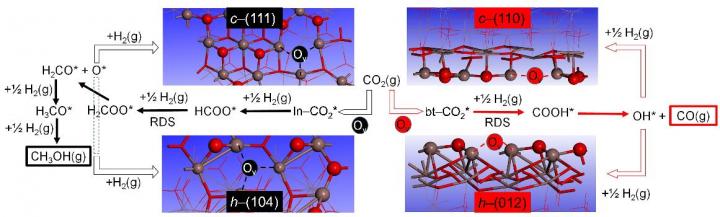
To rationally design In2O3-based nanocatalysts with favorable methanol synthesis performance, researchers carried out extensive density functional theory (DFT) calculations to establish the catalytic mechanism of the In2O3 catalyst during CO2 hydrogenation to methanol and carbon dioxide by identifying preferred pathways. The computational modeling identified the rarely studied {104} facet of hexagonal In2O3 as the most favorable for methanol synthesis.

On the basis of this theoretical prediction, several experimental methods were then employed to synthesize In2O3 catalysts in different phases with distinct morphologies.

Interestingly, one of the four In2O3 catalysts synthesized in this way was confirmed to mainly expose the theoretically identified {104} facets. This catalyst also exhibited the best performance in terms of both activity and selectivity, confirming the DFT prediction. The methanol synthesis reaction catalyzed by this catalyst is favorable even at the very high temperature of 360 °C.

The space-time yield of methanol reached 10.9 mmol/g/hour at this temperature, which surpassed all previously known catalysts for this reaction, including previously reported In2O3-based catalysts and well-known Cu-based catalysts.

The In2O3 catalyst discovered in this research is promising as a way to directly convert CO2 into methanol for industrial applications. In addition, the discovery of this In2O3 catalyst will promote the further development of oxide/zeolite bifunctional catalysts for direct CO2 hydrogenation to various C2+ hydrocarbons (lower olefins, gasoline, aromatics and so on) via the methanol intermediate. Just as importantly, this discovery also highlights the pivotal role of computational science in helping to design industrially relevant catalysts.

###

Media Contact
SUN Yuhan
[email protected]

Original Source

http://english.cas.cn/newsroom/research_news/chem/202006/t20200618_238951.shtml

Related Journal Article

http://dx.doi.org/10.1126/sciadv.aaz2060

Tags: Chemistry/Physics/Materials SciencesNanotechnology/Micromachines
Share12Tweet8Share2ShareShareShare2

Related Posts

Mitochondrial l-2-Hydroxyglutarate Signals Cellular Metabolism

May 20, 2026

Tent5a-Mediated Insulin mRNA Polyadenylation Controls Beta Cells

May 20, 2026

How Atlantic Herring Rewired Their Reproductive Strategy to Thrive in Changing Oceans

May 20, 2026

Texas Tech Awarded $4.5 Million Grant to Propel Semiconductor Research Innovations

May 20, 2026
Please login to join discussion

POPULAR NEWS

  • blank

    New Study Reveals Plants Can Detect the Sound of Rain

    733 shares
    Share 292 Tweet 183
  • Research Indicates Potential Connection Between Prenatal Medication Exposure and Elevated Autism Risk

    846 shares
    Share 338 Tweet 212
  • ESMO 2025: mRNA COVID Vaccines Enhance Efficacy of Cancer Immunotherapy

    300 shares
    Share 120 Tweet 75
  • Breastmilk Balances E. coli and Beneficial Bacteria in Infant Gut Microbiomes

    58 shares
    Share 23 Tweet 15

About

We bring you the latest biotechnology news from best research centers and universities around the world. Check our website.

Follow us

Recent News

Mitochondrial l-2-Hydroxyglutarate Signals Cellular Metabolism

Tent5a-Mediated Insulin mRNA Polyadenylation Controls Beta Cells

How Atlantic Herring Rewired Their Reproductive Strategy to Thrive in Changing Oceans

Subscribe to Blog via Email

Enter your email address to subscribe to this blog and receive notifications of new posts by email.

Join 82 other subscribers
  • Contact Us

Bioengineer.org © Copyright 2023 All Rights Reserved.

Welcome Back!

Login to your account below

Forgotten Password?

Retrieve your password

Please enter your username or email address to reset your password.

Log In
No Result
View All Result
  • Homepages
    • Home Page 1
    • Home Page 2
  • News
  • National
  • Business
  • Health
  • Lifestyle
  • Science

Bioengineer.org © Copyright 2023 All Rights Reserved.