Credit: Edgar Lobaton
Researchers from North Carolina State University have developed an energy-efficient technique for accurately tracking a user's physical activity based on data from wearable devices.
One goal for wearable health technologies is to identify and track physical activity by the wearer. However, accomplishing this goal requires a trade-off between accuracy and the power needed for data analysis and storage, which is a challenge, given the limited power available for wearable devices.
"Tracking physical activity is important because it is a key component for placing other health data in context," says Edgar Lobaton, an assistant professor of electrical and computer engineering at NC State and senior author of a paper on the new work. "For example, a spike in heart rate is normal when exercising, but can be an indicator of health problems in other circumstances."
Devising technology for monitoring physical activity involves addressing two challenges. First, the program needs to know how much data to process when assessing activity. For example, looking at all of the data collected over a 10-second increment, or tau, takes twice as much computing power as evaluating all of the data over a five-second tau.
The second challenge is how to store that information. One solution to this is to lump similar activity profiles together under one heading. For example, certain data signatures may all be grouped together under "running," while others may be lumped together as "walking." The challenge here is to find a formula that allows the program to identify meaningful profiles (e.g., running, walking or sitting): if the formula is too general, the profiles are so broad as to be meaningless; and if the formula is too specific, you get so many activity profiles that it is difficult to store all of the relevant data.
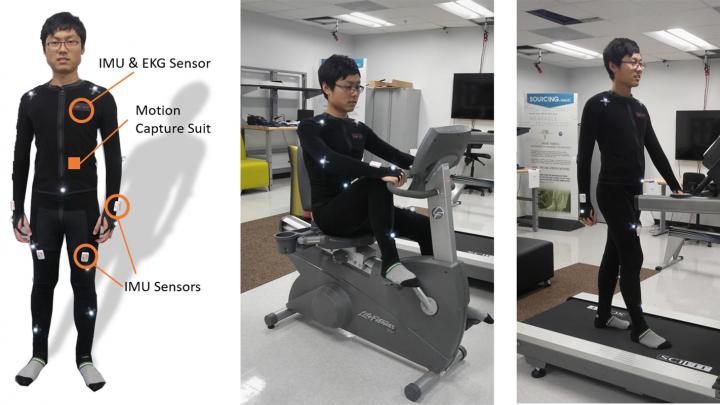
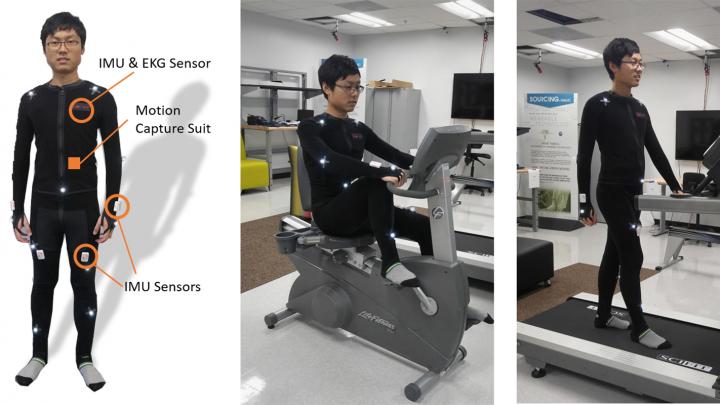
To explore these challenges, the research team had graduate students come into a motion-capture lab and perform five different activities: golfing, biking, walking, waving and sitting.
The researchers then evaluated the resulting data using taus of zero seconds (i.e., one data point), two seconds, four seconds, and so on, all the way up to 40 seconds.
The researchers then experimented with different parameters for classifying activity data into specific profiles.
"Based on this specific set of experimental data, we found that we could accurately identify the five relevant activities using a tau of six seconds," Lobaton says. "This means we could identify activities and store related data efficiently.
"This is a proof-of-concept study, and we're in the process of determining how well this approach would work using more real-world data," Lobaton says. "However, we're optimistic that this approach will give us the best opportunity to track and record physical activity data in a practical way that provides meaningful information to users of wearable health monitoring devices."
The paper, "Hierarchical Activity Clustering Analysis for Robust Graphical Structure Recovery," will be presented at the 2016 IEEE Global Conference on Signal and Information Processing, being held Dec. 7-9 in Washington, D.C. Lead author of the paper is Namita Lokare, a Ph.D. student at NC State. The co-authors are Daniel Benavides and Sahil Juneja, of NC State.
The research was done with support from the National Science Foundation's Nanosystems Engineering Research Center for Advanced Self-Powered Systems of Integrated Sensors and Technologies (ASSIST) under grant EEC-1160483. The goal of the ASSIST Center, which is based at NC State, is to make wearable technologies that are powered by a user's movement or body heat and can be used for long-term health monitoring.
###
Media Contact
Matt Shipman
[email protected]
919-515-6386
@NCStateNews
############
Story Source: Materials provided by Scienmag