None
The randomized trial comparing venous coupler and hand-sewn venous anastomosis in free-flap reconstruction arrives at a moment when microsurgeons have long relied on retrospective data to justify their choice of venous repair technique. Because venous thrombosis remains the leading technical cause of free-flap compromise, even small differences in anastomotic performance can translate into clinically meaningful differences in flap salvage. The trial’s design, in which arterial anastomoses were hand-sewn in every patient, deserves emphasis: by standardizing arterial inflow, the investigators isolated the venous technique as the principal variable under study, strengthening the internal validity of the comparison in a way that few prior observational series have achieved.
The magnitude of the time saving reported in the trial is striking. A mean venous anastomotic time of 8.1 minutes in the coupler group versus 19.2 minutes in the hand-sewn group represents a reduction of more than eleven minutes per venous repair, with a confidence interval indicating that the true saving lies between roughly ten and twelve minutes. In reconstructive procedures that often last several hours, this saving may appear modest, but its cumulative effect can be substantial. Shorter operative times are associated with reduced anesthesia exposure, lower costs, and potentially decreased risks of infection, thromboembolic events, and other perioperative complications, particularly in elderly patients or those with significant comorbidities undergoing lengthy oncologic reconstructions.
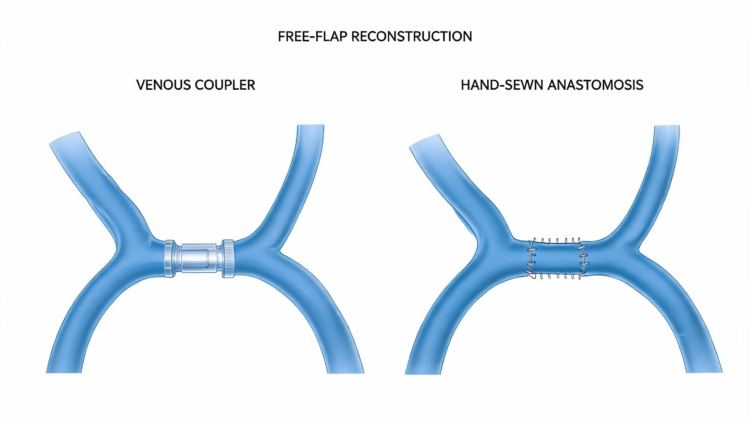
The mechanism by which the coupler achieves speed is worth understanding. The ring-pin device consists of two polyethylene rings with intraluminal pins; the vessel ends are passed through the rings and everted over the pins, which are then telescoped together. This produces an immediate, circumferential, intima-to-intima approximation without any suture material exposed to the bloodstream. By contrast, a hand-sewn anastomosis requires multiple interrupted sutures, each of which passes through the vessel wall and temporarily disrupts flow, creating opportunities for endothelial injury, mural thrombus formation, and turbulence. The theoretical hemodynamic advantage of the coupler, namely laminar flow across a smooth synthetic scaffold, has been supported by experimental studies of flow dynamics, although the clinical trial found no statistically significant difference in thrombosis rates between the techniques.
The reported thrombosis figures, 2.9 percent in the coupler group and 5.7 percent in the hand-sewn group, are consistent with the range of venous thrombosis rates reported across the broader microsurgical literature. The failure of this difference to reach statistical significance, with a p value of 0.68, should be interpreted cautiously. With seventy patients per arm, the trial was powered to detect a difference in anastomotic time, not in thrombosis or flap survival. Detecting a reliable difference in an event occurring at a rate of a few percent would require thousands of patients per group, as the authors themselves acknowledge. The absence of a statistically significant difference is therefore not evidence of equivalence, and clinicians should understand the trial as demonstrating a robust time advantage while leaving safety outcomes unresolved at the level of proof.
Complete flap survival exceeded 95 percent in both arms, reaffirming the overall reliability of contemporary free-tissue transfer. Success rates above 95 percent have become the expected standard in high-volume microsurgical units, and both techniques in this trial met that benchmark. The near-identical survival figures, 97.1 percent versus 95.7 percent, mirror the findings of prior systematic reviews and meta-analyses, which have generally concluded that coupler patency is at least comparable to hand-sewn patency in the venous circulation. Notably, the coupler has historically been considered less suitable for arterial anastomoses, particularly in smaller or thicker-walled arteries, which is why arterial repair remained hand-sewn throughout this study and why the findings apply specifically to the venous side of the microvascular circuit.
The observation that dual venous drainage was employed more frequently in the coupler group, 32.9 percent versus 18.6 percent, offers an interesting window into surgical decision-making. When a second venous anastomosis can be completed in approximately eight minutes rather than nearly twenty, surgeons may be more willing to invest in a second drainage pathway, particularly in flap types known to be vulnerable to venous congestion, such as those with large surface areas, deep inferior epigastric perforator flaps, or flaps draining into a single comitant vein. Although this difference did not reach statistical significance, it raises the possibility that the coupler changes not only how venous anastomoses are performed but how many are performed, a behavioral effect that could itself influence flap outcomes in ways the trial was not designed to detect.
The trial’s population spanned oncologic, traumatic, and infective indications across multiple anatomical sites, addressing a recognized gap in the literature, where much of the earlier evidence came from single-region series dominated by breast or head and neck reconstruction. This breadth improves the generalizability of the time-saving finding, since the coupler’s advantage in anastomotic speed is unlikely to be confined to one flap type. Nevertheless, the exclusion criteria, which barred severely irradiated recipient vessels, documented coagulopathy, advanced peripheral vascular disease, and poorly controlled diabetes, mean that the results apply to a relatively favorable vascular substrate. Whether the coupler performs equally well in calcified, irradiated, or friable veins, where hand-sewn repair allows more adaptive placement of sutures, remains an open question.
The requirement for recipient veins between 1 and 4 mm in diameter reflects the design limits of commercially available coupler sizes. Within this range, the device offers a standardized solution, but vessels outside it, whether exceptionally small calibre veins in pediatric or distal extremity reconstruction or larger veins in some trunk and breast reconstructions, fall outside the device’s scope. Surgeons adopting the technique must therefore maintain proficiency in hand-sewn repair as a fallback. The trial’s finding that no device-related mechanical failures occurred is reassuring, but mechanical failure of couplers, including ring fracture, pin dislodgement, and tearing of the everted vessel wall, has been described elsewhere and typically demands conversion to a hand-sewn anastomosis under time pressure.
The learning curve associated with each technique is another consideration. All anastomoses in the trial were performed by three consultant microsurgeons, each with more than five years of hand-sewn experience and more than two years of coupler experience, and each proficient in both methods. This deliberate standardization of operator expertise minimizes the confounding that has plagued observational comparisons, where coupler use often clusters among surgeons or units with particular case mixes. In less experienced hands, the coupler’s advantage may be even greater, because the device reduces the technical variability that disproportionately affects trainees; conversely, improper sizing or awkward vessel orientation can produce coupler-specific complications that careful hand-sewn technique would avoid.
The trial’s limitations merit transparent acknowledgment. Beyond the absence of prospective registry registration, which the authors themselves flag, the study employed per-protocol analysis after four post-randomization exclusions, a choice that preserves the integrity of the comparison between actual techniques but slightly weakens the intention-to-treat principle that guards against attrition bias in randomized trials. Because the excluded patients did not receive either intervention, the risk of bias here is likely small, but readers should recognize the distinction. Blinding was necessarily incomplete: surgeons could not be masked, patients were unaware of the technique, and blinded independent assessors evaluated postoperative outcomes, an arrangement that represents a reasonable compromise given the physical nature of the intervention.
From a health-systems perspective, the economic implications of an eleven-minute saving per venous anastomosis deserve attention. Operating theatre time is among the most expensive resources in surgical care, and microsurgical cases occupy theatres for extended periods. If the coupler shortens procedures without compromising outcomes, the cumulative savings across a high-volume reconstructive service could offset device costs, although a formal cost-effectiveness analysis would need to account for device pricing, failure and conversion rates, and the value of reclaimed theatre capacity. Such analyses remain scarce in the reconstructive literature and would be a natural next step for health services researchers.
The trial also contributes to a longer historical arc. Vascular coupling was first described by Nakayama and colleagues in 1962, and the modern ring-pin system refined that concept into a practical instrument. Yet adoption has been uneven across the international microsurgical community, with some units using couplers for nearly all venous anastomoses and others reserving them for selected cases or avoiding them entirely. Prospective randomized evidence of the kind now provided has been the missing ingredient in debates that have until now rested largely on retrospective series, registry data, and meta-analyses of heterogeneous observational studies.
For practicing reconstructive surgeons, the practical takeaway is nuanced. The coupler reliably shortens venous anastomosis, and no signal of harm emerged in this trial, but the study cannot exclude small differences in thrombosis or flap survival that only very large samples could detect. Surgeons should therefore weigh the time advantage against case-specific factors: vessel caliber and quality, the availability of appropriately sized couplers, the presence of size mismatch, surgeon experience, and the hemodynamic demands of the particular flap. In flaps at high risk of venous congestion, the ease of adding a second coupler-based drainage anastomosis may itself be a decisive advantage.
Future research directions follow naturally from this work. Multicenter randomized trials with large samples, or prospective registries with risk adjustment, could resolve the residual uncertainty around thrombosis and survival outcomes. Studies stratifying results by flap type, recipient site, vessel caliber, and radiation status would refine patient selection. Investigations into the hemodynamic behavior of coupled versus sewn anastomoses using intraoperative flow measurement or Doppler surveillance could clarify the mechanistic basis of any clinical differences. Until such evidence accumulates, this trial stands as the strongest prospective support to date for a simple proposition: that venous coupling is a practical, efficient, and apparently safe option for reducing operative time in free-flap reconstruction, provided surgeons retain the hand-sewn skills that remain the foundation of microvascular practice.
Subject of Research: Efficacy of venous coupler versus hand-sewn venous anastomosis in free-flap reconstruction: a single-centre randomized controlled trial
Article Title: Efficacy of venous coupler versus hand-sewn venous anastomosis in free-flap reconstruction: a single-centre randomized controlled trial
Article References: Haq, A., Singh, V. K., Sharma, S., Bhavana, K., Kumar, S., & Vishwadeep (2026). Efficacy of venous coupler versus hand-sewn venous anastomosis in free-flap reconstruction: a single-centre randomized controlled trial. BMC Plastic and Reconstructive Surgery, 2(1), Article 23. https://doi.org/10.1186/s44452-026-00036-6
Image Credits: AI Generated
DOI: 10.1186/s44452-026-00036-6
Keywords: Efficacy, venous, coupler, versus, hand-sewn, anastomosis, free-flap, reconstruction, single-centre, randomized, controlled, trial
Cite Scienmag News
APA
MLA
Chicago
Ophelia Keating. (September 3, 2026). Efficacy of venous coupler versus hand-sewn venous anastomosis in free-flap reconstruction: a single-centre randomized controlled trial. Scienmag. https://scienmag.com/efficacy-of-venous-coupler-versus-hand-sewn-venous-anastomosis-in-free-flap-reconstruction-a-single-centre-randomized-controlled-trial/
Ophelia Keating. “Efficacy of venous coupler versus hand-sewn venous anastomosis in free-flap reconstruction: a single-centre randomized controlled trial.” Scienmag, 3 September 2026, https://scienmag.com/efficacy-of-venous-coupler-versus-hand-sewn-venous-anastomosis-in-free-flap-reconstruction-a-single-centre-randomized-controlled-trial/. Accessed 3 September 2026.
Ophelia Keating. “Efficacy of venous coupler versus hand-sewn venous anastomosis in free-flap reconstruction: a single-centre randomized controlled trial.” Scienmag. September 3, 2026. https://scienmag.com/efficacy-of-venous-coupler-versus-hand-sewn-venous-anastomosis-in-free-flap-reconstruction-a-single-centre-randomized-controlled-trial/
Copy citation
Download RIS
Tags: anastomosisbenefits of venous coupler usecontrolledcouplerEfficacyflap salvage and success ratesfree-flapfree-flap reconstructionhand-sewnimpact of anastomosis method on surgical outcomesintraoperative efficiency in free-flap proceduresmicrosurgical venous repair techniquesoperative time reduction in microsurgeryrandomizedrandomized controlled trial in reconstructive microsurgeryreconstructionsingle-centrestandardization of arterial inflow in microsurgerysurgical time savings and clinicaltrialvenousvenous coupler vs hand-sewn anastomosisvenous thrombosis in free-flap surgeryversus