• HOME
  • NEWS
  • EXPLORE
    • CAREER
      • Companies
      • Jobs
    • EVENTS
    • iGEM
      • News
      • Team
    • PHOTOS
    • VIDEO
    • WIKI
  • BLOG
  • COMMUNITY
    • FACEBOOK
    • INSTAGRAM
    • TWITTER
Wednesday, September 23, 2026
BIOENGINEER.ORG
No Result
View All Result
  • Login
  • HOME
  • NEWS
  • EXPLORE
    • CAREER
      • Companies
      • Jobs
        • Lecturer
        • PhD Studentship
        • Postdoc
        • Research Assistant
    • EVENTS
    • iGEM
      • News
      • Team
    • PHOTOS
    • VIDEO
    • WIKI
  • BLOG
  • COMMUNITY
    • FACEBOOK
    • INSTAGRAM
    • TWITTER
  • HOME
  • NEWS
  • EXPLORE
    • CAREER
      • Companies
      • Jobs
        • Lecturer
        • PhD Studentship
        • Postdoc
        • Research Assistant
    • EVENTS
    • iGEM
      • News
      • Team
    • PHOTOS
    • VIDEO
    • WIKI
  • BLOG
  • COMMUNITY
    • FACEBOOK
    • INSTAGRAM
    • TWITTER
No Result
View All Result
Bioengineer.org
No Result
View All Result
Home NEWS Science News Chemistry

Effects of ‘Fenton-like’ reactions of ferric oxalate on atmospheric oxidation processes and radiative forcing

Bioengineer by Bioengineer
September 6, 2025
in Chemistry
Reading Time: 2 mins read
0
IMAGE
Share on FacebookShare on TwitterShare on LinkedinShare on RedditShare on Telegram

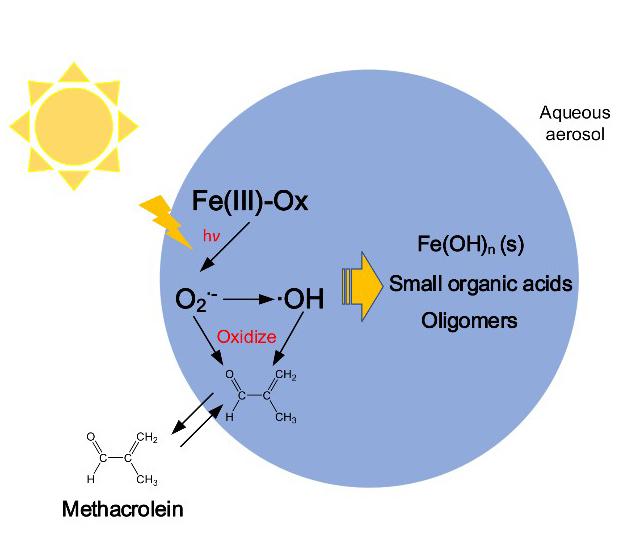
The Fenton reaction is a chemical transition involving hydrogen peroxide (H2O2) and the ferrous (iron) ion, which acts as a catalyst. This process is used to destroy hazardous contaminants in wastewater through oxidation. In the atmosphere, a similar reaction, or “Fenton-like” reaction, occurs continuously with ferric oxalate([Fe(III)(C2O4)3]3-) and aerosols suspended in the air. This is the most frequent chemical reaction that occurs in the atmosphere. A particle’s ability to oxidize is directly related to its phase, either gaseous or aqueous, which has an important impact on secondary organic aerosol (SOA) formation. Therefore, research is necessary not only to evaluate the contribution of this Fenton-like reaction to atmospheric oxidation, but also to improve the consistency of model-simulated and field-observed SOA budgets.

“It is generally believed that the contribution of the Fenton reaction to atmospheric oxidation comes from the generation of hydroxyl radicals.” said Prof. Wenbo Dong from the Department of Environmental Science & Engineering, Fudan University. “Scientists have not frequently addressed the role of superoxide radicals, which is generally regarded as the source of hydrogen peroxide and hydroxyl radicals.”

Methacrolein (CH2=C(CH3)CHO) is the primary oxidation product of isoprene(CH2=C(CH3)CH=CH2), which is the most abundant biological volatile organic compound (VOC) in the atmosphere. It can directly react with superoxide radicals to generate SOAs. While this is a common reaction, this process shows that other paths to VOC oxidation exist.

“Previous studies believed that superoxide radicals do not react with most organic compounds.” remarked Prof. Dong.

Some VOCs in the atmosphere may react with superoxide radicals just like methacrolein. However, SOA production potential from any VOC with attendant superoxide radicals and hydroxyl radicals is distinct from the methacrolein reaction. Researchers focused on the oxidation process of organic pollutants caused by these free radicals. They found that the oxidation process is related to the reaction mechanism of the organic matter accompanying these free radicals.

Previous studies have shown that the change in aqueous aerosol absorbance is attributed to the formation of brown carbon. However, in the case of photo-oxidation of methacrolein with ferric oxalate, Prof. Dong’s research group noticed a substantial increase in aerosol absorbance without formation of brown carbon. Further analysis is provided in their research article titled “Photooxidation of Methacrolein in Fe(III)-Oxalate Aqueous System and Its Atmospheric Implication” published in Advances in Atmospheric Sciences.

“When the Fenton-like reaction with a high concentration of iron occurs, the absorbance of the solution will change significantly, with the solution turning yellow.” said Prof. Dong. “This may not be the only situation with methacrolein, as it can come up with the Fenton-like reaction of other organic compounds.”

Prof. Dong continued, “The formation of insoluble or colloidal iron hydroxide increases the absorbance of atmospheric aerosols, affecting the radiative forcing, which has been overlooked for a long time.”

###

Media Contact
Ms. Zheng Lin
[email protected]

Related Journal Article

http://dx.doi.org/10.1007/s00376-021-0415-5

Tags: Atmospheric Chemistryatmospheric oxidation processesAtmospheric ScienceChemistry/Physics/Materials SciencesEarth ScienceFenton-like reactionsferric oxalate chemistryPollution/Remediationradiative forcingsecondary organic aerosols
Share13Tweet8Share2ShareShareShare2

Related Posts

New Boron Allotrope Bends Like Metal and Conducts Like a Semiconductor

New Boron Allotrope Bends Like Metal and Conducts Like a Semiconductor

September 23, 2026
Bulky Molecules Keep Rival Defect-Fighters From Cancelling Each Other Out in Perovskite Solar Cells

Bulky Molecules Keep Rival Defect-Fighters From Cancelling Each Other Out in Perovskite Solar Cells

September 23, 2026

Zinc–Cerium Nanocomposite Sensor Offers Rapid Detection of Controversial Yellow Food Dye

September 23, 2026

Seaweed, Seagrass and Phytoplankton Shape the Ocean’s Iodine Cycle, Review Finds

September 23, 2026
Please login to join discussion

POPULAR NEWS

  • Mimicking Cell Membranes With Tiny Polymers to Regrow Blood Vessels

    29 shares
    Share 12 Tweet 7
  • How Daily Environmental Swings Shape the Brain: Inside the Day2Day Environment Study

    29 shares
    Share 12 Tweet 7
  • Hidden Mosquito Diversity Surfaces in Mexico’s Celestún Mangrove Reserve

    29 shares
    Share 12 Tweet 7
  • RNA Tagging Machine Behind Endometriosis Blood Vessel Growth Revealed

    29 shares
    Share 12 Tweet 7

About

We bring you the latest biotechnology news from best research centers and universities around the world. Check our website.

Follow us

Recent News

Mimicking Cell Membranes With Tiny Polymers to Regrow Blood Vessels

How Daily Environmental Swings Shape the Brain: Inside the Day2Day Environment Study

Hidden Mosquito Diversity Surfaces in Mexico’s Celestún Mangrove Reserve

Subscribe to Blog via Email

Enter your email address to subscribe to this blog and receive notifications of new posts by email.

Join 85 other subscribers
  • Contact Us

Bioengineer.org © Copyright 2023 All Rights Reserved.

Welcome Back!

Login to your account below

Forgotten Password?

Retrieve your password

Please enter your username or email address to reset your password.

Log In
No Result
View All Result
  • Homepages
    • Home Page 1
    • Home Page 2
  • News
  • National
  • Business
  • Health
  • Lifestyle
  • Science

Bioengineer.org © Copyright 2023 All Rights Reserved.