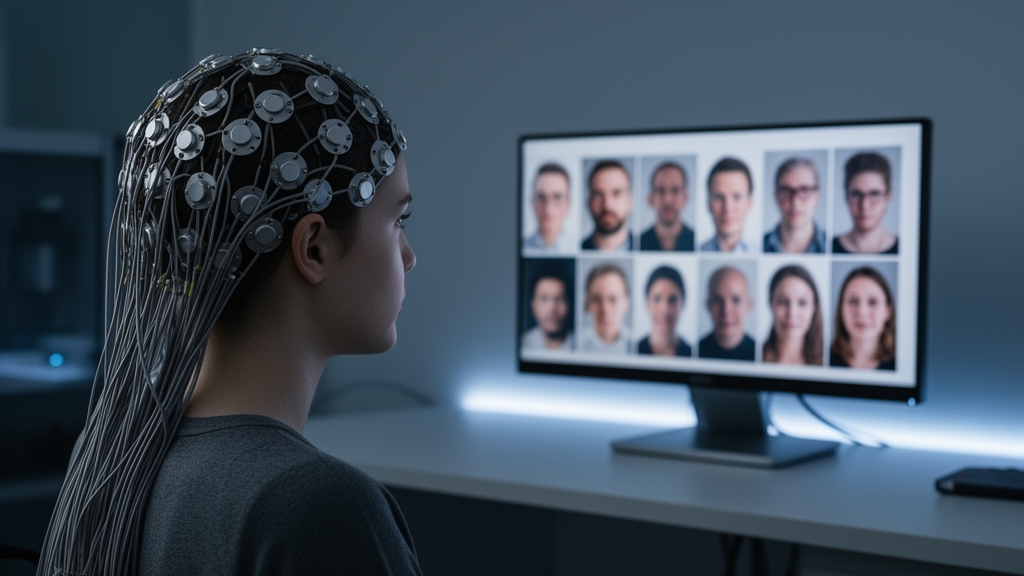
Researchers at the University of Kent have demonstrated that electroencephalography can detect when personally familiar faces break through into conscious awareness during rapid serial visual presentation. Published in Brain Informatics, the study provides a proof of concept for using this method to identify intrinsic salience in forensic contexts, where suspects may possess concealed knowledge of specific individuals. The findings suggest that even when participants are not explicitly instructed to look for familiar faces, their brains generate distinct electrical responses that differ significantly from those elicited by unknown faces.
The study utilized the Fringe-P3 method, a brain-computer interface technique derived from research on the attentional blink. In this paradigm, a stream of images is presented at a high speed, typically with a stimulus onset asynchrony of 133 milliseconds. Most stimuli in such a stream do not enter conscious awareness, but highly salient items can “breakthrough” and be perceived. This breakthrough event is associated with a specific EEG component, often a P3 wave or a related distinguishing feature, which can be measured and analyzed to infer recognition.
The primary objective was to extend previous findings on famous faces to personally familiar individuals. While famous faces possess high salience, they may not accurately reflect the level of familiarity found in real-world forensic applications, such as recognizing an accomplice. The researchers aimed to show that the Fringe-P3 method could differentiate between faces known to the participant and those unknown to them, even when the familiar faces were not task-relevant. This approach addresses the vulnerability of traditional concealed information tests to countermeasures, as the rapid presentation rate makes it difficult for participants to consciously detect and manipulate their responses to specific stimuli.
Fourteen students from the University of Kent participated in the experiment. The participants were selected to ensure they had a close working relationship with specific lecturers in the School of Computing, who served as the “Probe” stimuli. These familiar faces were compared against “Irrelevant” stimuli, which were faces of lecturers from a different university, Canterbury Christ Church University. Both sets of images were photographed using the same camera under similar lighting conditions and edited to match in brightness, contrast, and size, ensuring that low-level visual features did not confound the results.
During the experiment, participants were instructed to look for a single “Target” face, which was an unknown image from a database of distractors. They were not informed that familiar lecturer faces would appear in the stream. Each trial consisted of 18 faces presented in rapid succession, with one critical item being either a Probe, an Irrelevant, or the Target. The critical item was placed in a random position between the fifth and ninth slots in the stream to avoid contamination from the start or end of the sequence. Participants reported their detection of the Target and the type of finishing item at the end of each stream, but they were unaware of the presence of the familiar faces until a recognition test at the end of the session.
The EEG data was recorded using a BioSemi ActiveTwo system and analyzed in both the time and frequency domains. In the time domain, the researchers focused on two face-related ERP components: the N400f, an enhanced negativity associated with episodic memory activation, and the P600f, a late positivity linked to explicit recognition. The analysis revealed that while the N400f difference between Probe and Irrelevant faces was not statistically significant, the P600f component showed a highly significant difference at the group level. At the Pz electrode, the mean amplitude for Probes was significantly higher than for Irrelevants, with a t-value of 3.3198 and a p-value of 0.0055.
Per-participant analysis confirmed that 8 of the 14 participants (57.1%) showed a significant difference between the brain responses to familiar and unknown faces at the Pz electrode. This rate of individual detection was higher than at the frontal (Fz) or central (Cz) electrodes, supporting the notion that parietal sites are particularly sensitive to face recognition signals in this context. The researchers also observed an oscillatory pattern in the Probe responses, characterized by a theta-frequency burst, which was not present in the Irrelevant condition. This oscillatory feature, sometimes referred to as a “drunken wavelet,” suggests a complex neural processing pattern distinct from the classic P3 wave.
Frequency domain analysis further supported the findings. Event-Related Spectral Perturbation (ERSP) and Inter-Trial Coherence (ITC) measures indicated substantial increases in power and coherence for the Probe condition compared to the Irrelevant condition. In the narrower frequency band of 0.5 to 7 Hz, group-level ERSP analysis yielded a p-value of 0.0041, and ITC analysis yielded a p-value of 0.0371. Per-participant tests showed that 10 out of 14 participants had significant ERSP differences, and 9 out of 14 had significant ITC differences. These results indicate that the brain’s response to familiar faces involves not just a single evoked potential but a sustained oscillatory process.
Behavioral data corroborated the EEG findings. In a post-experiment recognition test, participants reported seeing the familiar lecturer faces with a confidence rating of 2.4 out of 5, whereas they rated the unknown lecturer faces at only 1.2 out of 5. This sevenfold difference in reported perception aligns with the neural data, suggesting that the familiar faces indeed broke through into conscious awareness more frequently than the unknown faces. The pre-experimental familiarity ratings confirmed that participants knew the Probe faces well, while they had no prior exposure to the Irrelevant faces.
The study acknowledges several limitations. The sample size was small, consisting of only 14 participants, which limits the statistical power and generalizability of the findings. The cohort was also skewed toward males, as all participants were students in the School of Computing. Additionally, the experiment was a proof of concept and did not involve active deception or countermeasures. The researchers note that while the Fringe-P3 method has shown resistance to countermeasures in previous studies using names, further research is needed to confirm this robustness with face stimuli in ecologically valid deception detection contexts.
Despite these limitations, the study offers a significant step forward in the application of EEG-based concealed information tests. By demonstrating that personally familiar faces can be detected using the Fringe-P3 method, the researchers have opened the door to potential forensic applications where a suspect’s familiarity with specific individuals can be assessed. The ability to detect intrinsic salience without explicit task instructions makes this method particularly promising for scenarios where suspects may attempt to hide their knowledge. Future work will likely focus on larger cohorts, diverse populations, and the integration of this method with other physiological measures to enhance accuracy and practicality.
The findings also contribute to the broader understanding of face perception and recognition. The observation of a theta-frequency oscillatory pattern in response to familiar faces provides new insights into the neural mechanisms underlying conscious access. This pattern, which was also observed in previous studies of famous faces, suggests that face recognition involves a complex interplay of evoked potentials and ongoing oscillations. The study’s use of orthogonal contrast window placement and detrending techniques helps to mitigate potential confounds, such as drift in the EEG data, ensuring that the observed effects are robust and reproducible.
In conclusion, this research demonstrates that the Fringe-P3 method can effectively detect the breakthrough of familiar faces into conscious awareness during rapid serial visual presentation. The significant differences in EEG responses between familiar and unknown faces, observed in both time and frequency domains, support the validity of this approach for inferring recognition. While further studies are needed to validate the method in real-world forensic settings, the current findings provide a strong foundation for the development of non-invasive, countermeasure-resistant tools for concealed information detection.
Subject of Research: Detection of familiar face recognition via EEG in rapid serial visual presentation
Article Title: Breakthrough percepts of familiar faces
Article References: Hajilou, O., & Bowman, H. (2026). Breakthrough percepts of familiar faces. Brain Informatics, 13(1), Article 16. https://doi.org/10.1186/s40708-026-00304-2
Image Credits: AI Generated
DOI: 10.1186/s40708-026-00304-2
Keywords: EEG, Face Recognition, Concealed Information Test, Rapid Serial Visual Presentation, Fringe-P3, Neuroscience, Forensic Psychology, ERP, Time-Frequency Analysis, University of Kent, Breakthrough, percepts
News Source: Denise Maddox. (November 10, 2026). EEG Detects Familiar Faces in Rapid Visual Streams. Scienmag.