Biodiversity is declining rapidly. Many conservation actions focus on single species. An alternative approach is to comprehensively improve ecological processes and habitats, thereby supporting entire species communities. This so-called ecosystem-based management is however rarely implemented because it is costly. There is also a lack of evidence that ecosystem-based habitat management is more effective than obvious alternatives, such as releasing animals to enhance stocks.
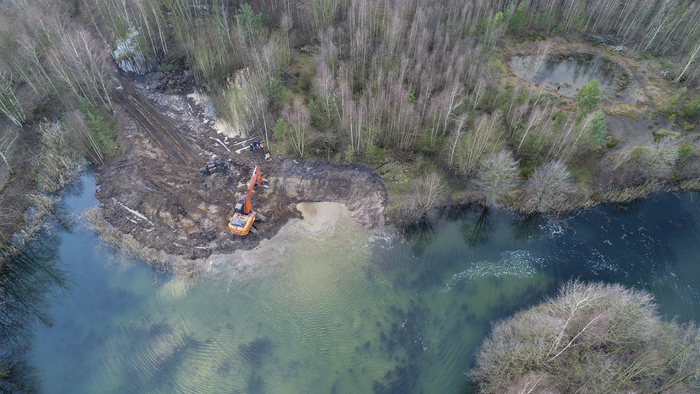
Credit: Thomas Klefoth
Biodiversity is declining rapidly. Many conservation actions focus on single species. An alternative approach is to comprehensively improve ecological processes and habitats, thereby supporting entire species communities. This so-called ecosystem-based management is however rarely implemented because it is costly. There is also a lack of evidence that ecosystem-based habitat management is more effective than obvious alternatives, such as releasing animals to enhance stocks.
Important lesson for fish conservation
A research team based in Berlin, in close cooperation with numerous angling clubs organized in the Angler Association of Lower Saxony, has presented a groundbreaking study. Scientists and practitioners worked together to conduct a set of whole-lake experiments and assess the outcomes of ecosystem-based habitat enhancement versus fish stocking in 20 gravel pit lakes over a period of six years. In some of the lakes, additional shallow water zones were created. In other lakes, coarse wood bundles were added to enhance structural diversity. Other study lakes were stocked with five fish species of interest to fisheries; unmanipulated lakes served as controls. The study was based on a sample of more than 150,000 fish.
The key result: The creation of shallow water zones was the most effective method to enhance fish populations. These zones are ecologically important for many fish species, especially as spawning grounds and nursery areas for young fish. The introduction of coarse wood had only positive effects in selected lakes; fish stocking completely failed. “Restoring central ecological processes and habitats – ecosystem-based management – is likely to have stronger long-term effects for rebuilding fish species and populations than narrow, species-focused conservation actions,” explained Johannes Radinger of the IGB, lead author of the study.
From the laboratory to jointly executed whole-lake experiments
Never before have fish communities been studied on such a large-scale set of whole-lake experiments involving numerous angling clubs and other practitioners. “In contrast to studies in the laboratory, field experiments that consider natural ecosystem variation as well as ecological and social interactions allow to gain robust evidence about the effectiveness of management measures,” explained Thomas Klefoth, professor at the Hochschule Bremen and co-initiator of the project. “To include multiple gravel pit lakes in the experiments was only possible through close cooperation between research and practice. The transdisciplinary approach contributed to a rethinking of fish stocking and fostered the acceptance of more sustainable, ecosystem-based management alternatives,” summarized study leader Robert Arlinghaus, Professor of Integrative Fisheries Management at the HU and the IGB.
Two key messages for freshwater conservation and fisheries management
The study highlights two central messages that are relevant beyond gravel pit lakes to other aquatic ecosystems as well: restoring ecological processes has a more sustainable impact on communities and species than narrow, species-focused conservation actions. Additionally, freshwater biodiversity conservation is most effective when user groups, such as angling clubs, take responsibility and are supported in their efforts by authorities, associations, and science. This approach allows for the reconciliation of conservation and use, as both species and fisheries benefit from ecosystem-based management.
******
About the project:
BAGGERSEE (www.baggersee-forschung.de) is a joint project of the Leibniz Institute of Freshwater Ecology and Inland Fisheries (IGB), the Angler Association of Lower Saxony (AVN), and the Technical University of Berlin (TU), in cooperation with the Hochschule Bremen (HSB). The research and implementation project was funded until the end of 2022 as part of the joint funding initiative “Research for the implementation of the National Biodiversity Strategy” by the Federal Ministry of Education and Research (BMBF) and the Federal Agency for Nature Conservation (BfN) with funds from the Federal Ministry for the Environment, Nature Conservation, Nuclear Safety and Consumer Protection (BMUV). The project has been coordinated by Prof. Dr. Robert Arlinghaus, who is affiliated with the IGB and the Humboldt Universität zu Berlin (HU). Further details about the working group can be found at www.ifishman.de.
About the Leibniz Institute of Freshwater Ecology and Inland Fisheries (IGB):
“Research for the future of our freshwaters” is the mission of the Leibniz Institute of Freshwater Ecology and Inland Fisheries (IGB). IGB is Germany’s largest and one of the leading international centres for freshwater research. It integrates basic and preventive research, and studies freshwater ecosystems and their biotic communities in all their complexity. With more than 350 employees at five locations, the Institute conducts research on how water bodies develop over very long periods of time, how they react to natural and human-caused environmental changes or how new forms of use, restoration or conservation affect rivers, lakes, wetlands and various species. In close collaboration with partners from research, politics, authorities, practice and civil society, IGB also deals with current ecological and societal challenges, such as how adaptation to climate change can succeed, how we protect and conserve aquatic biodiversity and how we use land and water bodies more sustainably. IGB is a member of the Leibniz Association and part of the Forschungsverbund Berlin e.V. www.igb-berlin.de.
Journal
Science
DOI
10.1126/science.adf0895
Method of Research
Experimental study
Subject of Research
Not applicable
Article Title
Ecosystem-based management outperforms species-focused stocking for enhancing fish populations
Article Publication Date
3-Mar-2023